1

Onkelos Translation

There is a new sefer which offers a translation of Onkelos published by Gefen books. Onkelos, which is considered the authoritative translation of the Torah has, unfortunatly, suffered from the difficulty people have in reading it. Instead, most English speakers rely upon other translation, some which do not follow Onkelos. This has now been remidied by this new book “Onkelos on the Torah: Understanding the Bible Text” by Israel Drazin and Stanley Wagner.
The book is very user friendly. It contains the Hebrew text of the Torah, Onkelos and Rashi (vocalized). Additionally, it contains an English translation of Onkelos. The translation bolds any words that Onkelos changed from the literal meaning. The authors then have a commentary on each of those changes explaining why this was changed. Additionally, the authors provide an even more in-depth commentary in the Appendix, for those who want to go even further. Drazin, has edited a more scholarly treatment of Onkelos published by Ktav (for a lot more money).

One example from last weeks Parsha. Exodos 8:2 discusses the begining of the frog plauge. The translation is as follows: “Aaron stretched out his hand over the waters of the Egyptians, and the frogs ascended and covered the land of Egypt.” Thus, both Egyptians and frogs have been chaged by the targum. We will focus on the “frogs” change. The authors explain

FROGS The biblical reading is “bring up the frog” (in the singular), suggesting that one frog covered the entire land. Indeed, Rashi cites an opinion found in the Babylonian Talmud (Sanhedrin 67b) and the Midrash (Exodus Rabbah 10:4) that a single from came, split into other frogs and swarmed over Egypt. Our targumist prefers to interpret the biblical singular as “frogs,” which is closer to the intended meaning. Rashi also states that the singular form represents a swarm of frogs, just as the word kinam in verse 13 and 14, in the singular, refers to many lice. Our tagumist translates kinam in the plural in keeping with his understanding of the intended meaning of the word.

The authors in a section titled “Onkelos Highlights” offer an additional reason why the targumist picked this explaination.

Onkelos most often attempts to translate Scripture in accordance with the view of Rabbi Ishmael, rather thatn that of Rabbi Akiva – both spiritual giants of the second centruy CE. Rabbi Akiva, recognizing the sacredness of every word in the Bible, understood Scripture literally. Hence, when the Bible describes the second plauge in verse 8:2, stating that a “frog,” in the singular, covered Egypt, he understood it to mean that it was a single frog that miraculously afflicted Egypt. Rabbi Ishmael, on the other hand, insisted that “Scripture speaks in human language,” and that it often metaphoric and imprecise, a view embraced by Onkelos. The tragumist, therefore, translates the Hebrew word as “frogs,” to reflect the intention of the Bible, which frequently uses the singular in the place of the plural.

Thus, there is a basic controversy how to understand the Bible, with Onkelos taking one position which is reflected in his targum.

It is worthwhile to note how other translations have translated this verse (8:2) to compare and understand what they were doing.

Artscroll actually differs depending upon which book one is looking at. In the Artscroll translation that includes a translation of Rashi, the verse is translated in the singular – “frog.” This, as noted above, reflects Rashi’s understanding of the verse based upon the Midrash and the Talmud. Artscroll in their introduction claim they follow Rashi in their translation.
In the Artscroll Stone edition which is just a translation of the Torah with a commentary, the verse is translated as “frog-infestation.” The commentary notes that they followed Rashi on this as well (the second explaination offered in Rashi). However, a closer reading of Rashi actually leads to a different translation. Rashi states “The simple understading of this verse is that a singular form of frog can mean frog infestation.” Thus, Rashi is saying although only the singular is used it can mean multitudes. Therefore, Rashi would actually translate the verse, according to this understanding, as “frog” which would mean frog infestation, not that the translation is actually frog infestation.

Additionally, Artscroll does not explain why in one book they translated it one way and in the other a different way.

JPS follows Onkelos and translates “frogs.”

I do have one criticism of the an otherwise excellent work. I think it would have been even better if they had aside from bolding the English to bold the actual targum words that are changed. However, beside for this, this work allows many, who constrained by the difficult language employeed by the Targum to now study this invaluable work.

I purchased this from Biegeleisen for $27. As of yet the only volume published is the Exodus volume, however, the authors note that Genisis is almost complete. One can also buy this directly from the publisher and also see page samples here


I See Dead People

Mary Roach in her excellent book “Stiff: The Curious Lives of Human Cadavers” discusses some of the facinating facts relating to dead bodies. However, she does not discuss some of the more interesting Jewish incidents of dead bodies.

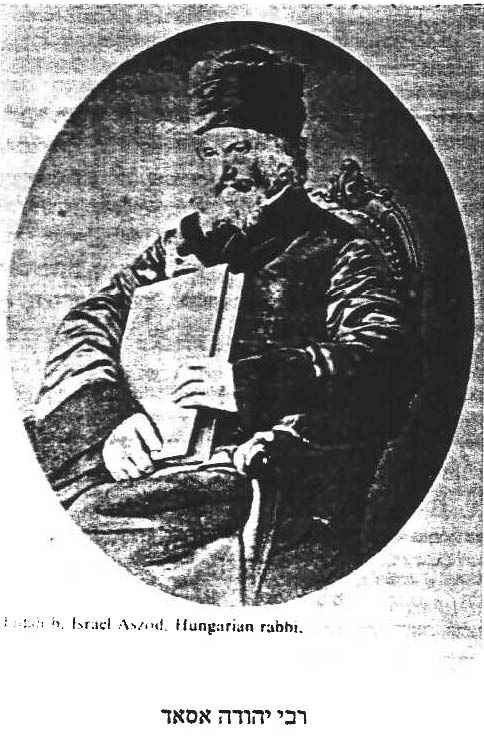
The first is the fairly well known story of R. Yehuda Aszod (1794-1866). R. Aszod’s grandson wrote a biography of his grandfather. Portions of this biography are included in R. Aszod’s commentary on the Torah, Divre Mahri.

“My grandfather never allowed for a picture or portrait of himself [based upon halachik reasons, for more on these reasons see G. Oberlander’s article in the latest Hechal haBeshet]. However, many of his students wanted his picture to remember their teacher. Therefore some of his students decided amongst themselves that after R. Aszod will die they will dress him in his Shabbat clothes, place him on his chair and this is how they obtained his photograph which is found in many people’s homes. However, those that participated in this bad befell them. It was not longer before the participants all died.” This event even engendered a discussion whether such a practice is permitted. R. Zev Tzvi Klien in his teshuvot Kehana Mesaya Kehana (no. 12) discusses this practice and concludes although not recommended it is not prohibited.

While this story does appear in R. Aszod’s commentary on the torah (p. 32) it is only is the older editions, the most recent the entire story including the relevant footnote was removed.

Additionally, there is a picture of R. Aryeh Leib ben Asher Gunzberg (Sha’agat Areyeh) which it appears he is dead. However, the legend underneath the picture reads “This is the picture of the Sha’agat Areyeh at the time he is dying.” I assume this “disclaimer” was placed there to mitigate any criticism of the kind the picture of R. Aszod is subject to. One can see this picture in the book R. Y.M. Stern, Gedoli HaDorot Jerusalem 1996, vol. 1.

There is another case, although not with a dead Rabbi, but with a Jewish question regarding the dead. In University College in London the noted philosopher Jermey Bentham had an interesting request in his will. As it appears on Wikipedia,

A further reason for Jeremy Bentham’s fame within UCL is due to the fact that his body is on display to the public. Jeremy Bentham specified in his will that he wanted his body to be preserved as a lasting memorial, and this instruction was duly carried out. This ‘Auto-Icon’ has become famous. Unfortunately, when it came to preserving his head, the process went disastrously wrong and left the head badly disfigured. A wax head was made to replace it, but for many years the real head sat between his legs. However, this head was frequently stolen and subjected to many student pranks, with students from rival King’s College London often the culprits. The head is said to have at one time been found in a luggage locker at Aberdeen station, and to have been used as a football by students in the Quad. These events led to the head being removed from display and placed instead in the College vaults, where it remains to this day.

Other rumours surrounding the Auto-Icon are that the box containing his remains is wheeled into senior college meetings, and that he is then listed in minutes as ‘present but not voting’. He is also said to have a vote on the council, but only when the vote is split, and that he always votes in favour of the motion.

When the Upper Refectory was refurbished in2003, the room became renamed the Jeremy Bentham Room (sometimes abbreviated JBR) in tribute to the man.

The London Bet Din for a few years put out phamphelts where they would discuss a in depth topics of interest. One of those titled “B’Inyan Ohel ha-Met” Dayan Grosnas no. 14, 1965, discusses whether a Kohen can go through the lobby, or today the JBR where Bentham’s body is. They actually state in the begining, which is not mentioned in the Wikipedia article that the head is kept in a special box, which although not on public display, if one asks it will be shown to you. Obviously, the same question of whether one could photograph it as was raised in the case of R. Aszod would apply as well.

You can see Bentham’s body here.


Censored Texts – Website

There is an interesting post, in Hebrew, on Hydepark, which has a list of censored texts. Although the list is not complete, (for more examples see my article in the latest issue of Hakirah), it still is rather good.
There are also numerous other gems on the site for those that take the time.


Manasseh of Ilya and Y. Barzilay

I recently finished reading Yitzhak Barzilay’s book on R. Manasseh of Ilya. R. Manasseh was a fascinating character. He was a student of the Vilna Goan, but wrote a pamphlet arguing for reconciliation between Hassidim and non-Hassidim. He wrote another work discussing the trop or cantilation marks and yet another, his mangum opus, on the Talmud. It is the later work that he is most well known for, although not necessarily in a positive way. The Tefferet Yisrael (R. Yisrael Lifshitz) on the Mishna quotes a brief passage from this commentary. R. Menasseh’s comments appear on the first Mishna in Perek Alu Mitzhut. (Baba Metziah 1:1). He understands the Mishna in a different fashion than the Talmud, thus provoking some to argue such a position is heritical.

R. Manasseh was a controversial figure. His book on the reconciliation, Pesher Davar, was publicly burnt. His work on Talmud, Alphei Menashe, after either the publisher or some outsider (depending on the source, there are a couple versions of the story), destroyed it right before it was completed. R. Manasseh was forced to reproduce the entire work from memory and find a different printer.

Additionally, although he had a close relationship with the Vilna Goan, the Vilna Goan severed that relationship after learning R. Manasseh had been in contact with R. Shneur Zalman of Lida (Ba’al haTanya).

All this being said, he is ripe for an excellent biography. Unfortunately, Barzilay does not deviate from his norm, and put out another poor work. Although Barzilay has written on many other interesting figures of Jewish history, almost always he fails to do anything substantive or worthwhile with the subjects.

This work is full of gross supposition that are never supported by any facts. For instance we have sentences like this “It may be assumed that in a talented person like Manasseh, his critical faculties must have awakened rather early, and already in his youth he may have arrived at some of his nonconformist views with regard to the Halakhah and its historical development.” (p. 24). Therefore, Barzilay wants to then claim and project back on Manasseh’s early years and label him as a radical even then based only upon “his critical faculties.” While that may be the case, there are also a million other possibilities. For instance, Manasseh was influenced later in life by someone else or he came to his “nonconformist views” based upon years of study and when he was 17 (according to Barzilay, again a guess) he did not hold these views.

Another example, where Barzilay is discussing Manasseh’s frequent trips to his wealthy relatives house who had a terrific library, Barzilay makes the following statement: “The role of this library in Manasseh’s life and intellectual growth cannot be overestimated . . . It may be further assumed, with a high degree of probability, that there also were to be found there the recent works of the Berlin maskilim, as well as those of the enlightened orthodox Jews from both Eastern Europe and the Germanies.” Barzilay then goes on to cite to the many subscribers of various haskalah literature as “proof” this library contained these books. There a basic problem with this argument. Since Barzilay is able to point to where these books went to as the subscriber list, lists both person and place, why then isn’t this rich relatives name ever listed if he was a collector of such works? Instead, Barzilay is satisfied to assume that the books were there as there were many haskalah books that “found [their] way among the Jews of Eastern Europe.”

These are but two examples from a book that is rife with such sloppy work. The only redeeming fact of the book is the extensive quotation from R. Manasseh’s works. As mentioned above, this is not the first book Barzilay wrote that fails miserably. He also did another biography on R. Shlomo Yehudah Rapoport (Shir), the son-in-law of the Ketzot HaChoshen and one of the leading figures of 19th century Eastern European Haskalah. This book is also disappointing.

unfortunate, the only other biography, Ben Porat Yosef, is no gem either. It was written by Mordechai Plungian an editor at the famed Romm press. This is more of an anecdotal than scholarly work. However, this work got Plungian in trouble as some claimed he attempted to make R. Manasseh into a maskil.

What is particularly strange is that a book review of Plungin’s book appeared in HaMagid. At the JNUL site, which contains old Hebrew newspapers, the version they have appears to have that portion blacked out. The review in question appeared in HaMagid on March 8, 1858.

The full citation for Barzilay’s book is Manasseh of Ilya: Precurser of Modernity Among the Jews of Eastern Europe (Manges Press, 1999).


Chanukah Customs and sources

While the only mandated mitzvot for Chanukah consist of lighting candles and saying the full hallel, there are numerous other customs that have come to be associated with Chanukah.

The custom to play driedel on Chanukah is steeped in mystical allusions. From the letters which appear on the driedel to the way the driedel spins, people have offered explanations to link this to Chanukah. The Beni Yisscar, R. Tzvi Elimelch says that the reason the dreidel is spun from the top and the gragger on Purim is turned from the bottom has to do with how each holiday’s miracles were effected. On Chanukah the miracle came from above, directly from God. However, on Purim, the miracles were directly brought about by the actions of Ester, Mordechi and the Jewish people. Thus, the dreidel is spun from the top showing the miracle came from above, and the gragger from the bottom showing the miracle came from below. Others explain the symbolism of the letters that appear on the dreidel, נ, ג, ה, ש. According to one explanation these hint to the mitzvot that we have on Chanukah, נרות שמונה (candles all eight nights) and הלל גמר (the complete hallel). Others note the gematria (numerical value) of the letters which correspond to the same gematria as משיח (the Messiah). Others still, link the letters with גשנה the city Yosef secured for his family in Egypt.

According to at least one source, the custom of playing dreidel was actually started in the time of the Maccabis. They say that in an effort to circumvent the Greek decree against studying the Torah, children and their teacher would have a dreidel handy to start playing in case the Greeks came upon them studying the Torah. They would claim they were not studying instead they were just playing dreidel.

Despite all of these explanations, in truth, dreidel is not Jewish in origin. Rather, driedel is really the rather old game of teetotum. Teetotum, which uses a top with four sides and four letters is one and the same with dreidel. The letters that appear on the dreidel are really just the Hebrew letters that appear on a German or Yiddish teetotum, G, H, N, S. G= ganz (all), H halb (half), N nischt (nothing) and S schict (put). Teetotum dates back to at least the 16th century long before we have any Jewish allusions to dreidel(it was originally totum or top, but became TEEtotum due to the use of T for take all, on the top). The well-known depiction of children’s games done by Brueghel in 16th century includes Teetotum(see here and here for the complete painting). The earliest Jewish mention of dreidel or the significance of it dates to the late 18th century.

The story connecting dreidel to the ruse of the Maccabis was first published in the book Minhagi Yeshurun, which was first published in 1890 (the name was changed to Otzar Kol Minhagi Yeshurin in the third edition, which is available online here from Hebrewbooks.org . The author included a nice picture of himself at the beginning, although he was a Rabbi in Pittsburgh at the turn of the twentieth century, he is holding a quill pen.) His source is a contemporary of his. [As an aside, although his explanation of dreidel is well-known he offers a similar explanation for playing cards on Chanukah, i.e. that the Maccabi did so. However, that one is not nearly as well know.]

The custom of Chanukah Gelt appears to have changed over time. The earliest sources that mention money on Chanukah connect it with either collecting money for the poor (presumably for money to purchase the necessary implements for the Chanukah lights)(Sefer Mataamim) or giving money to ones children’s teachers. (Hemdat Yamim, Chapter 3 Chanukah early 18th century, anonymous author, some claim was Nathan of Gaza, Shabbtai Tzvi’s “prophet” others just a student of the Ari).

Again, especially amongst the Hassidic commentators, the custom took on a life of its own, both in its scope to include giving money to children and in its significance. There was also a special emphasis on giving their respective Rebbi money as well. R. Chaim Palache (Pellagi) (1788-1869) is the first to mention giving children money. He offers a kabbalistic reason “as children are representative of נצח והוד (eternity and glory). Something I don’t profess to have any idea what that means.

Another custom, again somewhat late in origin, is the custom to not study Torah on Christmas eve. Menachem Butler has a post here on some sources, however, one should add that there is now a full length sefer devoted to this topic, Yisrael Barukh Mestinger, Nitel U’Meorosav, 2000. As well as a pamphlet, Hefaru Toresecha, maamar maktif mminhag avotanu bi-yadun (sic) odot lel ha-ofel nitel nacht, u-minhag yisrael l’vatel ma-asek ha-torah, 2004. Additionally, R. Gavreil Zinner, devotes a section of his work, Neta Gavreil on Chanukah to Nitel.

For more on the various customs associated with Chanukah, see Neta Gavreil Chanukah; Pardes Eliezer Chanukah 2 vol.; R. Yitzhak Tessler, HaDreidel (Sivvivon) B’Chanukah: Mikoroteha, Tameha, u’Minhageha, in Ohr Yisrael 50-62, vol. 14 (Tevat תשנ”ט).


Attack on Rabbinic Judaism and Historical Orthopraxy

What is perhaps one of the more intreging sefarim ever published. Behinat HaKabbalah is two books in one. The first, Kol Shakal (the voice of a fool), is a scathing attack on Rabbinic Judaism. Basically, anything not found explictly in the Torah is claimed as false. For example, the requirment of mikva is deemed wrong as the verse only requires one to “wash one’s body.” This first portion takes up the majority of the book. The second half, Sa’agas Areyeh, (roar of the lion) is a defense of Rabbinic Judaism. However, the defense in some sense proves the first half as it is so sparse leaving the reader to posit that the author of Sha’agas Areyeh actually agreed with the author of Kol Shakal. Some even go so far to claim the author really wrote both works in an extremly sly attempt to gain wider readership. That is, they created a work which externally would be viewed as a defense of Rabbinic Judaism i.e. Sha’agas Areyeh, only to be able to slip in the most more persausive Kol Shakal.

Typically, the second portion is attributed to R. Yehuda Areyeh of Modena. (Mar Gavriel has an excellent post on him here). If that is so, some then argue he was a closet heritic or perhaps in today’s vernacular- Orthoprax. That is, although R. Modena sat on the Venice Bet Din, wrote numerous traditional sefarim, and even authored on the selichot that is said on Yom Kippur Katan, in his heart he really did not believe in any of it. This, of course, is rather shocking.

In truth, the authorship of both of these works is somewhat up in the air. As mentioned, some attribute it to R. Modena, however, this is not certian. The reason being, this work was not published until 1852 and Modena died in 1648. The work was first published by Isaac Shmuel Reggio (YaSHar) a rather interesting character in his own right. [As an aside, Reggio was far from what many would consider “traditionally orthodox” he permitted shaving on Hol HaMoad which got him into trouble. (His father wrote a pamphelet against him on that issue). However, this year someone from Monsey reprinted his commentary on the Torah, apparently Reggio’s biography was unknown to the sponser of the printing.] Reggio claimed to have published this from a manuscript in Modena’s own hand. He has an extensive introduction as well as notes thourhout.

Others have questioned Reggio’s assertion that it emenates from Modena. One has even pointed to Saul Berlin the author of the noted forgery Besamim Rosh as the author of this. However, that has been discredited.

In the end, whom ever the author maybe this work still stands as one the most interesting and entertaining attacks on Rabbinic Judaism.

There is much in this area and the interested reader can consult Reggio’s introduction; T. Fishman, Or Hadash al Zemano shel Sefer Kol Shakal v’al Mekom Hibburo, in Tarbiz 59 (1990) 171-190; Fishman’s book length treatment in “Shaking the Pillars of Exile‘Voice of a Fool,’ an Early Modern Jewish Critique of Rabbinic Culture;” E. Rivkin, Leon da Modena and the Kol sakhal; B. Kahlar, Shagas Areyeh al Kol Shakal in Mehkarim v’Inyuim (Tel Aviv, 1954) 357-378.