1

Comparison Between De’ah veDibur and Shafan haSofer

While I don’t have the time to go through the entire Dei’ah veDibur article and demonstrate the extant of the copying, I will provide some of the more egreious examples.

Here is a quote from the Dei’ah veDibur article (in italics) with the orginal Hebrew intersperced and my commnets in bold. One should remember that the original article was written in first person.
The first manuscript that the Romm family obtained was Rabbenu Chananel’s commentary which now appears alongside the gemora on many masechtos. The manuscript was kept in the Vatican archives but it had not been well preserved. The pages were very worn and were marked by rust stains, while the edges of the sheets had been eaten away. Moreover, the commentary was written in Latin characters, which made deciphering and copying it much harder.כי הנה בראשית שמנו לבנו להעתיק כתב יד פירוש של רבנו חננאל בר חושיאל ז”ל על מסכת רבות מתלמוד בבלי שנמצו באוצר ספרים שבוואטיקאן ברומו והכתב באותיות רש”י בצורות איטאליאניות [נוסח איטלקי] אשר רוב ישראל בזמננו לא כהלין כתבא דא למקריה.
Now, the article continues on to explain who they found who was still able to read this script. The article discusses that the person, R. Mordechi Yakov Yosef, was in the midst of copyingfor Solomon Buber for his Midrash Tanchuma and worked with R. Raefal Nata Rabinowitz. As Buber was also a Maskil, this entire discussion is left out as is the name of the copyist.
Instead, we have the following which sums up this discussion without mentioning the “sorrid” details of who and what they were busy with.
Permission was also not granted to remove the manuscript from the Vatican, which necessitated bringing copyists in to do the work there. The few copyists in Rome who were sufficiently qualified to do the job, were fully occupied with other work and it seemed that things had reached an impasse. The copyists however, accorded great significance to the printing of the Shas and they agreed to interrupt their other work in order to devote their time to copying Rabbenu Chananel’s commentary. After several months of work, another problem loomed with the approach of the official holidays in Rome. The Vatican library would be completely closed for their duration; nobody at all had access to it at this time. A four-month stoppage of the work at that stage would prove very harmful to the printing house. Missing the deadline for the appearance of the first volumes might lead subscribers to cancel, wreaking havoc with the whole project.ויהי בהגיענו להעתקת פירוש רבנו חננאל למסכת עירובין והנה עצרה חדשה קמה נגדה, כי הגיעו ימי הסגר האוצר בימי המנוחה בקיץ לארבעת חדשי השנה אשר לא יותן לאיש לבוא אל בית האוצר כל הימים ההם, ויצר לנו מאד, כי עצרת ההעתקה את פירוש רבנו חננאל לכמה מסכתות שבאוצר ההואתחבל את כל סדר הדפסת הש”ס וחלוקת חלקיו להחותמים על מקנתם בזמניהם אשר יעדנו להם
The members of the Romm family tried to reach every contact they had that might possibly be of assistance in this situation. They succeeded in obtaining special permission, contrary to the Vatican’s laws, to open up the library during the recess for them alone, so that work could proceed on copying Rabbenu Chananel’s commentary. The Romm family would have to pay the cost of a guard for the archives but otherwise, the place would be completely open to them, even during hours that it was usually closed to the public.והנה שלח ה’ מלאך מושיע לנו את הג”מ רפאל נטע ראבינאוויץ ז”ל אשר לו מודע הגענעראל-קאנסול במינכן לממלכת זאכסען, הוא השוע החכם הר, מאיר ווילמערסדארפער והוא השיג בעדו מכתב-מליצה מהנסיך האהענלאהע לאחיו הנסיך הקארדינאל האהענלאהע ברומו וגם הפרופיסור ג”ר שעג במינכען נתן לנו מכתב מליצה להקארדינאל הערגענרעהטער ושני הקארדינאלים הששתדלו לפתוח לו לבדו או לבא כוחו את שער האוצר לכל ימי הסגרו. והוא הושיב תחתיו את המעתיק הנ”ל לפירוש רבינו חננאל על הש”ס בעדנו ורק הוטל עלינו לשלם שכר שומר האוצר לזמן ההוא ועוד יותר הגדילו לעשות להעתקותינו, להפר בעדה עוד שני חוקים אשר לבית האוצר ההוא מעולם לסגרו אחר הצהריים וגם בימי חגיהם, ולהמעתיק שלנו הרשו לעשות בו גם אחרי צהרים וגם בימי חגיהם הקטניםSo this time the discusion with the detail regaring R. Rabinowitz and the cardinals has been compressed into “they tried to reach evey contact they had that might possibly be of assistance.”
One of the workers on the project wrote, “Looking in retrospect, the Vatican had always been the source of deadly hatred of the Jewish nation and even more so of our literature, [hatred] that spread to every Christian land, often leading kings to level decrees of forced apostasy, slaughter, killing, destruction and harsh exile . . . Worst of all, they confiscated and burned Jewish books on many occasions, sometimes decreeing that the Jew be burned together with the holy books . . .This unamed “worker” is of course Shafan haSofer והנה בהביטנו אחרינו אל הוואטיקאן הזה אשר ממנו ירדה מעולם שנאת מות לישראל, וביותר לספרותנו, בכל ממלכות הנוצרים, ובעטיו גזרו מלכיהם על ישראל פעמים אין מספר גזירות שמד, הרג, חרב ואבדן וגלויות קשות עד. . . ! ועל כלם החרימו ושרפו את ספרי ישראל פעמים רבות גם גזרו לפעמים לשרוף באש את היהודי יחד עם הספר העברי
“Now, wonder of wonders, out of the very furnace into which they always threw Jewish books for burning, kindness and goodwill that are unparalleled even towards Christian rulers lehavdil are being extended towards those very same seforim. The only explanation is that the great merit of Rabbenu Chananel — everything written by whom is faithful transmission — is standing him and his commentary in good stead, so that his powerful light be thus revealed from the darkness to illuminate the Talmud, so that the eyes of its scholars be illuminated to see Torah’s truth.”This quote is taken from Shafan haSofer.

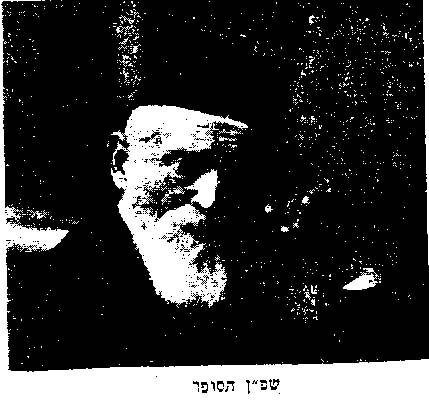


Widow Rom and Shafan haSofer

As per Menachem’s suggestion I have posted the pictures of the Widow Rom (Devorah) and Shafan HaSofer. These appear in Yahadut Lita, 1960, p. 296.


Haredi Robbers

Although we have alluded to the fact that Haredim “borrow” from others without attribution, I have come across a particularly egregious example. Here, is an article discussing the Romm Press and what became known as the Vilna Shas. Although the byline states that it was written “by Yated Ne’eman Staff” this is a wholesale reproduction of R. Shmuel Feigenshon’s article on this topic. Shmuel Feigenshon (Shafan HaSofer) was the editor of the Rom press for many years. He wrote a history of the press which first appeared in part in the journal HaSofer (vol. 1 27-33 and vol. 2-3 46-57, 1954-55). It was then published in its entirety in Yahadut Lita vol. 1. 1959.

The Yated via Dei’ah veDibur, has in turn copied this word for word, including the title headings. Of course, as some of the discussion may be deemed unpalpable to it Haredi readership they skipped a couple of things and in turn this ended up conflating some of the history. And, importantly, although Safan HaSofer wrote some of the article from a first person perspective as he was intimately involved in some of the facts, the Yated has removed that. In fact, there is absolutely no mention of Shafan HaSofer at all. I assume this is because he was a bit of a Maskil and although it is fine to plagerize from a maskil his name should never escape one’s lips.


Dei’ah veDibur Fabrication – Dr. Leiman

As I noted previously, the Haredi mouthpiece Dei’ah veDibur had a rather insightful piece on the falicy of the Golem of Prauge. However, although the article ended with the hope that after bringing this fabrication to the readers attention people will only tell true stories. Shnayer Leiman, however, notes that the story itself in Dei’ah veDibur contains a rather glaring inaccuracy.

The March 1, 2006 issue of _Dei’ah Ve-Dibur_ — a haredi journal — includes an essay entitled: “The Golem of Prague — Fact or Fiction?.” Adducing evidence from a variety of sources, the essay concludes that “it is unclear whether or not the Maharal ever made a golem.”

Much of the blame for leading people to think that the Maharal had made a golem, the essay suggests, rests with Y.Y. Rosenberg [sic: while all the other rabbis mentioned in the essay are entitled “Rav” or “Rabbi,” only Y.Y. Rosenberg, who was a distinguished rabbi with ordination from the greatest rabbis in Poland, is defrocked], whose 1909 volume on the Golem of the Maharal (Sefer Nifla’ot Maharal) is identified as a forgery. The essay concludes with appropriate warnings that one should rely only on literature that is “historically reliable.”

Such a critical reading of Jewish literature — and concern with Historical truth — is certainly a welcome breath of fresh air from a circle that has not always covered itself with glory regarding such matters. Alas, the essay fell into the very trap about which it was warning others: beware! One paragraph reads:

“At one point the author [Y.Y. Rosenberg] of the book actually admitted that he had invented the story. In _Halelu Avdei Hashem_, which contains stories in Yiddish about HaRavMoshe Aryeh Freund zt”l, av beis din of the Eida HaChareidis, Rav Yechezkel Halberstam zt”l of Shineveh, author of _Divrei Yechezkel_, is quoted as having made the following comment. “A shochet ubodek from Antwerp heard from the Rov z”l, who heard from his father the Rov of Honiad (an important Jewish community in Hungary), who heard from the Rov of Shineveh (eldest son of the Divrei Chaim zt”l of Sanz). The Shinever Rov said that whenever he sees the book _Niflo’os Maharal_ it pierces him because the author of the stories personally admitted to him that he fabricated the whole thing.”

Leaving aside significant errors of translation, the Shinever Rov — Rav Yechezkel Halberstam, author of _Divrei Yechezkel_ and eldest son of the Divrei Chaim — died on 6 Teveth, 1898. Rabbi Yehudah Yudl Rosenberg published his _Nifla’ot Maharal_ for the first time in Warsaw, 1909. It can easily be proven that the book did not exist until shortly before it was published in 1909. The Shinever Rov never heard of the book, never saw it, and was not “pierced” by its content.

Indeed, one should rely only on literature that is “historically reliable.”


Purim, Mixed Dancing and Kill Joys

Although the Megilah only lists mishloch monot, matnot l’evyonim, and reading the Megilah as the customs on Purim, many others have become accepted. Most are of the ilk of boofunery or merrymaking. From making noise to drinking in excess, all have become part of the Purim landscape. With these, however, there are some lesser known customs. What is perhaps of interest is that it seems that there are those authorities that permit much if not all of these types of customs, there are others who seem set on shutting down much of the Purim fun.

For instance, the Rabbi Judah of Minz permits cross-dressing on Purim. This is so, even though this runs counter to a law in the Torah prohibiting these actions. What is lesser know, is that R. Minz also permits mixed dancing on Purim as well. In the Taknot of Padua it says “we decree that no one is permitted to dance with a married woman, no man with any married woman, with the exception of Purim.” (emphasis added).

Rabbi Yehuda Herzl Henkin in his Beni Banim vol. 1 no. 37 (5), links the two statements of R. Minz. R. Henkin says, just as R. Minz permitted cross-dressing as it was done for the joy of Purim, he permitted the mixed dancing under the same rational. That is, the dancing was just an outgrowth of the joy and not for licetnioius purposes.

Or, in the Customs of Worms, they not only celebrated Purim on the day, on the Shabbat after Purim they celebrated with similar merrymaking. Including, after the Friday night prayers all the people would first go to the Rabbi for a blessing, and then proceed to the women’s section where the Rabbi’s wife “would place her hands on their heads and bless them.” Additionally, R. Hayim Yosef Azulai in his travelogue, Ma’agel Tov, records that the Jews in Amsterdam would party all night long on the Friday night after Purim.

Although R. Minz was a proponent of happiness and its outgrowth on Purim, there were others that did not view Purim in the same vein. Rather, they seem bent on outlawing as much as possible even on Purim.

For instance, R. Samuel Aboab takes issue with at least two such Purim customs. First, he says in his Sefer Zikhronot, an ethical work and published anonymously, that he was befuddled his entire life how R. Minz and in turn R. Moshe Isserles in his Rama could allow for cross dressing on Purim. He spends at least four pages to demonstrating why this is incorrect. He states even if R. Minz is correct he should have kept that to himself. This is not his only negative opinion regarding Purim. In his responsa, Devar Shmuel, he says it is absolutely prohibited to read or even own the parody Mesachat Purim. He says any such copies should be destroyed.

Another person who looked with askance on the merry making was R. David ben Shmuel haLevi (Taz). He first follows the ruling of his father-in-law, R. Joel Sirkas (Bach), that cross-dressing is prohibited. R. Levi then also states in the law of Tisha B’av, that the prohibition of filling ones mouth with joy, is applicable even at at wedding and even on Purim.

So it seems that just as in society at large there are those who dislike the merrymaking on Purim, this is reflected in the Halakhic authorities as well. And conversely, there are those that viewed the merrymaking as a positive thing and therefore permitted many other things in connection with that merrymaking.


More on story fabrication – The Golem

As some have mention in the comments to my previous post, the story of the Mahral and the Golem although many take it as true, it is not. Popularized by Rabbi Yudel Rosenberg, the work is a work of fiction, something even noted in a bibliography published of Rabbi Rosenberg’s works. Some of the people who discuss this are Ira Robinson, “Literary Forgery and Hasidic Judaism: the Case of Rabbi Yudel Rosenberg,” Judaism 40 (1991), pp. 61-78), Shnayer Z. Leiman, “The Adventure of the Maharal of Prague in London; R. Yudl Rosenberg and the Golem of Prague,” Tradition 36:1 (2002): 26-58 and Eliezer Segal.

However, surprisingly, in the online publication Dei’ah veDibur, there is also an article on this topic (hat tip A Simple Jew). The article “borrows” heavily from the above mentioned articles (without citation). It also references some early sources which cast doubt on the veracity of the story, the article does so without identifying the source. One of the unnamed sources I think is a reference to R. Shlomo Yehuda Rappoport’s introduction to Kalmen Leiben’s Gal Ed however, the dates don’t work out exactly (Gal Ed 1856). It would make sense to leave this unidentified, as though R. Rapoport was the son-in-law of the famed author of the Ketzot HaHoshen and even added the index and some notes to his Aveni Milumim, R. Rapoport is not considered the most traditional Jew (See Barzaily typically terrible biography on Rapoport). Additionally, although the article in Dei’ah veDibur is rather detailed it also leaves out R. Shlomo Schick’s criticism (based upon Rapoport) of the story as well. Again this may be due in part to some people’s views regarding Schick (see this post where some of Schick’s work was censored). [Additionally, the article mentions a small book by R. Eckstein titled Sefer Yetzirah which appears to be available on the Rare Hebrew Books from Harvard’s Collection Microfilm].

But perhaps the most surprising thing in the entire article is its conclusion

Rabbi Eshkoli emphasizes that we should be raising our children with literature that is historically reliable, for which our extensive traditions about the greatness and holiness and the powerful prayer of the tzakkikimand Torah giants of earlier times amply suffice. Niflo’os Maharal therefore ought no longer to be circulated unless each copy carries a clear disclaimer stating that the story is fiction. Neither, he also points out, should the book be quoted from as though it was reliable information.

Dei’ah veDibur bills itself as “A Window Into The Charedi World,” so perhaps this emphasis on truth will signal a new trend in haradei biographies only time will tell.

[One interesting side note a Polish TV crew went into the attic of the Altena Shul in Prague and filmed the contents. The pictures they found were published in a Polish book. These pictures show a big mound of dirt but no Golem as far as I can tell.]