1

Plagiarism II (Talmudic Terminology): An Update by Marc Shapiro

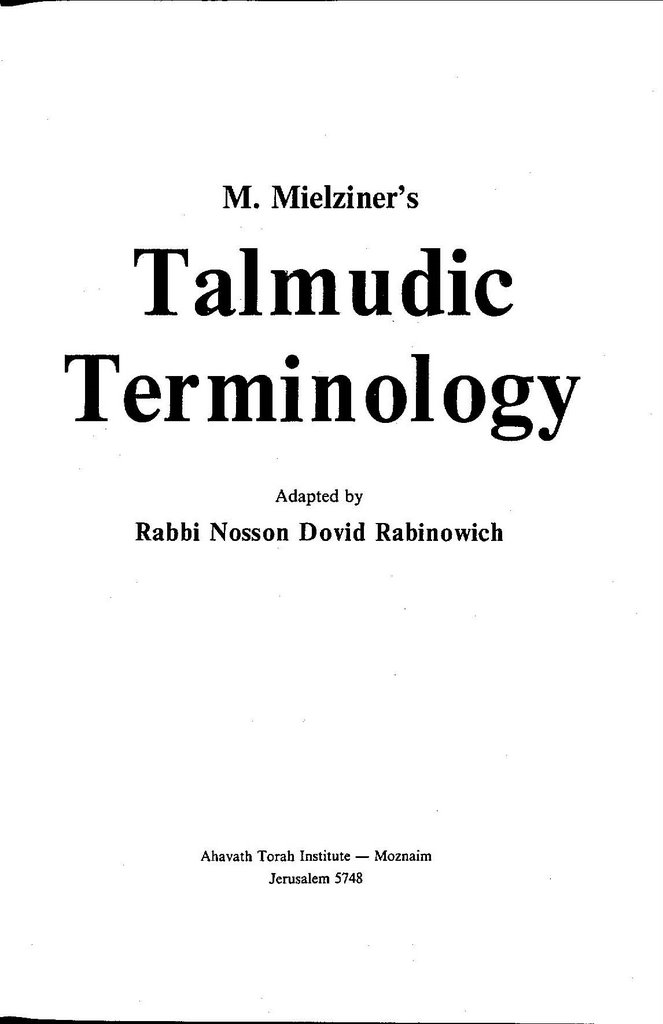
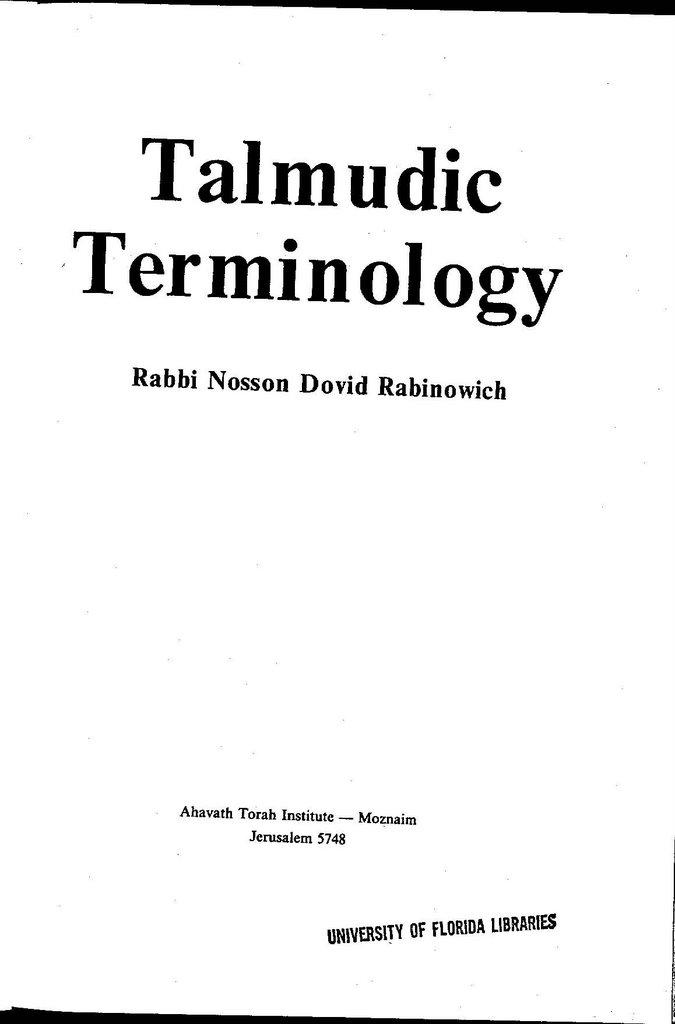
In 1988, Rabbi Nosson Dovid Rabinowich published a book titled Talmudic Terminology. However, as was noted in brief by Dr. Marc Shapiro, this was plagiarized from Moses Mielziner’s Introduction to the Talmud, first published in 1894. This omission, however, has been corrected in Rabinowich’s reprints of his Talmudic Terminology where the title now reads that Rabinowich’s work is “adapted” from Mielziner’s.

While this would appear to be the end of the matter it is not. Dr. Shapiro has investigated this issue further and has sent the following:

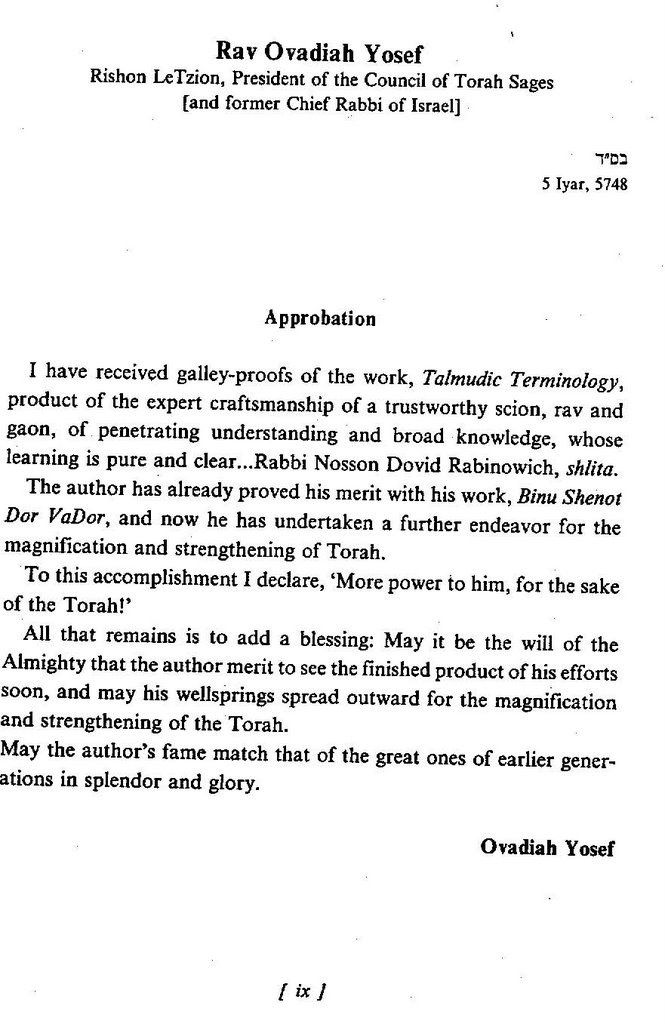
After I published my book Saul Lieberman and the Orthodox a number of people pointed out to me that Nosson Rabinowich’s plagiarism of Mielziner is more extensive than what I point out. I didn’t know what they were referring to since I had the first edition of his book M. Mielziner’s Talmudic Terminology, published in 1988 (in my kuntres, there is a typo, as it says 1998). Or so I thought. I succeeded in locating another copy by interlibrary loan, and lo and behold, the title page does not say M. Mielziner’s Talmudic Terminology adapted by N. Rabinowich but it identifies him as the author. What’s even more fascinating is that the other edition has haskamot of Rabbis Ovadiah Yosef and Aharon Feldman. Obviously, when the scandal broke, Rabinowich quickly produced a new title page and took out the haskamot (and also added a note on p. xv and made a slight change in note 2). p. xv (replacing “some” with “most”.) It is obvious why the haskamot were taken out, since they praise Rabinowich for producing a book which he didn’t write. In fact, Rabinowich is responsible for something very interesting. We find here the first example in history where gedolim put a haskamah on a work written by a Reform rabbi! Unknowingly, Rabbis Yosef and Feldman gave a haskamah to Mielziner. You can be sure this is not something that makes them happy.

Additionally, in an effort to keep the two “editions” the same, Rabinowich did not alter the pagination; this is so, even though he removed the haskamot. Consequently, the “new” edition is missing those pages. I have provided both title pages as well as Rabbis Yosef’s and Feldman’s haskamot (as one can no longer get them).
Latest MOAG Ban Runs Counter to an Agreement with R. Eliyashiv

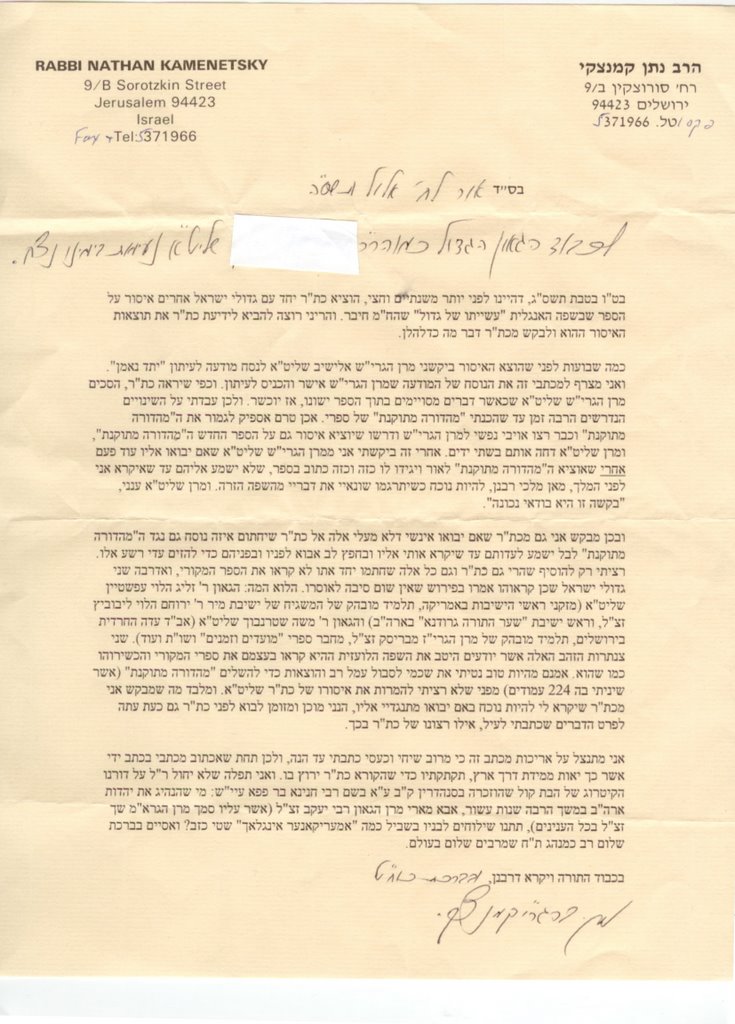
A reader has sent me the following letter from R. Kamenstky discussing the possiblity of a ban on the improved edition of MOAG. The letter says “if people will come to complain to R. Eliasiv about the new edition and say such and such is written there, he will not listen to them until he first calls me, and I will need to present when they translate my book for him.”

Additionally, I have received the following relevant information.

“The letter quotes Rav Elyashiv as saying that the request that the author should be called and given a fair chance to defend himself is just. This was repeated by a number of meetings that the author had with R’ Elyashiv. Before the letter was sent out it was shown to Aryeh Elyashiv – the grandson in charge of all the appointments and present in the room during all meetings to assist his grandfather – and he stated that the quote was correct and it conveys faithfully his grandfather’s say on the matter.

The letter was delivered to the following Rabbis:
Steinman
Sheinberg
Karelitz
Kanyevsky
Markowitz
Auerbach
It was not sent to Rabbi Shapiro because he already apologized for the first time that he signed against the book, and had already said that he will not have anything more to do with this affair. Sure enough he kept his word now and didn’t sign.
R’ Wolbe was omitted because he’s not alive.
R’ Elyashiv didn’t have to receive this letter because he was the subject of the letter.
R’ Lefkowitz was not sent this letter because he was very vicious the time before, and could not be expected to be fair.

The author has made it his habit to daven in the morning in R’ Elyashiv’s minyan from time to time, so that if anything arises he can be informed of immediately.

This last Friday and Sunday he was at the minyan and no one (including Yisroel Elyashiv – another grandson) said anything when asked if everything is fine. It was only after he came home that he found out about the ad and article in Yated Neeman.”


Plagiarism I

As some of you have brought up in the comments regarding other works that had been plagiarized I thought it would be appropriate to discuss some of the more famous and those less so of instances of plagiarism.

The first example, is perhaps the most well-known one, that of the work Mekore Minhagim. This work which in question and answer form, discusses the sources and reasons for various customs was first printed in 1846 in Berlin by R. Avrohom Lewysohn (1805-1861). This work contained 100 of these questions and answers and consequently ended with a , ויזרע אברהם מאה שערים ויברכו ה and Avrohom planted 100 gates. This, of course referenced the authors name and the fact he wrote 100 questions. This is lifted from the verse in Genesis 26:12 ויזרע יצחק . . .מאה שערים ויברכו ה.

However, if today one tries to purchase this book (any one still can it has been reprinted many times) instead of a photocopy of the 1846 edition by Lewysohn, one gets a book with the same title but the author’s name is actually Yosef Finkelstein (originally published in Vienna in 1851). Also, instead of 100 questions there are only 41. Those differences aside, the remaining 41 questions and answers are word for word the same as Lewysohn’s.

This plagiarism was noted almost immediately by David Cassel, (1818-1893), in the first issue of Monatsschrift für Geschichte und Wissenschaft des Judentums, October, 1852 p. 34. However, this did not stop Finkelstein, and his edition was published possibly twice in 1851 alone and from then on numerous times to this day.

While Finkelstein’s is word for word, he was forced to change a few minor things. One in particular was the play on the verse at the end, his reads, ויזרע ויסף מא’ שערים. Although he attempted to retain the play on the verse, this fails as there was only 41 gates in his edition.

Finkelstein did not stop there. When his treachery was revealed in the paper HaMagid, he actually went on to argue that it was Lewysohn who copied from him and not the other way around. Finkelstein claimed when he was passing through Berlin, Lewysohn asked to borrow his manuscript and surreptitiously copied it. Finkelstein, however, does not explain how Lewysohn was able to add the additional 59 question and answers. Additionally, we will see in the next installment on this book, how Finkelstein gives himself away.

For more on plagiarism especially the halakhic discussion see here.

(Continued here)


Text of the New Ban on Making of a Godol

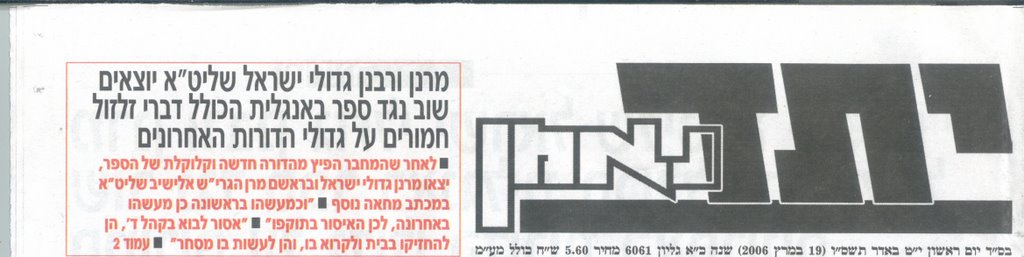
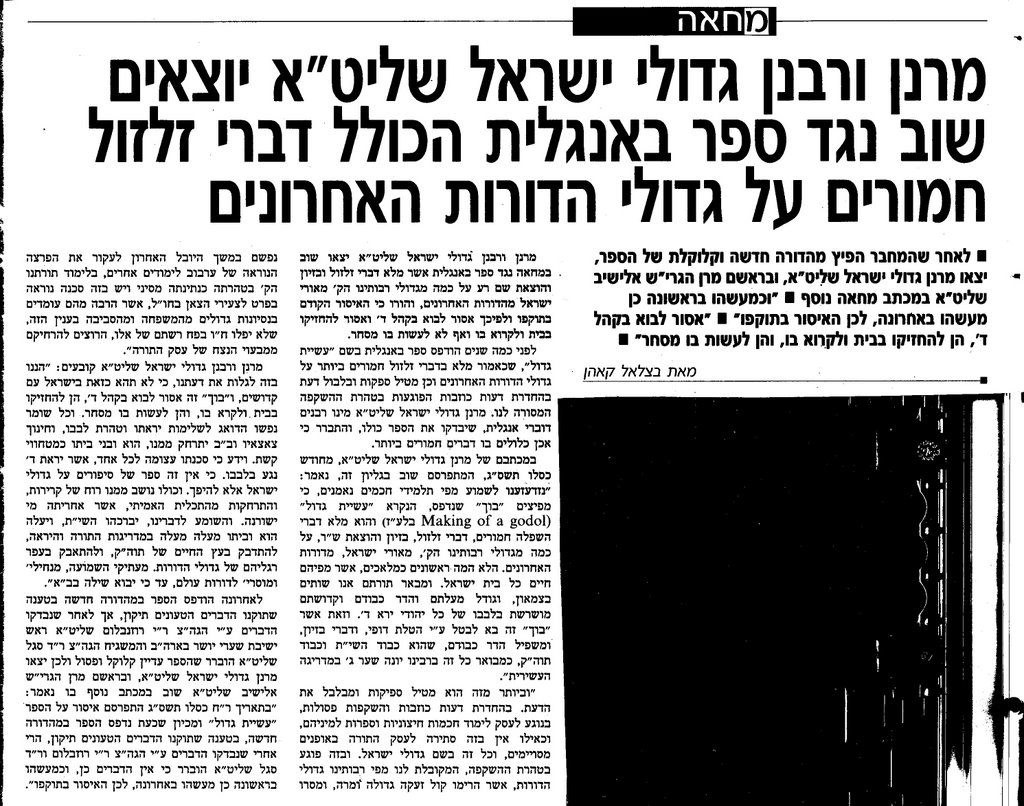
A helpful reader has scanned the Yated with the latest ban against Making of a Godol (“MOAG”). It is notable that R. Eliashiv has signed again as have others who were part of the original ban. Also, as you can see this appeared on the top of the front page as well as a separate article. Those who signed claim that this edition of MOAG although ostensibly “fixed” the “problems” it was unsuccessful and they state “the second edition is the same as the first.” Addtionally, the orignal ban is reprinted with a note that it is still in force. You can click on the scans for a larger view. For some of the differences between MOAG I and MOAG II see here, here and here.


Upcoming Auctions

There are three upcoming auctions. Two of those have their catalogs online. Kestenbaum whose auction will happen this Thursday has some very nice pieces, including R. Hirsch’s manuscript on Devarim est. $50,000, you can view the catalog here. And Asufa will have their auction this Sunday the 26th, and their catalog is here. They also have some unique pieces, well worth checking out. The final auction is Jerusalem Judaica which will take place the 30th but unfortunatly their catalog is not online so you will have to find a store which carries it (Biegeleisen has it).


Making of a Godol Banned – Again

An astute reader emailed me that it appears the new and improved edition of Making of a Godol has been banned. Although this edition attempted to “fix” some of the “problems” of the first, it appears that it has not satisfied it detractors. See here. I hope to get a copy of the letter referenced in the article, when I do I will post it.