1

Pesach posts

Also, if you haven’t already seen it Menachem Mendal has a very interesting post about using oat matzo for pessach. He also has a great post on another story assumed to be of Jewish origin which is not (the story of the two brothers and the temple mount).
Also one hopes that Mississippi Fred McDowell will post on his excellent site English Hebraica, on the early haggadas printed with English or in England.
Finally, although not directly related to pesach, although it would not be that hard to tie it in, there is a new Mishna Berura Yomi blog for all those wishing to devel deeper into this work.


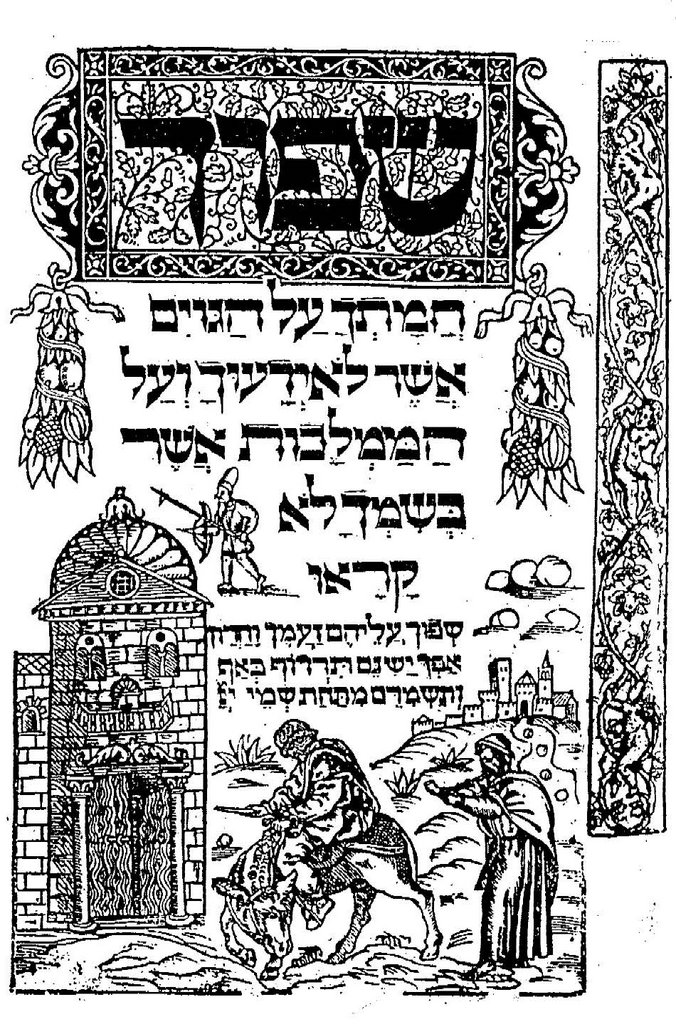
Prague 1526 Haggadah

The first fully illustrated haggadah was the Prague 1526 haggadah. This haggadah was reprinted in 1977 by Mekor and is now available for everyone at the Jewish National University Library site here. (They have other important haggadas available for viewing including some of the earliest haggadas).

The Prague haggadah is filled with fascinating and important illustrations. As we have seen previously, the Prague haggadah contained nudes, which when appropriated later were removed. This included in the haggadah context as well as in other works.

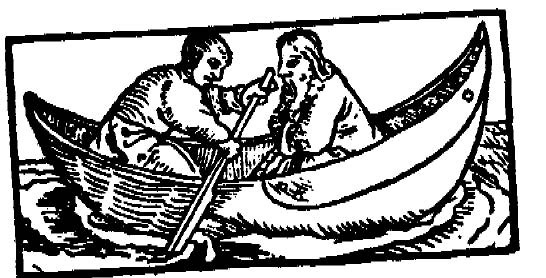
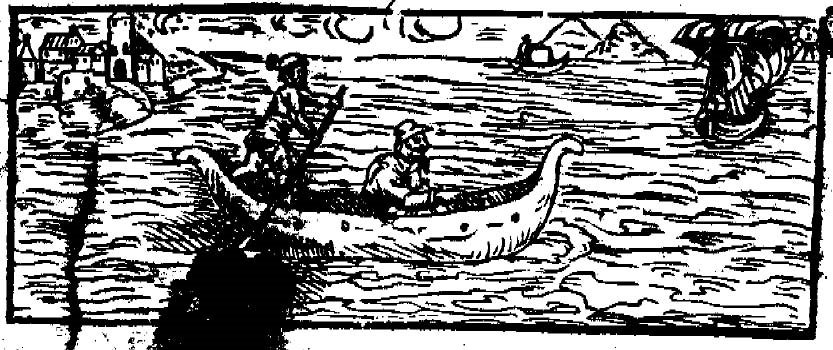
Aside from these illustrations, there is an illustration of Abraham when God takes him “from the other side of the river.” In the Prague haggadah we have Abraham in a row boat. However, when this was appropriated in the Mantau, 1560 haggadah, the row boat was changed into a gondola.

Also, this haggadah contains brief comments or instructions as well as the text of the haggadah. There are two which bear mention. The first is the passage underneath the Tam – simple – son. Typically, the simple son is understood to be less than stellar. However, in this haggadah, the verse תמים תהיה עם ה’ אלקך (One should be simple with God) (Devarim 18:13). As this verse is claiming this simplemindedness is a good attribute, this seems to indicate that the simplemindedness of the son is something positive.

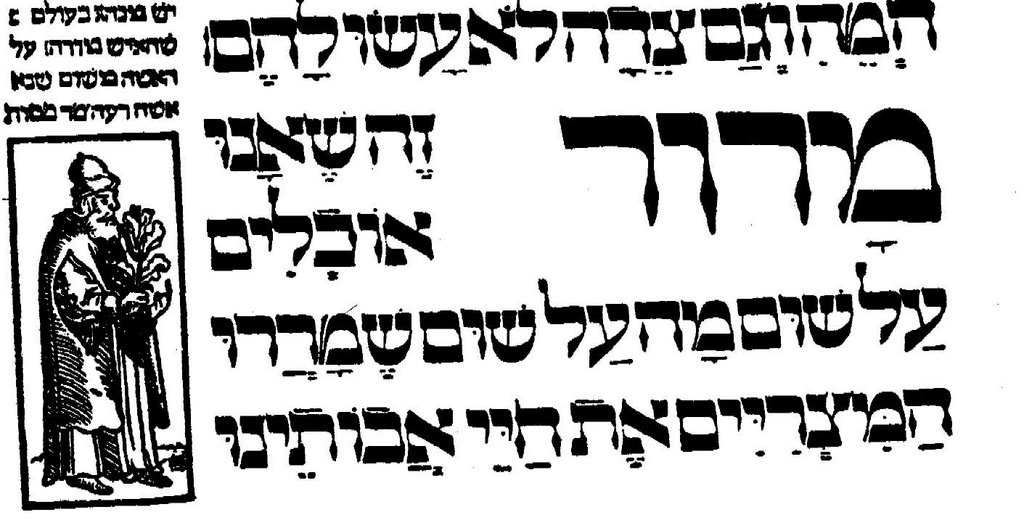
The second passage comes in the form of an instruction. In the margin at the mention of marror the bitter herb, is the following “It is a universal custom to point at one’s wife [at the mention of marror] as the verse says ‘I have found the woman worse [more bitter] than death. (Kohelet 7:26)'”


Eliyahu Drinking from the Cup

I hope to have a few posts in the coming days discussing some of the artwork found in various haggdah. While for hundreds of years artwork played an integral part of the haggadah recently this has fell into disuse. While there are few notable exceptions to this, Raskin, Moss Haggadahs, this practice of richly illustrating the haggdah has been replaced with a focus on commentaries.

One of the reasons, however, the practice of illustrating the haggadah, can be found in the discussion which sheds light on the custom of pretending or assuming that Eliyahu, who according to legend, visits each home on Pesach night.

The last cup of wine poured is for Eliyahu. While originally this cup was not necessarily connected to Eliyahu, today it has become associated with him. The cup of Eliyahu is not mentioned until the 15th century. Various reasons are given. The Gra explains as there is a controversy whether one must drink 4 or 5 cups, a controversy which will be resolved only when Eliyahu comes. (Divrei Eliyahu, Parshat Va’arah p. 35). The earliest source to discuss the cup, R. Zeligman Benga (student of Mahril), says that the custom to pour a cup for Eliyahu is as the night of Passover is an auspicious night for redemption, we await Eliyahu’s coming and therefore we need a cup for him.

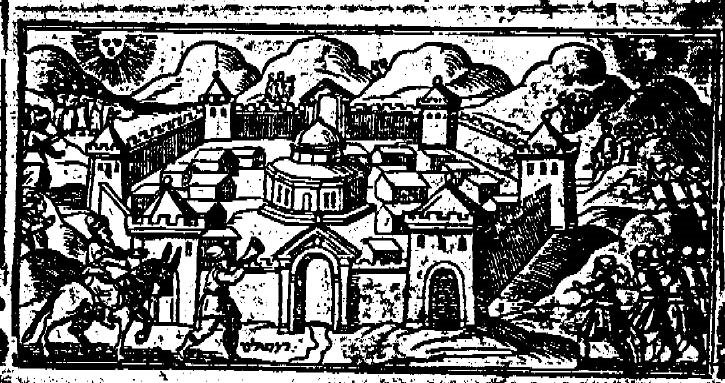
A rather interesting custom sprang up in connection with Eliyahu’s visit on Pesach night. R. Jousep Schammes (1604-1678), records that the custom in Worms was to draw depictions of Eliyahu and the Messiah in order to bring to life the belief in these figures. As you can see from the pictures on the side, this was common in the Haggadah. The first picture is a depiction of Messiah on his donkey. This was originally depicted in smaller format in the Prague 1526 haggadah, but in this edition, Mantua, 1560 is greatly enlarged. The second picture comes from the Venice 1629 hagaddah. As you can see it is again the Messiah coming in to Jerusalem, but note the prominence of the Dome of the Rock in the center.

In Frankfort they went one step further than just drawing Eliyahu and the Messiah. R. Yosef Jousep Hahn (1570-1637) says they used to hang a dummy who looked like Eliyahu or the Messiah behind the door. When they would open the door for Eliyahu the dummy would drop down and seem as if he had appeared. (He then goes on to record a long story of a dybuk who invaded the body of a women who questioned whether the Exodus happened.) It is worthwhile noting that not everyone was thrilled with these depictions. R. Yair Hayyim Bacharach (1639-1702) who became the Rabbi in Worms at the very end of his life, says these types of things only make a mockery of the seder.

However, we see from the above, that there was, at least among some, an effort to create a feeling that Eliyahu actually would visit the seder. Some did it through pictures, others through reenactments. Although today those have fallen to the wayside, it would seem the idea that Eliyahu actually drinks from the cup is a form of those methods.

Sources: Yerusalmi, Haggadah and History; Shmuel and Zev Safrai, Haggadah of the Sages, p 177-78. Minhagei Vermisai, p. פז; R. Y. Bacharach, Mekor Hayyim.


The Ban on the book HaGaon

Now, as the Yiddish newspaper Der Yid has gotten around to commenting on the book HaGaon, I thought it would be worthwhile flesh out the entire controversy surrounding this book. Interestingly, R. Kamentsky in Making of a Godol actually discusses this very topic, although not in the context of HaGaon.

HaGaon written by R. Dov Eliakh in three volumes discusses everything and anything having to do with the Vilna Gaon. Most of the book is not controversial at all, instead, in painstaking detail R. Eliakh chronicles what we know about the Gra and the times he lived in. However, the third volume was the one that many took issue with. That volume, which discusses the controversy between the hassidim and the non-hassdim, also includes most of the primary literature on the topic. That means, R. Eliakh quotes extensively from many of the early anti-hassidic tracts which were published. Some of these contain scathing critiques of the hassidim and accuse them of rather disturbing acts.

However, as many are aware this was not the first time these were published. All of these, and more, have been published by Mordecai Wilensky, in his Hasidim u-Mitnagdim (which is now available again). In fact, much of this has even been translated into English in Elijah Schochet’s The Hasidic Movement and the Vilna Gaon. But, for some who are unaware of these, Eliakh’s book was highly disturbing.

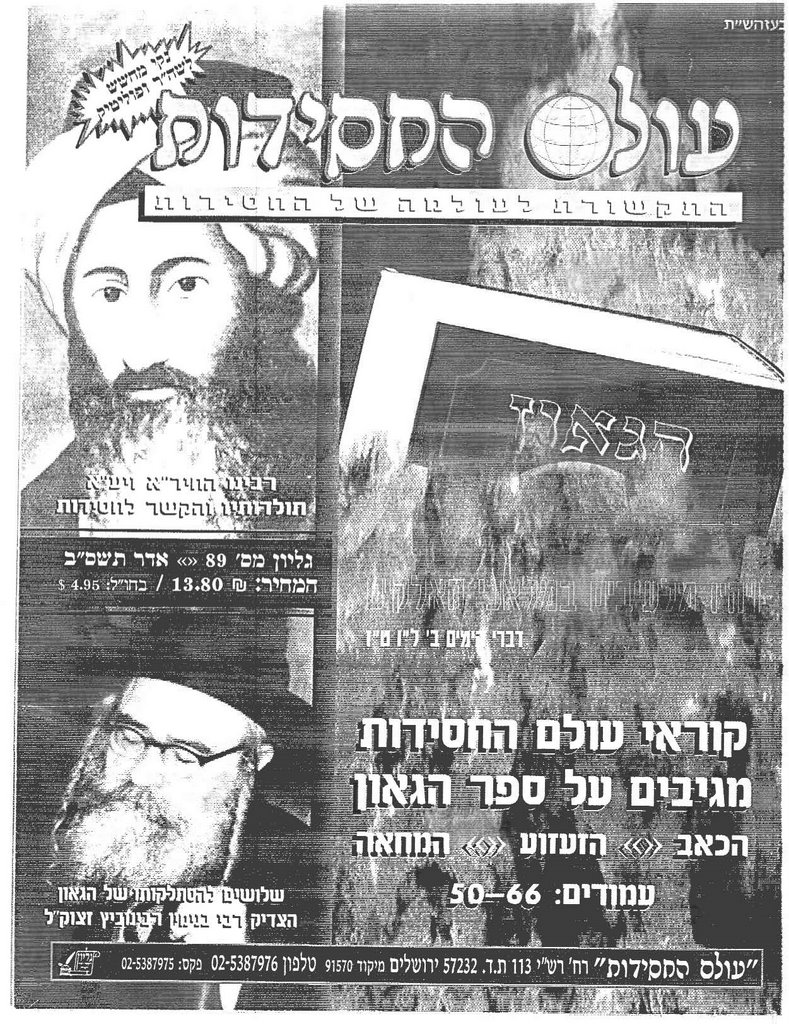
The main complaints came, as is not a surprise, from hasidic circles. For instance, in the magazine Olam haHasidut, has three issues devoted to the book. On the cover of two of those issues, the book HaGoan appears in flames. Needless to say they were not fans of the book. The title reads אוי לדור שכך עלתה בימיו (how unfortunate we are to have this happen in our time). Among the major complaints about the book is that it is “written in the style of the maskilim (enlightenment).” I assume that means that as Eliakh documented everything he wrote that is in the style of the maskilim.

Additionally, they complain that as this controversy is no longer applicable (as the hasidim of today don’t do what they did back then), it serves no purpose in relating this again.

Now, here is where Making of a Godol comes in. R. Nathan Kamenetsky records what his father, R. Yaakov’s opinion on whether to discuss the history of the controversy between the hasidim and the non-hasidim. “My father [R. Yaakov] approved of snubbing of ‘a book on the Goan of Vilna by an outstanding author’ because ‘the author had purposely omitted chapters dealing with the Gaon’s opposition to Hasiduth and that he [R. Yaakov] said, ‘It is prohibited to conceal substantive and important issues such as these. Such distortion is tantamount to falsehood.'” R. Nathan Kamentsky goes on to relate that the book in question was R. Landau’s biography of the Gra and that his father [Rav Yaakov Kamenetsky] actually confronted R. Landau and accused him of “falsifying the image of the Gaon.” See Making of a Godol vol. 1 pp. xxvii (available here).

Consequently, R. Yaakov felt that leaving out such a seminal fact in a biography was equivalent to lying. However, as we see, the publishers of Olam haHassidut appear to disagree. They are not the only ones. R. Yaakov Perlow, the Novominsker Rebbi, wrote a long article where he also takes issue with Eliakh’s book. He also claims that R. Eliakh should have left out the details of the controversy.

It would appear that there is a fundamental controversy as to whether or not one should lie regarding history. In fact, in the journal Ohr Yisrael, there was an article addressing this very point – whether one should lie to tell stories that create yirat shamyim. The author concludes “if the teacher is telling stories which are not true, but is doing so leshem shamyim, so long as he doesn’t make a habit out of it, there is a place to be lenient in this matter, however, one should try to minimize this.”

Interestingly, in the next volume the Admor from Slonim has a stinging rebuttal of the article. He starts by saying, “Our tradition is based upon truth . . . how terrible it is to inject lies into our tradition.” He then explains such a view undermines our entire religion “whomever permits [one to lie] it is as if he is creating uncertainty in the truth of our entire tradition, which is based upon the passing from generation to generation. My teachers have taught that one should only accept truthful stories.”

So it would appear that there is an ongoing controversy, one which implicated the book HaGaon, with some arguing lying or covering up fundamental historical facts, is ok. While others claim this is totally unconscionable.

Sources: Olam haHassidut no. 88, Shevat 2002; 89, Adar 2002; 90, Nissan, 2002. Rabbi H. Oberlander, “HaIm Mutar l’Saper Ma’siyot shaninom amitim kedi l’orrer al yedi zeh l’Torah v’lyerat shaymim, Ohr Yisrael, 29 p. 121-123; R. Avrohom Weinberg (Admor M’Slonim Beni Brak), Letter, Ohr Yisrael, 30, 244. See also, Ari Zivotofsky, Perspectives on Truthfulness in the Jewish Tradition, Judaism 42:3 (Summer, 1993): 267-288. R. Yaakov Perlow, Yeshurun vol. 10 starting on page 831. Der Yid, Talumat Seftei Sheker haDovrot al Tzadik Atik, March 17, 2006. See also here for a discussion of the book. There are others that discuss this as well, and in R. Nathan Kamenetsky’s introduction he quotes them. Further, as a helpful reader/movie buff has noted, I should have included R. Dr. Jacob J. Schacter’s article on this topic available here.

Review of Where there’s Life there’s Life

Rabbi David Feldman, who is well known for his book on issues relating to Jewish law and the beginning of life (abortion, birth control etc.), has now published via Yashar Books, a book on end of life issues and Jewish law. This book covers such topics as reproductive technology, stem cells, organ transplants, suicide, and determining death. Although it covers such weighty topics it is a rather easy read. Rabbi Feldman eschews highly technical discussion and instead has opened the book for everyone. Each topic gets about ten pages of treatment and Rabbi Feldman lays out the basic principles underlying each of these issues.

He begins with an extensive introduction on pikuach nefesh which much of the subsequent discussions are premised upon. The book is a little over 130 pages, which means none of the topics are treated in great depth. However, as Rabbi Feldman states in the introduction his purpose was not to provide a comprehensive book on the topic, rather to give some general guidance on this hot button issues. In this area he succeeds. He does provide a very basic introduction to the topics and does provide some of the key sources. Consequently, one who reads this book will have the basics to further investigate these issues.

However, with this approach there are some significant draw backs. Rabbi Feldman, while stating what he feels the commentaries say, does not provide sources for these. He give almost no citations to any source he quotes (there are two exception to this, once he gives a citation to R. Feinstein’s responsum and once he gives a cite to a responsum from R. Moshe Sofer). For example, when discussing organ transplants he tells us the key responsum is from R. Yechezkel Landau (Noda Biyehudah) where he holds when the organ donor is “in front of us.” That is, on a simple level, one can only do a transplant when one has a ready person to accept the organ. Rabbi Feldman then goes on to discuss others who have applied this statement all without ever providing where R. Landau said it, nor where the subsequent discussion can be found. This seriously hampers any follow up a reader wishes to do or for that matter, to ensure Rabbi Feldman’s reading is the correct reading.

To be fair, Rabbi Feldman does offer that is one contacts him via email he will provide citations and additional sources, however, his email doesn’t appear anywhere in the book. Assuming these citations were omitted to enable easier reading, why they could not be included on a page or two at the end I do not understand. Instead, we are left to blindly trust Rabbi Feldman in his assessment of the sources.

Further, Rabbi Feldman is far from the first to write on these topics. Instead, a simple search of RAMBI one can see there are numerous articles on all of these topics, none of these are provided. While Rabbi Feldman is not obligated to cite the works of others, it is difficult to understand Rabbi Feldman’s claim that “the need to address [these issues] is both urgent and constant,” as these very issues have been already comprehensively discussed by many, many others.

Additionally, as I mentioned previously, this book does provide an excellent starting point for these discussions. We are bombarded with many who claim to know what the Bible says for these important topics, but most are blissfully unaware of what the Bible and more specifically Jewish law says and has said about these topics, this cures that. But, it is hard to say it will facilitate further discussion when one doesn’t know where to go next.

In the end, this book, in a clear and straightforward manner, if a bit curt, which provides the groundwork for understanding extremely important issues regarding the end of life and new technologies relating that implicate life and death.


Dei’ah veDibur on the MOAG Ban

Not that this is surprising, as Dei’ah veDibur is the English version of the Yated Neeman, but they have also posted the article and the new ban from below on their site in English.