1

Elliott Horowitz – Modern Amalekites From Adolf to Avigdor

In a previous post at the Seforim blog, Prof. Elliott Horowitz of Bar Ilan University and co-editor of Jewish Quarterly Review, described Isaiah Berlin on Meir Berlin (Bar-Ilan) and Saul Lieberman [see here].  This is his fourth contribution to the Seforim blog. We hope that you enjoy.
Modern Amalekites: From Adolf to Avigdor
by Elliott Horowitz
     Well before the outbreak of World War II the Nazi regime in Germany came to be associated by many Jews with Israel’s ancient arch-enemy, Amalek. Perhaps the first to do so was the noted historian Simon Dubnow who in a 1935 (Hebrew) letter from Riga to his disciple Simon Rawidowicz bemoaned the recently promulgated Nuremberg Laws, and then prophetically exclaimed “We are at war with Amalek!” During that same decade some ultra-Orthodox European rabbis were using the epithet of “Amalek” with reference to their more secular coreligionists who adhered to such modern ideologies as Communism or Zionism. This was true, for example, of the great Talmudist R. Elhanan Wasserman, one of the leaders of Agudat Yisrael, who like Dubnow was to meet his death in 1941 at the hands of the Nazis. Wasserman, who had studied in Volozhin and Telz before joining the kollel of the Hafetz Hayyim (R. Israel Meir Ha-Kohen, 1838-1933), cited the latter’s confident opinion that the Soviet Jewish communists (known as the Yevsektzia) were “descendants of Amalek.” Ironically, his even more ultra-Orthodox Hungarian contemporary R. Hayyim Elazar Spira of Munkacz (1872-1937) included among the ranks of modern Amalekites not only the Zionists, but also the members and leadership of Agudat Yisrael.[1]  In September of 1941 Joseph Hertz, the Chief Rabbi of (what was then still) the British Empire, delivered a thundering sermon at a public “intercession service” held on the ruins of London’s Great Synagogue, which had just been destroyed by German bombs. Drawing upon the previous week’s scriptural reading from Deuteronomy 25, which is also the “additional” reading for Shabbat Zakhor, Hertz referred to Nazi Germany as “Amalek’s latest spiritual descendant; he fears not God; he closes the gates of mercy on those who cannot resist his might.” The Chief Rabbi stressed that God’s war with Amalek was not to be left in divine hands, but was to be “carried out by…men and nations filled with an endless loathing of Amalek and all his works and ways.” He also praised those Jews who had shown support for “our beloved country in her struggle to blot out the memory of Amalek from under the heavens of the Lord.”[2]  Hertz, who had studied at New York’s City College (where he received a gold medal for English composition) before attending the Jewish Theological Seminary of America (of which he was the first rabbinical graduate), was not the first British clergyman to portray the Germans as contemporary Amalekites. Early in October of 1939, shortly after his arrival in Jerusalem to serve as chaplain of St. Andrew’s Scottish Church (and a month after Germany’s invasion of Poland), Dr. Norman Maclean chose as the text for his Sunday sermon the account (in Exodus 17) of Amalek’s attack at Rephidim. The prayer by Moses on the adjacent hill-top, asserted Maclean (1869-1952), who had earlier served as minister of St. Cuthbert’s Church in Edinburgh, “described our duty in the grim conflict now being waged.” Then as now “the nations which abolished God or reduced Him to a tribal deity confronted the nations that held fast to the faith of their fathers.” In the balance, both at Rephidim and in the present, lay nothing less than “the fate of the world’s soul.”[3]  The connection between the world’s soul and the Jewish people had concerned Rev. Maclean (to whom I hope to return in a future post) well before his arrival in Jerusalem, which he first visited in 1934. During the First World War, while still serving at St. Cuthbert’s he contributed a foreword to Leon Levison’s The Jew in History (1916) which opened with the words: “The world owes its soul to the Jews.” In consonance with that position Maclean shared the hope of Levison, his Safed-born brother in Christ,[4] that the war’s end “may be the restoration of the Jews to Palestine,” which Maclean saw as “the only lasting reparation that Christendom can make for centuries of wrong,” adding that “it was a disgrace that the holy places of Christianity should be in the hands of Mohammedans.”  Not surprisingly, Rev. Maclean, whose views were not quite in consonance with those of Britain’s Mandatory representatives, did not last very long at St. Andrews in Jerusalem. Early in January of 1941 the Palestine Post laconically reported that “Dr. Norman Maclean and the Hon. Mrs. Maclean are planning to return to Britain shortly.” Several months later he completed his tenth book, His Terrible Swift Sword: On the Problem of Jewish Immigration to Palestine (1942), which he had begun writing “on the summit of one of the hills of Judah looking down on Ain Karem,” but completed in Portree on the Island of Skye. As the Palestine Post reported, it was prohibited for importation into Palestine by the High Commissioner (Harold MacMichael) who may not have approved of such passages as: “Nine months after we declared war on Hitlerism, victims of Hitlerism are still in Athlit (p. 16).” Shortly after the book’s publication Maclean spoke at an event sponsored by the Jewish National Fund at London’s Dorchester hotel.[5]  At that event he may well have met Chief Rabbi Hertz, who was a fervent Zionist – a position of which not all prominent British Jews then approved. Had Maclean crossed the ocean to visit New York City he could, of course, have met many rabbis who shared his criticisms of British immigration policy, including Israel Levinthal of the Brooklyn Jewish Center. The Vilna-born and Columbia-educated Levinthal, like many of his coreligionists and fellow clergymen on both sides of the Atlantic, saw Hitler as a modern-day Haman and the Nazis as Amalekites, but by 1947 he was also willing to add others to the list. In a sermon delivered on Shabbat Zakhor of that year (and later published in his collection Judaism Speaks to the Modern World) he asserted that the British, who earlier “pretended to be friends of Jewish Palestine” now “suddenly reveal themselves as the modern Amalek,” and that Ernest Bevin, the Labour government’s foreign secretary, “is just like Haman himself.”[6]  It is unlikely that such ardent religious Zionists as Hertz and Levinthal were able to imagine that in the Jewish state they hoped and prayed for chief rabbis would emerge who would hurl the epithet of “Amalek” at fellow Jews, including members of parliament. Yet as many readers will recall, less than a decade ago R. Ovadia Yosef compared then-education minister Yossi Sarid to Haman, adding that “he is wicked and satanic and must be erased like Amalek.” Although the office of then-attorney general Elyakim Rubinstein pursued a criminal investigation on grounds of possible incitement to violence the redoubtable Rishon le-Zion was never charged. He was thus understandably less reluctant to make use of the same rabbinical WMD during the recent elections, when many Shas supporters showed signs of leaving the Sephardi Sage of Har Nof for the Russian Rage of Nokdim. At the same Saturday night live broadcast at which R. Ovadiah had in 2000 asserted that Sarid “must be erased like Amalek” he turned his rhetorical rifle to the right and aimed it at MK Avigdor Lieberman, announcing that “a vote for Lieberman was a vote for Amalek.”


[1] See Elliott Horowitz, Reckless Rites: Purim and the Legacy of Jewish Violence (Princeton: Princeton University Press, 2006), 140-41, and the sources cited there.

[2] See Joseph H. Hertz, Early and Late: Addresses, Messages, and Papers (Hindhead: The Soncino Press, 1943), 67-69.

[3] Palestine Post, 2 October 1939. Maclean’s imminent arrival, together with that of his wife, was reported in the same publication on 9 May of that year. The couple had previously been living on the Island of Skye.

[4] On Levison see Frederick Levison, Christian and Jew: The Life of Leon Levison, 1881-1936 (Edinburgh: The Pentland Press, 1989).

[5] idem., 4 June 1942, 17 September 1942.

[6] Israel H. Levinthal, Judaism Speaks to the Modern World (London: Abelard-Schuman, 1963), 77-84. On Levinthal see Kimmy Caplan, “The Life and Sermons of Israel Herbert Levinthal (1882-1982),” American Jewish History 87:1 (March 1999): 1-27.


Daniel J. Lasker – Birkat Ha-Hammah 5769

Get Ready – It’s Almost Time to Bless the Sun
by Daniel J. Lasker

Daniel J. Lasker is Norbert Blechner Professor of Jewish Values at Ben-Gurion University of the Negev, Beer Sheva, and is chair of the Goldstein-Goren Department of Jewish Thought. His landmark work Jewish Philosophical Polemics against Christianity in the Middle Ages, originally published in 1977, was recently republished with a new introduction in 2007.   

This is Professor Lasker’s second post at the Seforim blog. His previous post about ve-ten tal u-matar li-verakha was entitled “December 6 Is Coming: Get Out the Umbrellas,” and is available here.

לזכר אבי מורי ז”ל
In less than two months, on April 8, 2009 (Erev Pesah, 14th Nisan, 5769), the once- in-28-years Blessing of the Sun (Birkat ha-Hammah) will be recited, celebrating the occasion when the sun returns to the position where it was when it was first created, on the same day of the week and the same hour of the day as it was then. For those with short and medium range memories, and for those who were toddlers or perhaps not even born in 1981, it is useful to review the reason for this ceremony, one of the very few Jewish events which follow a solar calendar rather than our standard Jewish luni-solar calendar. This year’s Blessing is the first one in the internet age, so it is appropriate to publicize it on a blog; one can only imagine what technological breakthroughs will be around at the time of the next Blessing in 2037.
The Talmud Berakhot 59b states: “He who sees the sun at its tekufah, the moon in its power, the stars [or planets] in their orbits, and the signs of the zodiac in their orderly progress, should say, ‘Blessed be the Maker of Creation’ (ברוך עושה בראשית).” The Talmud continues: “And when is that? Abbaye said: ‘Every twenty-eight years when the cycle is repeated and Tekufat Nisan falls in Saturn on the evening of Tuesday, going into Wednesday.” It should be noted right away that Abbaye is commenting only on the first event described in the baraita, namely, “seeing the sun at its tekufah,” and that parallel passages (Tosefta Berakhot 6:10, Jer. Berakhot 9:2 [13d], and Leviticus Rabbah 23:8) do not include Abbaye’s explanation. It is that explanation, however, which is the basis of the ceremony of Birkat Ha-Hammah.
What does Abbaye’s comment mean? First of all, Tekufat Nisan refers to the vernal equinox, the exact time when spring begins, when the sun rises exactly in the east and sets exactly in the west. Since night and day are then equal, sunrise and sunset on those days are at 6:00 AM and 6:00 PM respectively (in local time; not necessarily in standard time). Second, the ancients believed that there are seven planets (Sun, Moon, Mars, Mercury, Jupiter, Venus and Saturn); and each hour of the day is controlled by a different planet on a weekly rotation (each planet controls 24 different hours during the week, repeating the cycle every seven days). For instance, the planet which controls the 6:00 AM hour names that particular day: Sunday (Sun); Monday (Moon); Tuesday (Mars – think the French mardi); Wednesday (Mercury – mercredi); Thursday (Jupiter –jeudi); Friday (Venus – vendredi); and Shabbat/Saturday (Saturn). The 6:00 PM Tuesday hour, namely the onset of Wednesday according to the Jewish practice of beginning the day at night, is Saturn; thus, “Saturn on the evening of Tuesday, going into Wednesday.” According to Abbaye, when the vernal equinox falls every 28 years on Tuesday at 6:00 PM, the blessing of the sun is to be said. Since at the time of equinox the sun sets on Tuesday at 6:00 PM, the halakah maintains that the Blessing of the Sun is to be recited on Wednesday morning after sunrise. April 8, 2009, is the Wednesday after the Tuesday on which Tekufat Nisan occurs at the 6:00 PM for the first time in 28 years.
But why does the vernal equinox fall at 6:00 PM on Tuesday night once every 28 years? This assertion is based on a number of assumptions: 1) The world was created in Nisan (actually at the end of Adar) and not in Tishrei (actually the end of Elul), following R. Yehoshua’s view in Rosh Hashanah 10b-11a. 2) When God created the sun on the fourth day, He wasted no time and did so at the very first minute of the fourth day, namely, what we call Tuesday evening at 6:00 PM. 3) The sun was created at the moment of the vernal equinox (Tekufat Nisan). 4) The solar year is exactly 365 ¼ days long. On the basis of this calculation, the tekufot (the equinoxes and the solstices) progress each year by one day and six hours (365 ¼ days is 52 weeks, one day and 6 hours). If the first Tekufat Nisan was on Tuesday night at 6:00 PM, the next one is Wednesday night at midnight; the next one was Friday morning at 6:00 AM; then Saturday at noon; Sunday night at 6 PM, and so forth. The first time after creation that Tekufat Nisan fell again on Tuesday night at 6:00 PM was in the year 29 AM, 28 years after creation. On 14th Nisan, 5769, the vernal equinox will be at 6:00 PM on Tuesday for the 207th time (5769/28 = 206 with a remainder of 1). To celebrate this event, the blessing “Blessed be the Maker of Creation” will once again be recited.
The perceptive reader may have noticed that the assumptions upon which the obligation to recite the Blessing of the Sun are based are highly problematic. There are more than seven planets and they do not revolve around the earth (which itself is a planet); and most people do not believe that each hour of the day is ruled by a different planet. Our celebration of Rosh Hashanah on the first of Tishrei seems to indicate that the world was not created in Nisan (e.g., we say: היום הרת עולם). The Bible gives no indication that the sun was created on the equinox (either vernal or autumnal), or that it was created at 6:00 PM on Tuesday night (after all, before the creation of the sun, there was no 6:00 PM). But most significantly of all, the year is not exactly 365 ¼ days long.
There are a number of consequences of the discrepancy between the actual length of the year and the approximate length of 365 ¼ days (called Tekufat Shmuel [cf. Eruvin 56a], which is the same calculation which is at the base of the Julian calendar; see my contribution to the Seforim blog on November 30, 2007, in the context of a discussion of the prayer for rain in the diaspora, also calculated according to Shmuel’s imprecise length of the year). One consequence is that the Blessing of the Sun is moving progressively forward vis-à-vis the Gregorian calendar. In 2121 the blessing will be said on April 9, not April 8. In 2205 it will be said on April 10, and so on (the Hebrew date changes every time since the Blessing is based on the solar calendar). More importantly, however, the Jewish world is blessing the sun as it returns to its original time at the vernal equinox on a date which has nothing to do with the true vernal equinox (which is this year on March 20, 11:44 UTC).
Why, then, do observant Jews observe a commandment which is so questionable (especially this year when it falls on the eve of Pesah, not the most convenient time to have a ceremony which is intended to be performed in as large a group as possible – ברוב עם הדרת מלך)? Is it just another example of Jewish stubbornness and inertia – holding onto an ancient ceremony even when it is based on questionable assumptions (perhaps like the second day of holidays in the diaspora because of calendrical doubts which were laid to rest over a thousand years ago)? Or is it a sign that in matters of religion, especially when it comes to halakhah, logic is not the only important factor or perhaps not a factor at all. The Hatam Sofer ruled (Responsa, Orah Hayyim 56) that once the great Rabbis of Israel (Maimonides [H. Berakhot 10:18], Yosef Karo [Orah Hayyim 229:2], et al.) had codified the practice of blessing the sun, the matter was closed. It would seem that, indeed, tradition, even illogical tradition, has had a strong hold on Jews; it is this Jewish loyalty to tradition which has maintained us during our long history.
And so, let us hope that on this 14th of Nisan/April 8, the skies will be clear, the sun will be bright, and we can once again thank God for making the works of creation!


Milah Books & Manuals

Milah Books & Manuals
by Eliezer Brodt & Ish Sefer
Much has been written on milah. Hebrew Books has over forty seforim on this topic. There are those books that discuss the various controversies, including abolishing milah in toto[1]or specific parts of milah such as metzizah be-peh.[2] Others focus on the philosophic and theological implications of milah.[3] This post, however, will focus on two types of milah books, one what we will refer to as milah manuals and the second, books about milah. The former is comprised of books that explain, in detail, the process of milah – these can include the physical process, i.e. how the surgery is to take place, as well as the more esoteric processes such as thoughts or prayers that are to accompany the milah. The second type of book doesn’t focus on the technical aspects of milah but instead focuses on the customs, the laws, etc. that are connected with the surgery. One final point, this is not intended to be a complete bibliography of either type of work, instead, we have picked out a few titles that hopefully will be of interest to the readers.
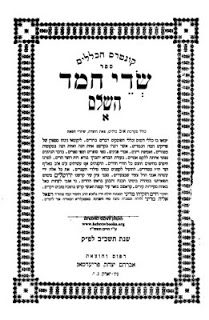
Milah ManualsThe first manual up for discussion is R. Tzvi Benyamin Auerbach’s, Brit Avraham, Frankfort, 1860. This book includes a nice introduction dealing with a history of the Ravan as well as other Rishonim. Additionally, all the liturgy associated with brit and explanations of the liturgy is included. There is a section on the laws relating to milah. At the beginning of this section, Auerbach notes that although he takes a different view of some of rules governing milah, he provides explainations for his divergent opinions in another section. Indeed, Auerbach does provide a detailed discussion of the law of milah including a discussion of most, if not all, relevant opinions. Interestingly, although the laws and liturgy are in Hebrew, this section, the section discussing the bases for Auerbach’s opinions, is in German. Not only is it in German, but in Latin characters indicating that Auerbach was trying to demonstrate the correctness of his opinion to only those who could read German. Let us explain. Auerbach’s work includes one other section in the vernacular. That section discusses various cures associated with milah. This section is written in Yiddish in Hebrew characters. Auerbach explains that he did so “so that even those who do not understand Hebrew will understand this section.” Thus, there are three potential audiences for this book. Those who only understand Yiddish, those who understand Hebrew, and finally, those who understand German as well. R. Auerbach is most well-known for another work, Sefer ha-Eshkol he edited and published from a manuscript and added his own commentary, Nahal Eshkol. As Dr. Shapiro has discussed, this work was accused of being a forgery, that although it was attributed to Rabbi Abraham ben Isaac, a Rishon, it was in fact a later invention. Ironically, in the introduction to Brit Avraham (pp. 24-25), Auerbach discusses the importance of authenticating manuscripts and ensuring proper attribution. Specifically, Auerbach provides Brother, the following story illustrates how must care and time one must take in authenticating old manuscripts that are found in various libraries. In fact, Gedolei Yisrael have erred because they failed to take proper care [in authenticating manuscripts] when it came to the prohibition of terafot. Auerbach offers the story that when he was studying under R. Leib Karlburg, R. Karlburg ruled that an animal was not a terifah which appeared to be in contravention with the understood law. Auerbach questioned him on this ruling and R. Karlburg explained that all the Rabbis in Cologne and Bonn permit this because of a responsum authored in 1626 and signed by numerous rabbis that remained in manuscript but was included in the communal pinkas from R. Yehuda Miller’s library. Auerbach went and looked this up, and indeed there was such a responsum attributed to various Rabbis. Auerbach, however, wrote to his father-in-law, an expert in yoreh deah, regarding this leniency, and his father-in-law told him to ignore it and follow the accepted stricter position. Auerbach continues, that after he got to Frankfort, he told R. Aaron Fuld this story and R. Fuld immediately showed Auerbach a responsum from R. Mordechai Halberstatt, Ma’amar Mordechai. R. Halberstatt published the responsum (as well as other manuscripts from R. Miller’s library) and after doing so states “all of the preceding manuscripts are forgeries and the product of the the doer of a terrible deed, may his name be blotted out, Lieb the non Jew who is the well-known informer Kreski (this wicked one is referred to in the book Ametz Yosef as the informer Krauss . . .) . . . he is the the one who forged and spoke falsehoods in the names of various luminaries.” Auerbach then finishes “that I have spoken at length [regarding the need for caution authenticating manuscripts] because there is still a community who follows the [erroneous] practice regarding the above issue of terifah.” Ironically, one of the justifications for Auerbach publishing a forgery was that Auerbach was duped regarding the manuscript and failed to do correctly authenticate the manuscript he attributed to the Sefer ha-Eshkol.[4] The next two manuals are interesting in both their content as well as their titles. These two manuals are more focused on the kabbalstic intent that one is to have during the ceremony. Sod ha-Shem has already been discussed here and here due to the fact the author, R. David Lida, has been accused of being a Sabbatian. But, it should also be noted that both Sod ha-Shem and Hotem ha-Shem use God’s name in the titles. Indeed, in the later case, God’s full name is spelled out – Yud, Hey, Vav, Hey (additionally, must of what is in Hotem ha-Shem comes from Sod ha-Shem). Such use of God’s name is not unique to these books. The first to discuss the issue of using God’s name in the title actually arose not because the book in question had God’s name but rather because the title could be (incorrectly) read to be referring to God. Of couse, we speak of Hezkiyah Medini’s Sedi Hemed. The Sedi Hemed was not published in a single set as it is available today. Instead, R. Medini sent kuntresim in paperback as the parts became available to various rabbis to get their opinions on the work. Although much of the feedback R. Medini got was positive, R. Medini recieved two letters from a rabbi R. Medini does not identify that questioned R. Medini’s work and more particularly, the title of his work. These letters complained that since the Sedi Hemed had a paper cover with the title on it, when one went to bind all the kuntresim together, the binder would inevitably remove one cover. According to the anonymous rabbi this was problematic because Sedi also spells out a name of god and thus opens the potential for discarding of a page with god’s name on it.
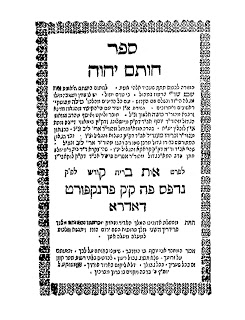
R. Medini responded by noting that since the word in question “sedi” is not intended to be holy, although the same word may also have a holy connotation, whether it is in fact holy is dependent upon the intent of the author (i.e. elohim referring to idols). Here, the intent was not god’s name so there is no problem. R. Medini also noted that of the many, many rabbis who wrote to him regarding his book, none had refrained from mentioning the title and none brought this “issue” to his attention. R. Medini then cataloged a few books that, like the Sod ha-Shem and Hotem ha-Shem, have god’s actual name in the title and none of these authors were at all bothered by that. Indeed, it seems rather odd to worry about a book title, when the entire book is to be respected. R. Medini then wrote to numerous rabbis to check and make certain that his logic was sound (they all responded that R. Medini was correct). The first he wrote to was the extremely erudite scholar, R. Yosef Zekhariah Stern. R. Stern agreed with R. Medini and offered additional titles that contain god’s name. Additionally, R. Stern also highlighted names that include god’s name in them such as eliyahu, eliezer, daniel and the like. R. Stern proclaims that although these names contain god’s name in them no one has ever had a problem with them nor did he ever see anyone hyphenate or otherwise alter the name to ensure that god’s name doesn’t appear. Today, however, the very practice that R. Stern notes was never done, has become commonplace in some quarters. In the end, R. Medini’s work retained the title Sedi Hemed; however, the title now carries nekkudot to ensure that no one makes a mistake regarding the pronunciation.
In 1892, Zichron Brit li-Rishonim was printed. Although published in the end of the nineteenth century, this manual is based on the pesakim of the rishonim R. Yakov ha-Gozer and his sons. Israel Ta-Shma points out that this is the first specialist sefer written in times of Rishonim where we do not know anything about them in others areas of torah (as there were other specialist seforim written before but by well-known gedolim). Additionally, Ta-Shma demonstrates that this work was meant for the Moheleim of the time to improve the field. See I. Ta-Shma, Keneset Mechkarim, Iyunei be-Safrut ha-Rabbanim be-yemi ha-Benyaim, (Bialik Institute, Jerusalem: 2004), vol. I, pp. 320-22; idem, Halakha, Minhag, u-Metziut be-Ashkenaz 1100-1350, (Magnes Press, Jerusalem: 1996), pp. 96-99 The question is why the name “ha-Gozer.” R. Yissacar Tamar in Alei Tamar [Moed 1:149];has a lengthy piece on the topic where he points out there are almost no sources in chazal that “gozer” refers to a mohel. He suggests that maybe the editor stuck it in. R. Tamar then suggests that perhaps the name “gozer” has nothing to do with Milah. Instead, it was a nickname of respect that he was a Tzadik and what he was gozer hashem did. [See also R. Elijah Levita, Tishbi, s.v. gezeriah.] However it appears that Alei Tamar missed a known Midrash which provides: שבעה הרי שמונה, אמר משה בזכות המילה שניתנה לשמונה נקרע הים, ונקלס באז. אמר ר’ לוי לגוזר ים סוף לגזרים (תהלים קלו יג), שכן בלשון ארמי קורין למהולין גזורים, בזכות המילה נקרע הים (מדרש תנחומא (בובר) פרשת בשלח סימן יב) .
Other Works on Milah An excellent sefer on milah, Koret ha-Brit, was written by R. E. Posek and first printed in Lvov in 1893 and recently reprinted (300 pgs). This sefer covers all topics relating to milah and provides incredible sources and many of his own fascinating insights on the topics. It also includes an abridged selection of all the kabbalah aspects mentioned in R. Lidas Sod ha-Shem. He received many nice haskomos to the sefer among them the Marsham, Adres and Sdei Chemed. Besides for receiving these haskomot he also received many notes on his work from the Adres and Marsham indicating that both read the book closely. The Adres, in his haskamah, discusses limiting oneself to a single topic. ומצאנו לרבותינו ז”ל שהיו מצוינם במקצוע אחת יותר מחבריהם [עי’ ברכות כ’ א’ , מו”ק כח ב, ע”ז ד’ א’ , ב”ק לט נג א, ב”מ ס”ו פו א’, חולין נב ב, גיטין ה’ ב] ומה”ט קבעו הלכה כמותם בזה [עי’ רש”י כתובת מג ב, רא”ש ב”ק פרק ד] כן נוכל לומר על ידידינו המחבר… Another important work was the Zecher Dovid written by R. Dovid Zechus Modena first printed in 1816 . This work is extremely special. This was very rare ever since it was printed and therefore it was rarely quoted even Sefer ha-Brit, discussed below, which quotes many seforim on the topic does not quote this work. The sefer Otzar ha-Brit from the famous yerushalmi mohel does quote this work often as he received special permission from Hebrew University to borrow it when he was working on his seforim. In 2001, Ahavat Sholom reprinted this work in a beautiful set of six volumes including a volume of indexes and a volume of dershos of his on chumahs that was never printed before. This work is an encyclopedia on Milah and many other topics. It is divided into three sections the first two relate to milah in all aspects of kabalah and halacha. The importance of this work is besides for quoting an excellent selection of sources on his topics he adds in many of his own nice points brings many sources from unprinted manuscripts and organizes it all very well making it a pleasure to read. The third section of this sefer is all about the cycle of the year from Shabbat and all the Yamim Tovim here too he deals a little bit about milah but mostly focuses on the Yamim Tovim and includes excellent discussions and sources on the topics. This is one of the best seforim which Ahavat Sholom has printed.

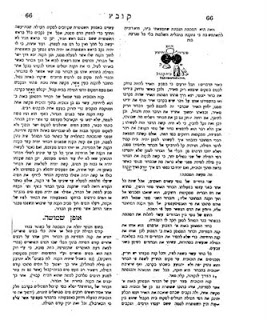
Another work on the topic is Machsehrei Milah written by R. Eliyhu Halevi, Livorno, 1793 and recently reprinted by Ahavat Sholom. This new edition includes a selection of the Kuntres on metzizah from R. Hezkiah Medini the author of the Sedi Hemed as well as a selection of halachos from R. Yakov Hillel. Another work is Sefer ha-Bris written by famous mohel R. Pirutinsky comprised of 415 pages and is an extremely thorough work on the topic. One section of great interest is on metzizah (pp. 216-26) where he brings many sources on the topic including R. Chaim Solovetick’s and R. Aron Kotler’s opinions (p. 224). Another sefer of interest is called Meshiv Nefesh first printed in 1906 and recently reprinted by Tuvias. The author was Dr. Sherhai a doctor who also appeared to be a big talmid chacham. This work consists of three parts. The first part titled Meshiv Nefesh is about Halacha Limoshe Misinai all over chazal He also deals with the Rambam Shitas on this topic at great length. The second part of the sefer deals with many aspects of Milah showing, at great length, that the metzizah is an very important part of the Mitzvah and is not just based upon danger to the baby. He has a interesting discussion about the famous concept nishtanh ha-teveh (pp. 21b- 22b, 34a-34b). He also claims, like many others, that the Chasam Sofer teshuvah on the topic of metzizah is not a forgery but, instead, was a horas sh’eah (p.64). The third part of the sefer is titled Bris Shalom in which the author argues, using medical sources, that metzizah is not dangerous at all. As an aside besides for all his discussions in regard to Milah he also has a few other interesting discussions where he deals with going to doctors (p12b), the knowledge of Noach, Moshe Rabenu (p.12b) Tanim vamorim in medical areas (p.18a) including a list of those that actually practiced medicine (pp.14b,17a). He also includes a list of Geonim Rishonim and achronim (pp.19a- 22b) who practiced medicine including Rashi (p.19b). He concludes this section with a very interesting piece (p.23a): מדוע נשתנה הדור הזה מדורות הראשונים שהיו גם כן חכמים גדולים בחכמת הרפואה וגאונים גדולים בחכמת התורה, אף שברוך ה’ לא אלמן ישראל כי נמצאים גם בזמננו בפרט בארץ אשכנז… ורופאים הושמרים תורתנו הקדושה כדיו וכדת בכל פרטיה ודקדוקיה מהם וגם כן גדולי תורה על כל זה אינם במדה מרובה כמו בדורות הראשונים… התשובה לשאלה הזאת נמצא גם כן בתורתינו הקדושה על פי מליצת חז”ל באמרם לעולם יכנוס אדם בכי טוב ויצא בכי טוב, פירוש כל מה שיתחל האדם ליכנס באיזה דבר או באיזה חכמה ללמוד יכנס בכי טוב ואין טוב אלא תורה פירוש אל יכונס אלא כשישים תורת ה’ לעיקר, וכן בדורות הראשונים שבתחלה מלאו כריסם בש”ס פוסקים כמו כל הגאונים שהבאתי ורצו ללמוד החכמה הזאת באשר היא שייכה לחכמת התורה, והרבה ענינים בחז”ל מה שלא יכלו לבארם בביאור נכון רק על ידי חכמת רפואה כמו כל הגאונים שהבאתי ורצו ללמוד החכמה הזאת באשר היא שיכה לחכמת התורה, והרבה ענינים בחז”ל מה שלא יכלו לבארם בביאור נכון רק על ידי חכמת הרפואה… וכוונתם היתה רצויה להיות להם מזה מטרה בח בחיים ושיהא להם לחם חוקם מזה בכדי שיוכלו ללמוד וללמד את שתי חכמות שתהינה מתאימות ועולות בד בבד ותהיינה לאחדים בידם וגם לקיים מצות מעשה היא פיקוח נפשות חיי דברייתא, ומאחר שנכנסו בכי טוב שלמים בחכמת הרפואה ומלאים במדות טובות וביראת שמים וכל שיראתו חטאו קודמת לחכמתו חכמתו מתקיימת, אבל לא כן עתה בדור הזה רובא דרובא נכנסו ללמוד הכמות ולשונות בעודנו כשהוא נער הוא כתינוק שנשבה לבין הנכרים דלא עסקו בלימוד התורה כפי הנצרך… Over the years many sefarim and articles have been written about metzizah pro and against doing it with a klei. One such work was called Sefer Dam Brit, printed in 1901 in London by Alexander Tertis. This work contained a method of doing metzizah be-klei called the Tertis-apparatus (see below) and including many important haskomot of gedolim. One haskamah was from the Orach Hashulchan (p.34) but R. Pirutinsky already points out that in his work Orach Hashulchan (Y.D. 264:19) that R. Epstein takes a different view than the one he expresses in his haskamah. דע שיש בזמנינו שאומרים שיותר טוב לעשות המציצה לא בפה אלא באיזה ספוג שמספג את הדם ולא נאבה לאם ולא נשמע להם ורבותינו חכמי הש”ס היו בקיאים ומחוכמים יותר מהם אך זהו בוודאי שהמוצץ יהיה לו פה נקי בלא שום מחלה ושניים נקיים… ואין לנו לחדש חדשות כאלה ונהיה כאבותינו ובמדינתינו לא שמענו זה: Many of the haskomot are worth studying and quoting but one of the important ones was from R. Yakov Yosef where he writes (p. 6): וכבר למדנו חז”ל ללמוד בדברים הנוגעים לחכמת הרפואה והטבע מחכמי הרופאים… ולמה לא נסמוך על הרופאים שאומרים כי מציצה של שמירת הבריאות תוכל להיות על ידי כלי מתוקן על זה וגם לא מצינו במסכת שבת באיזה אופן לעשות… This haskamah in particular incurred the wrath of the Adres in a rather harsh letter recently printed in his Shut Mayneh Eliyhu (p. 352). Shockingly this letter was not edited out .The letter is really worth quoting in its entirety as it is very important for the whole topic but here is part: לבי ידאב על מעשה הקובץ של לעטריס שהדפיס בעתונו היהודי המקבץ שו”ת ממי שהוא מונה וספור שלשים וא גם יותר רבנים המתירים, ובראשם ימנה הגאון חת”ס והגאון חריף שקוראים אותו בארץ ליטא חריף. צחוק מכאביב לב עשה לנו בהזוג הזה, ומאן מעייל בר נפח בארעא דעיילי זקוקין דנורא, מה ענין ר’ יעקב מנויארק אשר היה רב בזאגר ומ”מ בווילנא, ועל ידי מכונות ותחבולות כדרכו יצא לנויארק, וידענו היטב היטב את האיש ואת שיחו תהלוכותיו ותחבולותיו מתחילה עד סוף, מה ענינו לרבינו החתם סופר, אשר עוד כשמונים שנה בדור דעה שהיו אז כל הגאונים האידרים בחיים הי’ הוא הראש וראשון להוראה וממנו יצאה תורה לכל ישראל, ואותו הרב ר’ יעקב שלא שמש תלמידי חכמים ומלך מעצמו, על פי תבונותו, כי פקח גדול הוא, אינו מגיע לקרסולי תלמידי תלמידו של הגאון חתם סופר, לא בתורה ולא במעשים טובים, והרי לפנינו שעזב עיר וולינא תפארת ליטא, והלך לנוע על ארצות אמעריקא להיות שם רב ראשון בנויארק כחלומו אשר חלום… והרואה דברי הר”מ פ”ו ה”א מדיעות, יעי’ שם היטב בלשונו, יראה עד כמה מלאה לבו יראת שמים לעשות כן. ואיש כזה אשר בהיותו מולדותו לא הי’ מגדולי הרבנים רק מגדולי הדרשנים כיד הדיבור הטובה עליו, אשר בעבור זה נתקבל למ”מ בווילנא (אחרי תחבולות רבות מצידו), הוא נעשה חריף בעברו על הים ובא לארץ החדשה, כשושנה בין החוחים, ונעשה שר לסרוחים. והנה הוא גם בעל הוראה ויתיר כמו שלבו טוב עליו, ובדור החושך הזה מקלו יגיד לו, כל המיקל הרי זה משובח, וכל המחמיר הוא ללעג ולמטרה לפני בני עולה, כמעשה אתרוגי קורפו, שביעית, ועוד ועוד אשר הדבר נמסר לעורכי העתונים לעפר בעפר על כל מי שלא יאמר כדבריהם. Interestingly enough elsewhere the Adres writes much less harsh about the topic in his notes to R. Posek Kores Habris the Adres writes (pp.143a-143b) בזמנינו המציאו חכמי הרופאים פני המציצה כמין שפופרת חלקה למצוץ על ידה בפה ולא להכניס האבר בפה ולמוץ וכל זה מחשש חולי המתדבק להמוצץ או מהמוצץ להתינוק והתירו פרושים את הדבר ובכיוצא בזה י”ל שמאל דוחה וימין מקרבת As an aside we see from this letter the tremendous respect and kovod he had for the Chasam Sofer. Other places in his writings show this for example is in Shivis Zion (p.233) after quoting the famous Chasam Sofer in succcah … (36b) that some edited out that says: … לע”ד רבי ישמעאל נמי לא אמר מקרא ואספת דגנך אלא בא”י ורוב ישראל שרויין שהעבודה בקרקע גופה מצוה משום יישוב א”י ולהוציא פירותי’ הקדושי’ ועל זה ציותה התורה ואספת דגנך ובועז זורה גורן השעורי’ הלילה משום מצוה וכאלו תאמר לא אניח תפילין מפני שאני עוסק בתורה ה”נ לא יאמר לא אאסוף דגני מפני עסק התורה ואפשר אפילו שארי אומניו’ שיש בהם ישוב העולם הכל בכלל מצוה אבל כשאנו מפוזרי’ בעו”ה בין או”ה וכל שמרבה העולם יישוב מוסיף עבודת ה’ חורבן מודה ר”י לרשב”י וע”ז אנו סומכי’ על ר’ נהוראי במתני’ סוף קידושין מניח אני כל אומניות שבעולם ואיני מלמד בני אלא תורה היינו בח”ל … The Adres adds: … הרי לנו דבר נפלא מגאון עולם אביר הרועים רבינו שבגולה אשר הוא עומד ההוראה שכל בית ישראל נשען עליו ומי יבא אחריו … . [See also the list in Seder Eliyhu pp.122-123] For more on this see here . As an aside it seems that R. Yakov Yosef never knew about the Adres opinion of him as in a Haskamah to the sefer Neveh Sholom written five years later in 1900 he writes : ומחמת כי חולה אנכי ל”ע ע”כ לא יכילתי לעיין בו כראוי אבל המיעוט אשר ראיתי יעיד על ספרו כולו כי ראוי להוציא לאור עולם ובפרט כי כבר הוסכם ספר של מחבר הנ”ל מידידי הרב הגאון כו’ מו”ח אליהו דוד ראבניבוץ אב”ד פאנויעז ואין בודקין מן המזבח ולמעלה[Thanks to Eli Markin for this source.] Another excellent collection on Milah is called sefer Otzar Habris (four volumes) written by the famous Yerusalmi Mohel R. Yosele Weissberg. As an note of interest in his section on the metzizah controversy in volume four on page seven in the beginning of this section he gives credit to Jacob Katz for Katz’s essay on the topic
[1] See J. Katz, Divine Law in Human Hands, Magnes Press (Jerusalem: 1998), pp. 320-56. [2] J. Katz, Divine Law in Human Hands, Magnes Press (Jerusalem: 1998), pp. 357-402. [3] See, e.g., Shaye J.D. Cohen, Why Aren’t Jewish Women Circumcised?, University of California Press, (Berkely & Los Angeles, Ca.: 2005).[4] For more on this responsum, see Kuntress ha-Teshuvot, vol II, no. 2031.


Review of Quntres

Review of Quntresby B. Jackson First, a quick note regarding Prof. Haym Soloveitchik's apparent position that anonymous critiques are inappropriate.  It appears that his position overlooks at least one example of just that.  As Dan Rabinowitz has pointed out in a prior post, R. Shmuel Aboab authored an ethical work which critiqued some of the perceived laxity of the day but did so anonymously.    Turning to the new online journal Quntres: An Online Journal for the History, Culture, and Art of the Jewish Book. This online only journal, which focuses on the history of the Jewish book has just published its inaugural issue. The editors explain that they view this journal as a "to continue the tradition of scholarship dedicated to the history of the Jewish book once represented in Europe in Hebräische Bibliographie and the Zeitschrift für hebräische Bibliographie, then transplanted to Israel in Kiryat Sefer, and now taking on a virtual form at the libraries of the Jewish Theological Seminary."  Although not noted, arguably there have been such journals in America already such as the Jewish Book Annual.  Additionally, in Israel, Ali Sefer, although on extended hiatus, has recently been restarted (soon to be reviewed). Be that as it may, any addition to the study of the Hebrew book is most welcome.    This issue contains four articles, three in English and one in Hebrew.  The first two articles are articles truly devoted to Hebrew bibliography.   Marvin J. Heller, a prolific writer in this field, already having authored his excellent studies on the printing of the Talmud as well as his Abridged Thesauruses of the Hebrew book, turns his keen eye to unraveling the bibliographical history of the Sefer ha-Kavanot.  Indeed, this issue is also dealt with by Yosef Avivi, in his recent bibliography of writings of the Arizal.  The second article, by Jordan S. Penkower is also of interest to Hebrew bibliographies as well as students of the Bible.  In particular, Penkower traces the history of Norzi's Introduction to his Minhat Shai.  As most are aware, Minhat Shai, is a fundamental work on textual variants of the Bible, and the introduction, not included in the first edition of Norzi's work – nor many other editions – is important as well.  Penkower has published other similar bibliographical and Bible related studies such as his articles on the verse divisions of the Bible, the chapter divisions of the Bible and his seminal article which is steeped in bibliographical finds on the pronunciation of the word "zekher."[1] The final English article, while not directly devoted to Hebrew bibliography is still of interest to the history of Hebrew bibliography as it is an appreciation of Moritz Steinschneider, one of the most important Hebrew bibliographers of all time. The final article, in Hebrew, is by Shmuel Glick and discusses some examples of censorship in the responsa literature.  Glick, of course, is the editor of the Kuntress ha-Teshuvot he-Hadash project (two volumes have already been completed [see reviews here and here], with the third and final volume set to appear this summer) and thus is perfectly placed to write such an article.  Indeed, Glick mentions the project in many footnotes for additional details. The start of the article is not all that promising as Glick trots out the well worn example of the responsa of the Rema regarding yayin nesach.  This is one of the most well known examples of censorship in responsa literature.  Many have discussed this example, but curiously Glick doesn't reference most of the scholarly literature on the topic.  For example, Asher Siev, in his edition of the She'elot u-Teshuvot ha-Rema discusses this as does Daniel Sperber in Minhagei Yisrael. [2]  Neither source is mentioned. Another omission is Glick's discussion of the responsa of R. David Tzvi Hoffmann.  Glick notes that in the Kest-Leibowitz edition a responsum regarding headcovering is removed.  It appears that Glick was unaware of Dan Rabinowitz's article (see here) where he notes this as well as other examples of censorship specific to headcovering.  One other example that Glick discusses should also be augmented. Glick mentions the responsum of R. Ezekiel Landau regarding a suspected case of adultery.  The responsum contains graphic details discussing the alleged act.  David Katz, "A Case Study in the Formation of a Super-Rabbi: The Early Years of Rabbi Ezekiel Landau, 1713-1754," (PhD dissertation, University of Maryland, 2004), 228-248, provides much in the way of background with regard to this case.  While it is possible that Glick didn't see this dissertation, the sources Katz provides should be added to the single source Glick provides.  One other addition regards the Hatam Sofer's responsum discussing metiziah be-peh. Glick correctly notes that this responsum was subject to much controversy whether it was authored by Hatam Sofer.  While Glick provides a few sources, he fails to mention that Jacob Katz has written an excellent article on the topic  –  see  Jacob Katz, "The Controversy Over the Mezizah," Halakhah in Straits: Obstacles to Orthodoxy at its Inception (Jerusalem: Magnes Press, 1992), 150–183 (Hebrew), translated in idem, "The Controversy Over the Mezizah: The Unrestricted Execution of the Rite of Circumcision," in Divine Law in Human Hands: Case Studies in Halakhic Flexibility (Jerusalem: Hebrew University Magnes Press, 1998), 357-402 as well as the more recent article by Shlomo Sprecher, "Mezizah be-Peh: Therapeutic Touch or Hippocratic Vestige," Hakirah 3 (September 2006): 15-66.  Another example of responsa censorship that Glick provides bears mentioning because Glick's discussion supplements the discussion in Kuntress ha-Teshuvot.  Glick, in this article, mentions the removal of the responsum from R. Y. Greenwald to R. Sonnefeld regarding joining the Agudah from Greenwald's Zikrhon Yehuda.  In Kuntress ha-Teshuvot, Glick questions Miamon's story regarding how and why this responsum was removed.  Maimon claimed that as Greenwald argued against joining the Agudah, the Agudah purchased all the copies of Greenwald's responsa and removed and substituted a different responsum.  Unfortunately, the censors failed to change the index to reflect the alteration and in all copies, the index records a responsum discussing joining the Agudah and in some editions the responsum in question (no. 210) deals with that while in others it deals with the issue of eating on the eve of Yom Kippur.  Glick, however, questions this in Kuntress noting various problems with Maimon's story.  (See Kuntress ha-Teshuvot, vol. 1, no. 1310).  Now, Glick provides additional material that appears to indicate that Maimon was wrong.  In particular, Glick cites Schisa's article where Schisa provides a very different version of what happened. Namely, that the printers, in order to be able to sell this work at a convention that was an Agudah convention, on their own switched the responsum in question.  According to this version, the alteration was for profit not ideology.  Curiously, Glick makes no mention that the article considerably augments what appears in Kuntress ha-Teshuvot.        Of course, the balance of Glick's article is very interesting and provides some lesser known examples of censorship in responsa literature.  Two technical notes.  First, in Glick's article he refers to non-existent page numbers.  That is, he references pages in his article (see, e.g.,  pp. 43, 65 n.56, 69 n.66) that are internally incorrect.  Second, although this journal is published digitally, the format is somewhat poor.  In particular, the lines are justified but, rather than get all the words on a single line, a considerable amount of words are broken up and hyphenated.  This makes for difficult to reading both digitally and in hard copy.      

[1] See Jordan S. Penkower, "The Chapter Divisions of the 1525 Rabbinic Bible," Vetus Testamentum 48:3 (July 1998): 350-74; idem, "Verse Divisions in the Hebrew Bible," Vetus Testamentum 50:3 (July 2000): 379-93; idem, "Minhag and Mesorah: On the Recent Ashkenazi Custom of Double Vocalization of זכר עמלק (Deut. 25:19)," in R. Kasher, M. Sipor, Y. Sarfati, eds., Iyenei Mikrah u-Parshanut 4 (Ramat Gan: Bar-Ilan University Press, 1997), 71-128. [2] Teshuvot ha-Rama, Ziv. ed. no. 124, and pp. 66-67; D. Sperber, Minhagei Yisrael, (Jerusalem: Mossad ha-Rav Kook, 1991), vol. 2, p. 56 n.26; D. Sperber, Netivot Pesikah (Jerusalem: Reuven Mass, 2008), pp. 104-14; Y.S. Spiegel, Amudim be-Tolodot ha-Sefer ha-Ivri Ketivah ve-Hataka (Ramat Gan: Bar Ilan University Press, 2007), p. 273 and the notes therein.


David Berger A Brief Response To Marc B. Shapiro

A Brief Response To Marc B. Shapiro by David Berger In response to Prof. Marc B. Shapiro's recent comments in, "Thoughts on Confrontation & Sundry Matters Part II," Prof. David Berger, submitted the following response to readers of the Tradition-Seforim blog. For the recently-published paperback edition of his book on Lubavitch messianism, which follows the Hebrew translation of his book — see David Berger,HaRebbe Melekh HaMashiach, Sah'aruriyyat ha-Adishut, ve-ha-Iyyum al Emunat Yisrael (Jerusalem: Urim Publications, 2005) — and which includes a new introduction where he responds to earlier criticisms of the book, see David Berger, The Rebbe, the Messiah, and the Scandal of Orthodox Indifference, With a new Introduction  (Oxford: The Littman Library of Jewish Civilization, 2008).

This is his first contribution to the Tradition Seforim blog.

Since I've written an entire book about Chabad messianism, there is little point in my rehearsing the arguments here in truncated form.  I will make just two brief observations.

First, Prof. Shapiro writes, "Unlike Professor David Berger, it doesn't overly concern me that the belief in a Second Coming didn't exist twenty years ago. After all, Judaism is a developing religion."  My point, of course, is not that the belief did not exist twenty years ago. It is that Jews through the ages repeatedly–through both word and deed–rejected the possibility that God would send the Messiah to announce that redemption was imminent, preside over a movement identifying him as the Messiah, and then die in an unredeemed world.  In short, Chabad messianism destroys the gedarim, or defining parameters, of one of the ikkarei he-emunah.  Since this point was a key argument used against Christianity for untold generations, rendering it false is a betrayal not only of the Jewish faith but of generations of Jewish martyrs.

Second, there is the reality of toleration by rabbinic leaders (my "scandal of indifference"), which for Prof. Shapiro determines not only what Judaism has become but what we ought to accept as legitimate.  Now, in discussing Christianity, he goes on to say that the incarnation, or belief that a human being is God, is way over the line.  He does not, however, return to Chabad in that part of his discussion, because he would be required to confront his earlier criterion with all its terrible consequences.  I have shown that a significant segment of Chabad hasidim (not just a few lunatics) maintain a fully incarnationist doctrine, and yet the rabbis who believe this (including some of Prof Shapiro's "great Torah scholars" who allegedly deserve respect despite their adherence to the "messianic foolishness") are also generally treated as Orthodox rabbis in every respect.  The reasons for this indifference are discussed in chapter 13 of my book, and they have little to do with theology.  It may indeed be that even this belief will become so legitimated that Judaism will be fundamentally transformed; it is, however, much too early to make such a judgment even about "mere" messianism, and it is beyond irresponsible to look at this development with the cool eye of an analyst without attempting to stem the tide.  Historic Judaism is in mortal danger.  Let outsiders watch this process in detached fascination.  Those of us who care about preserving the faith of our ancestors must take a stand.  If we fail, the proper reaction will not be to accept this with equanimity as analogous to the distribution of shirayim; it will be to tear keriah as we mourn the destruction of core elements of our faith.


Message From Professor Haym Soloveitchik

Message From Professor Haym Soloveitchik

It has come to my attention that a critique of my article “Halakhah, Hermeneutics and Martyrdom” published by the Jewish Quarterly Review has appeared in the Tradition Seforim blog in Fall of 2008. In principle, I do not respond to blogs, as this would place my time at the mercy of anyone who can type. However, I am preparing my articles for re-publication in 3 volumes by the Littman Library. The articles will be reproduced as originally published. However, I hope to relate to new developments in the prefaces to the individual essays. I welcome any criticism or relevant notes that individuals would send me. If I find merit in their remarks, I will note it; if their criticism seems substantive, I will try to address it.

I should add, I will not respond to anonymous communications. As I view such traffic as inappropriate. Intellectual engagement entails reciprocity of exposure. To criticize others behind a shield of anonymity is to my thinking craven and unworthy of a scholar or talmid hakham.


Haym Soloveitchik (solo@yu.edu)
Merkin Family Research Professor at Yeshiva University