1

Answers to Quiz Questions and Other Comments, part 2

Answers to Quiz Questions and Other Comments, part 2
 
by Marc B. Shapiro
1. In my previous post, in discussing the words in Ecclesiastes 2:8 עשיתי לי שרים ושרות, I referred to the interpretation in Kohelet Rabbati. This very section of Kohelet Rabbati has an amazing comment, which as far as I know was never referred to in the dispute over Sara Hurwitz’ rabbinical ordination. Commenting on the words שדה ושדות, which appear in the same sentence as שרים ושרות, the Midrash states:

שדה ושדות: דיינים זכרים ודיינות נקבות
In other words, Solomon is portrayed as appointing female dayanim! (See also Ruth Rabbah 1:1 where Deborah and Yael are described as judges.[1]) The standard commentaries find this passage very difficult and offer alternative explanations, sometimes in opposition to the plain sense of the words. Etz Yosef suggests that the job of the women was to judge other women. R. David Luria adopts the lav davka approach, and assumes that דיינות must mean policewomen of sorts.
ודיינות נקבות: לאו דווקא דיינות דאשה פסולה לדון. אלא שופטת להשגיח שלא ישלטו [ישלחו?] הנשים בעולתה איש לרעותה את ידה
His position is rejected by R. Abraham Horowitz, Kinyan Torah ba-Halakhah, vol 1, no. 8:3. Rabbi Horowitz, who was a member of the Edah Haredit beit din, assumed that when the Midrash referred to female dayanim, it didn’t mean that they actually took part in beit din proceedings, but it did mean that they decided halakhic matters, and in that sense they are דיינות. Here are his words, which everyone should examine closely.
ובאמת ל”י [לא ידעתי] מה החרדה הזאת דהא הפת”ש בחו”מ סי’ ז’ סק”ה הביא מספר החינוך מצוה קנ”ח דאשה חכמה ראוי’ להורות . . . אפש”ל דיינות שנתמנו [ע”י שלמה] רק לפסוק הוראה ולא לדון. ועימנ”ח סו”מ ע”ח דפשיטא לי’ דנשים מצטרפות לרוב חכמי הדור אם חולקין באיזו דין . . . מכ”ז נראה דאין לזלזל בסמכות אשה כשירה
I requested that readers examine his words, because in the backlash over Hurwitz’ ordination a number of statements were made the upshot of which was that halakhic decision-making is reserved for men. Ironically, this position is given support by at least some of the women serving as yoatzot, for they are careful to stress that while they provide guidance, they don’t, Heaven forbid, actually decide halakhah. When there is a real halakhic question they turn to the experts, that is, the male rabbis. The message of this is, of course, that women, no matter how learned, are disqualified from deciding halakhah.[2]
Returning to Kohelet Rabbati, R. Yisrael Be’eri accepts that the Midrash means what it says when it refers to dayanim, but suggests that Solomon not only had female courts, but also “co-ed” batei din. See Ha-Midrash ka-Halakhah (Nes Tziyonah, 1960), p. 317:
ולולי מסתפינא אמינא שזה היה הרכב זוגי ז”א אותו דין היה מתברר בפני בי”ד רגיל וכן הוסיף שיתברר בפני דיינות נקבות שאולי יש בהן בינה יתירה וגישה מיוחדת ואחר כך שוקלין זה מול זה ואז היה מתברר הדין בדקדוק ושיקול מיוחד וצ”ע.
It is noteworthy that he sees value in having the female dayanim examine the matter, since they can bring a feminine perspective to bear. If I just presented the text without telling you who the author was and when it was written, I am sure people would assume that only a modern feminist type could have penned these words. Yet we see that this is not the case.
R. Hayyim David Halevi also deals with this Midrash (Aseh Lekha Rav, vol. 8, pp. 247-248). He suggests that the Midrash is indeed operating under the assumption that there is no problem with women dayanim. Alternatively, he suggests that Solomon and his council accepted the authority of the women, and therefore this was permissible. In other words, there is only a halakhic problem when a woman is made a dayan against the will of the community, but if she is accepted by them, then she can serve. And how do we determine if the community accepts her as a dayan? Halevi explains:
וקבלה ודאי שמועילה, והכל כשרים לדון בקבלה, וקבלת גדולי הקהל מספיקה ואין צורך שכל העומדים לדין יקבלו עליהם. וכן מצאנו “דיינות נקבות” כלשון המדרש, ואין סתירה להלכה
What this means is that if the leaders of the community accept women dayanim, then this is sufficient. (I am speaking about in matters of Hoshen Mishpat, not dayanim for Even ha-Ezer.) Therefore, if leaders of the OU or the RCA declare that they accept women, that would open the door to appointing a woman as a dayan on the RCA beit din. Halevi refers to acceptance by גדולי הקהל. In the context of the United States, where there are lots of different kehilot, I would assume that this means that if the leaders of any one community, or even of one synagogue, agree to accept a woman as dayan, then this is sufficient.
R. Ben Zion Uziel also claimed that women can serve as dayanim, and the means of achieving this would be through a takanah. He cites meta-halakhic reasons to explain why this is not a good idea, but from a pure halakhic standpoint, he sees it as entirely acceptable.[3]
Leaving aside the issue of serving as a dayan, it is obvious to me that women rabbis are coming to Modern Orthodoxy, even if the powers that be are standing firmly against it. Yet they have already let the genie out of the bottle. By sanctioning advanced Torah study for women, there is no question that the time will come when there will be women scholars of halakhah who are able to decide issues of Jewish law. The notion that a woman who has the knowledge can “poskin” is not really controversial, and has been acknowledged by many haredi writers as well.[4] Very few rabbis are poskim, but every posek is by definition a “rabbi”, whether he, or she, has received ordination or not.[5] So when we have women who are answering difficult questions of Jewish law, they will be “rabbis”,[6] and no declarations by the RCA or the Agudah will be able to change matters. I am not talking about pulpit rabbis, as this position has its own dynamic and for practical reasons may indeed not be suitable for a woman. Yet as we all know, very few rabbis function in a pulpit setting, and much fewer will ever serve as a dayan on a beit din.
The reason why the issue of ordaining women has been so problematic is because the Orthodox community is simply not ready for it. Yet when women will achieve the level of scholarship that I refer to, and are already deciding matters of halakhah, then their “ordination” will not be regarded as at all controversial in the Modern Orthodox world, and will be seen as a natural progression. People will respond to this no differently than how they responded to the creation of advanced Torah institutes for women. [7] Since women were already being taught Talmud, the creation of these institutes was a natural step.
There is one more thing that needs to be added, and that is that we have not reached the point where there are women halakhic authorities.[8] I hope I won’t be accused of bashing women by pointing out the following fact, that as of 2012 not one traditional sefer, in Hebrew, written by a woman has been published. By traditional sefer I mean a halakhic work or a commentary on a talmudic tractate. I am waiting for this day, which I hope won’t be too long in the future. I also hope that a learned woman is currently working on a commentary to a tractate, even if it is one of the easier tractates such as Megillah. The point is that for women to be recognized as talmudic and halakhic authorities they will have to do exactly what the men do, and that is show the world that they are serious talmidot hakhamim. The major way to do this is through publishing. (Publishing has its own significance, even if no one actually reads the book. Let’s be honest, of the many volumes of commentary on talmudic tractates that are published by people in yeshiva and kollel every year, does anyone read them? With so many great works of rishonim and aharonim on the tractates, as well as the writings of contemporary gedolim, the modern commentaries by unknown talmidei hakhamim are understandably not anyone’s focus. Yet they are of great benefit to the author, in developing his ideas and advancing his learning, and that is reason enough for the works to appear.)
I agree that it isn’t “fair” that while men can be given the title “rabbi” simply by learning sections of Yoreh Deah, the women must do a lot more to be accepted. But that is required any time new developments come into place. I have been assured by people in the know that the day is coming when we will have first-rate women halakhists and talmudists. It will be fascinating to see what insights they bring to matters, and if a woman’s perspective affects how halakhah is decided. But we haven’t reached that day yet, and just as importantly, the Orthodox world as a whole is not yet ready for that day, as they have not yet become comfortable with the idea of a woman poseket.
In note 7 I refer to the recent article by Broyde and Brody in Hakirah 11. While they leave open the possibility of a future with women rabbis, R. Hershel Schachter also has a very short article in that issue, and he is completely opposed. What I think is interesting is that the only recent authority he cites in support of his rejection of women rabbis is “Rabbi Shaul Lieberman.” I guess R. Schachter regards Lieberman as one of the gedolei Yisrael.[9]
Regarding R. Schachter’s opposition to women rabbis, there is one other point worth noting. In an earlier post, available here, I wrote as follows:
R. Hayyim Joseph David Azulai has an entry for “rabbanit” in his Shem ha-Gedolim. He lists there a few learned women. When Azulai uses the term rabbanit, it does not mean “rebbetzin” but “female rabbi”. I am sure that there are those who would object to the Hida that these women were never “ordained”. Yet the Hida also includes many others who were not ordained, but I don’t think anyone would take the title of “rabbi” away from them. One such figure is Moses ben Maimon.
My point in this was to show that women have already been given the title approximating that of rabbi by no less than the Hida (obviously in a pre-feminist context).[10] As far as I know, I was the only one to make this point during the hullabaloo a couple of years ago about the ordination of Sara Hurwitz. I was surprised that no one else picked up on this as I happen to think it would give the pro-ordination side a strong piece of ammunition.
My post went up on June 25, 2010, and someone must have mentioned this to R. Schachter because on July 7, 2010 he responded. You can listen to what he says here (beginning at minute 6). He mentions that the Hida’s use of rabbanit was cited in support of women’s ordination, and concludes that nevertheless this proof is “not so conclusive.” [11]
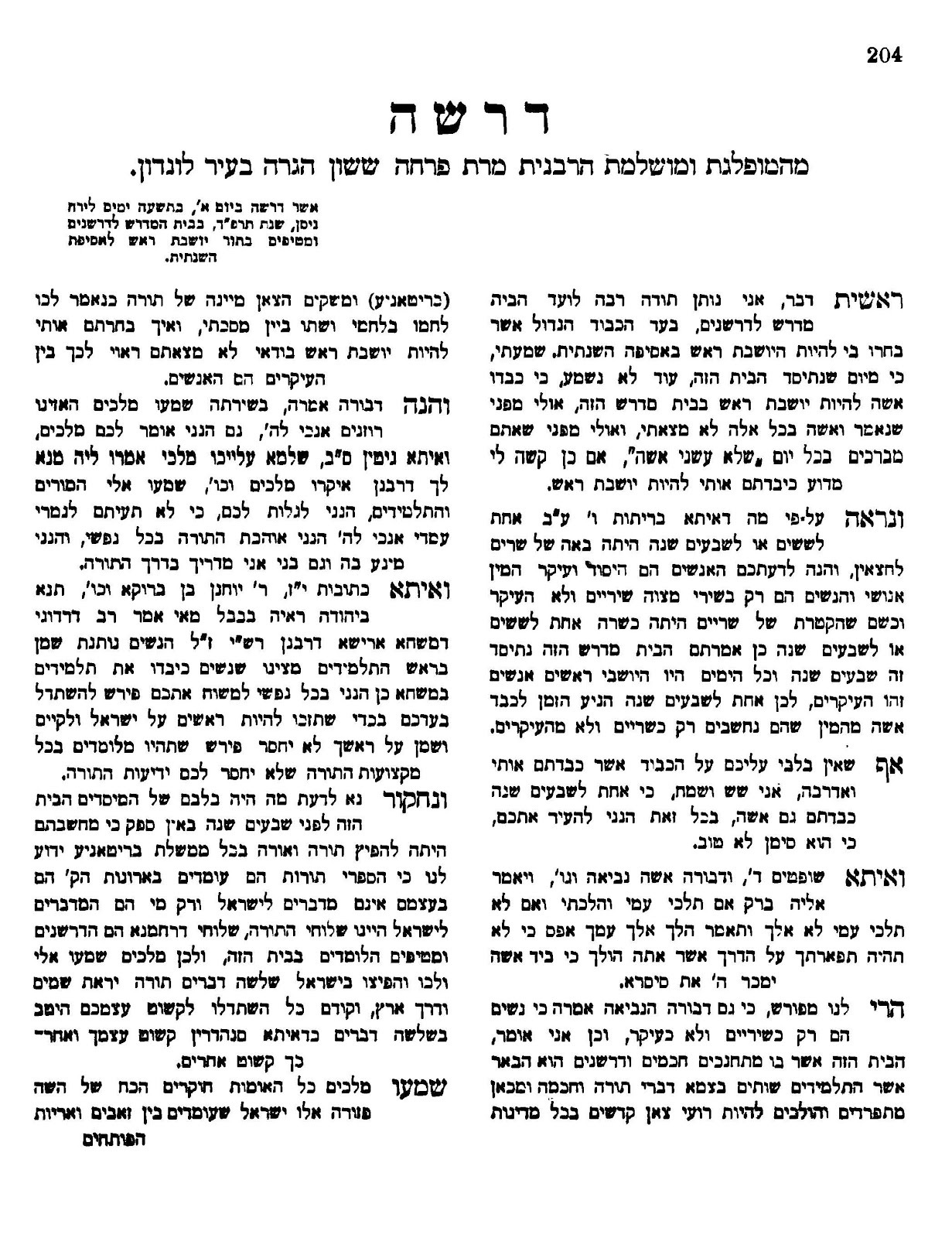
Flora Sassoon (1859-1936) was an extremely learned woman who lived too late to be included by the Hida.[12] In 2007 the Sassoon family published Nahalat Avot, which is a large collection of letters sent to the Sassoons by great Torah figures. Many of the Torah letters in this book were sent to Flora, and she is addressed in a number of them as “rabbanit”. Her husband held no rabbinic office and I think we can therefore conclude that the term “rabbanit” is being used as a title of respect for her knowledge.[13] Another example of this is seen in how she is introduced by R. Joel Herzog, who published a derashah she delivered in his Imrei Yoel, vol. 3, pp. 204-206. (Are there any other examples of a traditional sefer including something written by a woman?) Herzog too uses the term rabbanit as a title of respect.
Finally, with regard to women’s roles, let me call attention to what I think is a little known fact. Liberal Orthodoxy is very interested in finding ways to expand the opportunities for women to be involved in Jewish rituals. This encompasses everything from reading the Torah and leading Kabbalat Shabbat, to reciting sheva berakhot and reading the ketubah at a wedding. I haven’t yet seen any proposals to have a woman serve as a sandak. This would not be a new practice. R. Meir of Rothenburg writes that in his day in “most places” a woman sat in the synagogue and held the baby during circumcision.[14] In other words, this was the mainstream Ashkenazic minhag. R. Meir opposed this practice and made efforts to uproot it. This opposition was successful and is the background of R. Moses Isserles, Shulhan Arukh, Yoreh Deah 265:11, declaring that a woman cannot be a sandak, because it is peritzut.[15] Yet despite Rama’s comment, my experience is that this is the sort of judgment that the liberal Orthodox are quick to revise. Certainly, the Rama would assume that there is more peritzut in having a woman serve as a hazzan than in holding the baby during a circumcision. Yet for some reason, while the latter has become accepted on the left of Orthodoxy, I haven’t heard anyone speak about instituting female sandakot. (If there are places where women are indeed serving as sandakot, please leave a comment.)
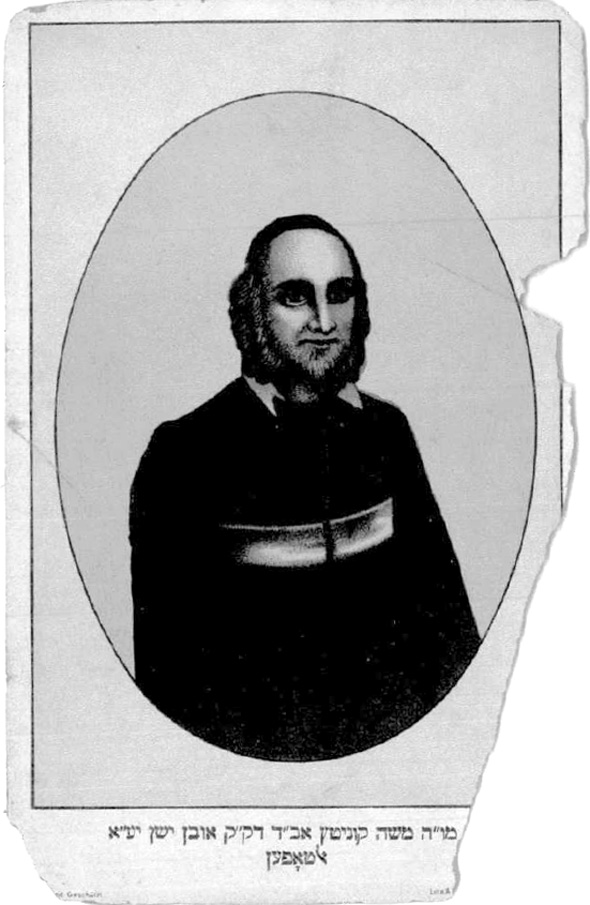
2. In an earlier post I discussed how R. Moses Kunitz’s biography of R. Judah the Prince was censored from a recent printing of the classic Vilna Mishnah. I also included a picture of Kunitz. Here is another, completely unknown, picture of Kunitz.
I found it in the Yeshiva University Archives, call no. 1992.008, and I thank the Archives for permission to publish it here.
In the earlier post dealing with Kunitz, I wrote:
Immediately following Kunitz’ essay, there is another article on the grammar of Mishnaic Hebrew by Solomon Loewisohn.[16] In the very first note he refers to the book of Ecclesiastes, and concludes his comment with והטעם ידוע למשכילי עם. What he is alluding to in this note is that Ecclesiastes is a late biblical book, and thus could not have been written by Solomon. To show this he points to the word חוץ, which in its usage in Ecclesiastes 2:25 is an Aramaism, and thus post-dates the biblical Hebrew of Solomon’s day. To use an expression of the Sages, we live in an olam hafukh. Kunitz’ essay was thought worthy of censorship, and at the same time this note remains in every printing of the Vilna edition of the Mishnah. Yet as I mentioned above, let’s see how long it is before this note, or even the complete essay, is also removed.
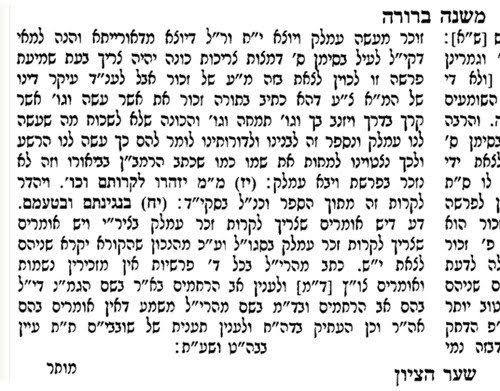
What I didn’t realize, and I thank an anonymous commenter for pointing out, is that this note has already been tampered with, and in such an ingenious fashion that there is now no need for it to be deleted. Here is how it appears in the Vilna Mishnah.[17]
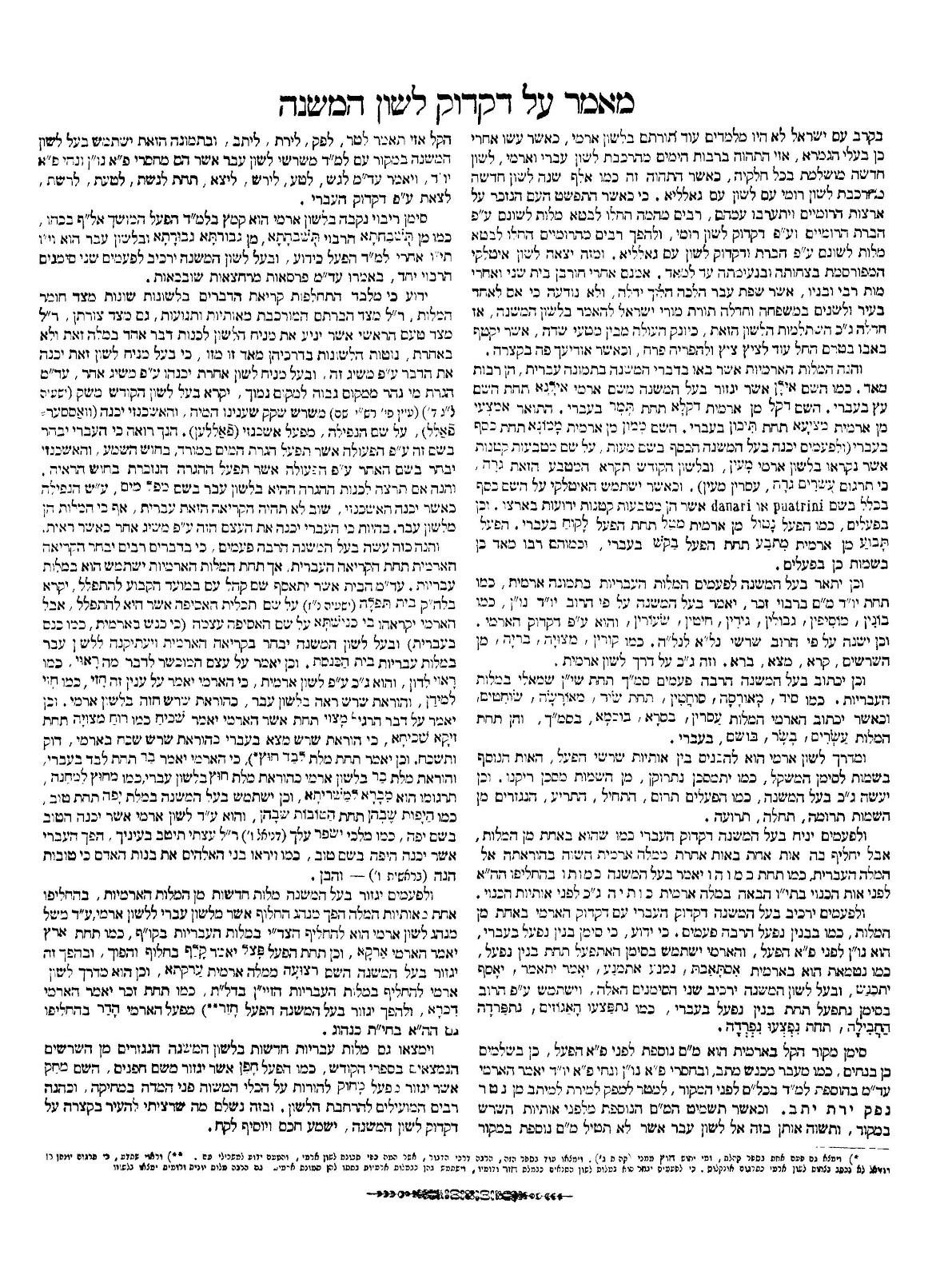
And here is the page in the 1999 Zekher Hanokh edition of the Mishnah, published by Wagshal (an edition which also deletes Kunitz’ introduction).
Now, instead of והטעם ידוע למשכילי עם, we have והדבר ידוע למשכילי עם. In the original, Loewisohn is telling the reader that the reason why there is an Aramaism in Ecclesiastes is known to the wise (i.e., the book is post-Solomonic), In the Zekher Hanokh edition all he is saying is that the existence of Aramaisms in Ecclesiastes is known to the wise, with no daring implication as to dating.
I also found something else of interest. Here is the last page of Kunitz’ essay on R. Judah the Prince.
Notice how he mentions Mendelssohn, Rabe’s German translation of the Mishnah, and how in his opinion R. Judah would be happy with such a translation.
This all sounds a little too “maskilish,” and here is what same page looks like as it appears on Otzar ha-Hokhmah.
Look at what has been removed. Is there really such an edition with the removed lines, or did Otzar ha-Hokhmah censor the material itself? (I will return to the censorship of Kunitz in the next post, as new information regarding this has recently come to light.)
There are other examples where I think it is Otzar ha-Hokhmah that is responsible for the censorship. Here is the title page of the book Va-Yakem Edut be-Yaakov (Prague, 1594) as it appears on Otzar ha-Hokhmah
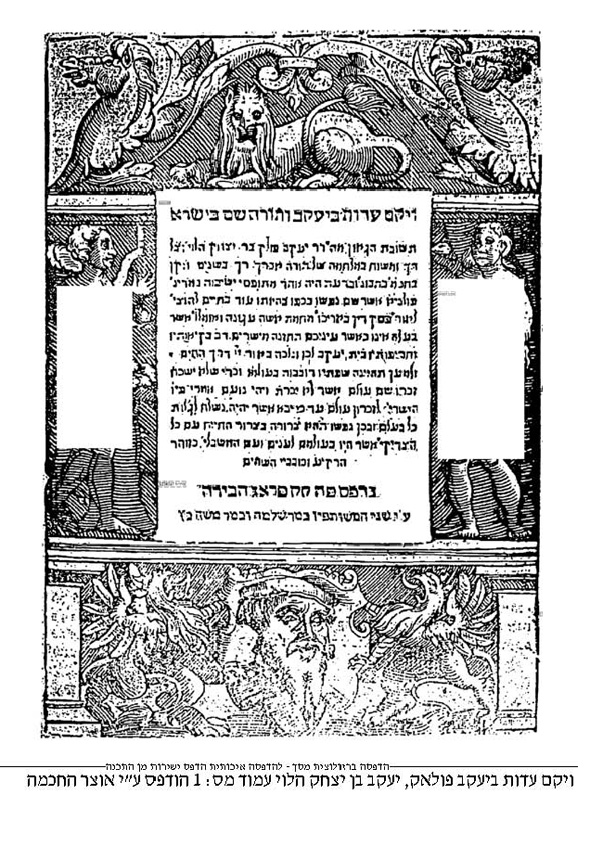
Here is the uncensored page, as is found on hebrewbooks.org
Incidentally, the title page of R. Yitzhak Chajes’ Derashah (Prague, 1589) used the exact same model.
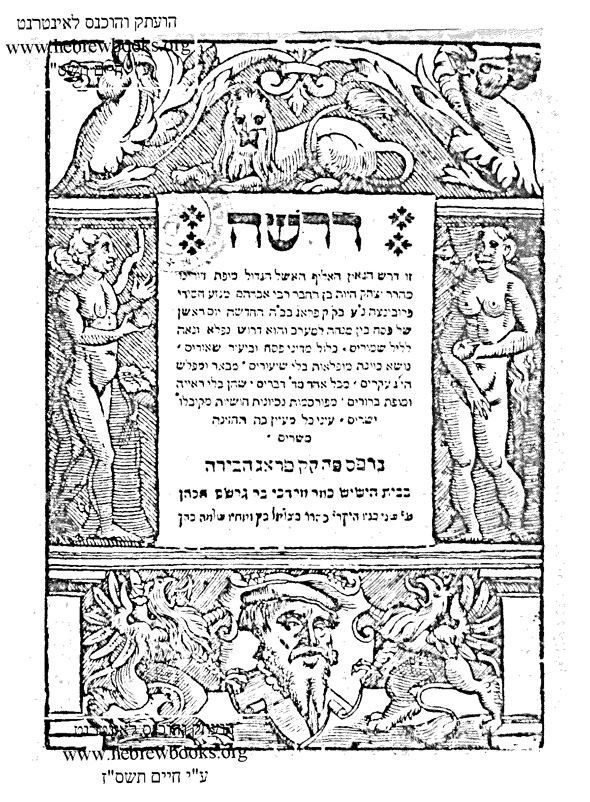
Dan already discussed the Chajes title page here and called attention to how an auction catalog ridiculously suggested, without any evidence whatsoever, that the non-Jewish workers of the Jewish publisher put this immodest picture in.
How were the workers able to get away with this? The catalog has the “religiously correct” answer: it was hol ha-moed and the owner was not around! Since a pious Jew would never have anything to do with such a picture, the non-Jewish workers must have used their own money to buy the plates for this engraving. And why would the non-Jewish workers have spent their own money doing something that would anger the owner and get them fired? It must be that they wanted to cause Jews trouble, which is what non-Jews are always interested in. Knowing that when the owner saw what they did he would never agree to sell a book with such a title page, the non-Jewish workers must have taken all the books from the printing press and, at their own expense, sent them out to all the book sellers. All this could happen without the owner being aware because it was hol ha-moed and during this time the owner of the press wouldn’t dream of dropping by his shop (so much did he trust his workers), just like today none of us know any religious Jews who would ever consider going to work on hol ha-moed.
The title page of Va-Yakem Edut be-Yaakov, published in Prague five years after Chajes’ Derashah appeared, shows us that the non-Jewish workers must have once more, on hol ha-moed of course, surreptitiously inserted the same picture as a title page for a different book. I think everyone has to wonder, why didn’t the publisher learn anything from the first time these non-Jewish trouble makers played around with a Jewish printing press?
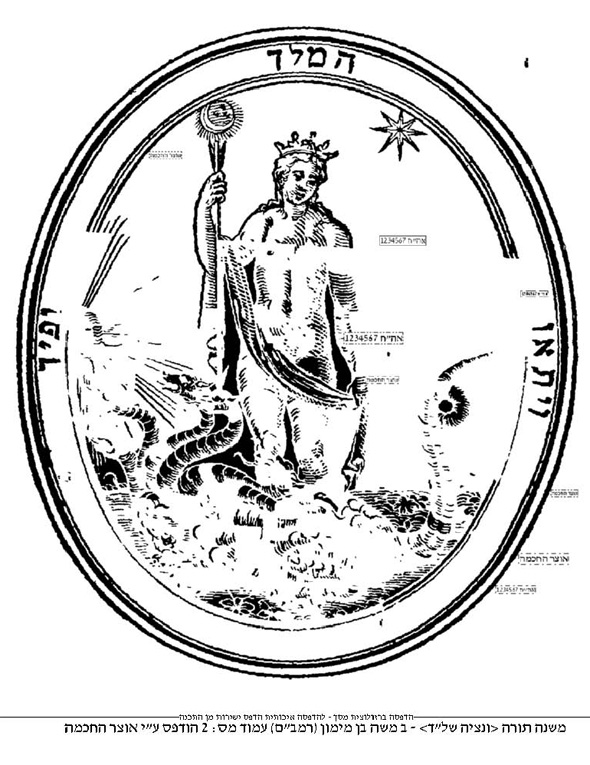
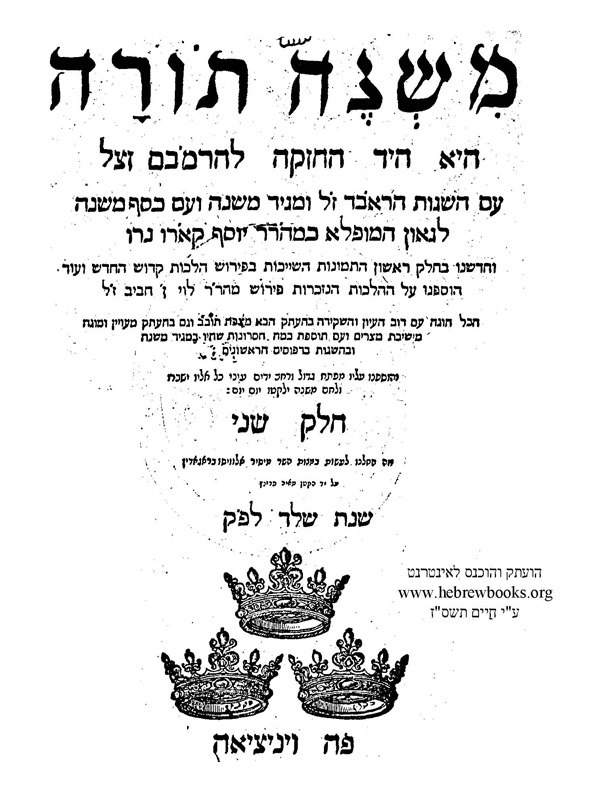
Another example of censorship on Otzar ha-Hokhmah is seen with the Venice 1574 edition of the Mishneh Torah. Here is the title page.
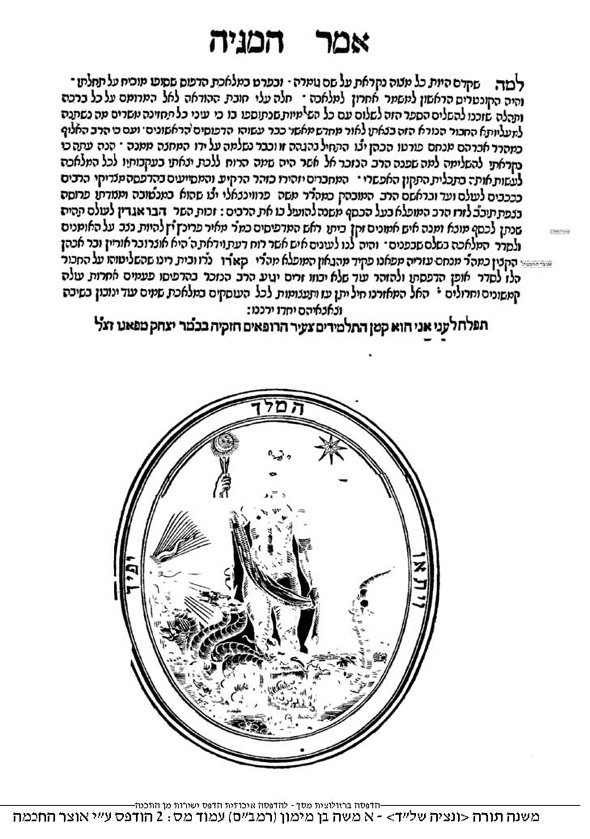
Here is how the second page looks, from volume 2 (as seen on hebrewbooks.org). The verse along the edges is from Psalm 45:12: “The king shall desire your beauty.”.
This edition was published in four volumes. In the copy on Otzar ha-Hokhmah, three of the four volumes contain the second page. Two of the pictures are significantly whited out, and in the second picture below you can see that they have whited out enough so that the reader will think he is looking at a man.
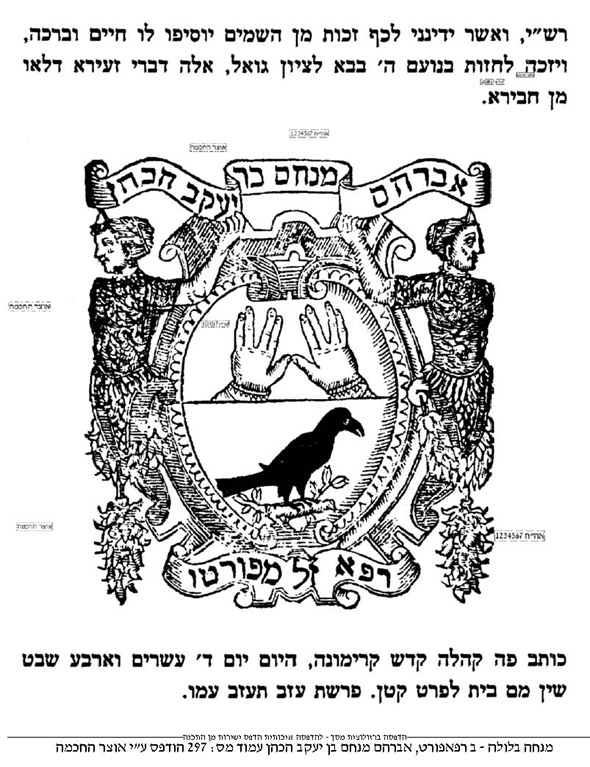
There are, to be sure, plenty of examples where the pictures appear without any censorship on Otzar ha-Hokhmah (and even with the examples I have given, it is not clear if Otzar ha-Hokhmah is responsible for the censorship or the book came to them this way). Here, for example, is the famous family crest of R. Abraham Menahem Rapa of Porto, which appears at the end of his Minhah Belulah.
S. has already pointed out that this picture was altered in a recent printing of the sefer.[18] Here is what the altered version looks like.
Michael Silber has noted that in Binyamin Shlomo Hamburger’s recent book Ha-Yeshiva be-Fiorda, the women have been turned into men, complete with beards![19]
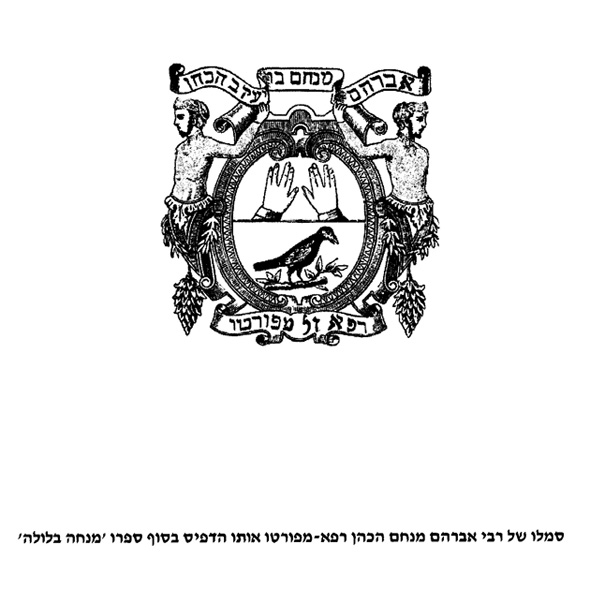
Here is what the Encyclopaedia Judaica, s.v. Rapoport, writes:
The name Rapa originated in the German Rabe (Rappe in Middle High German), i.e., a raven. In order to distinguish themselves from other members of the Rapa family, the members of this family added the name of the town of Porto, and thus the name Rapoport was formed . . . The family escutcheon of Abraham Rapa of Porto shows a raven surmounted by two hands raised in blessing (indicating the family’s priestly descent).
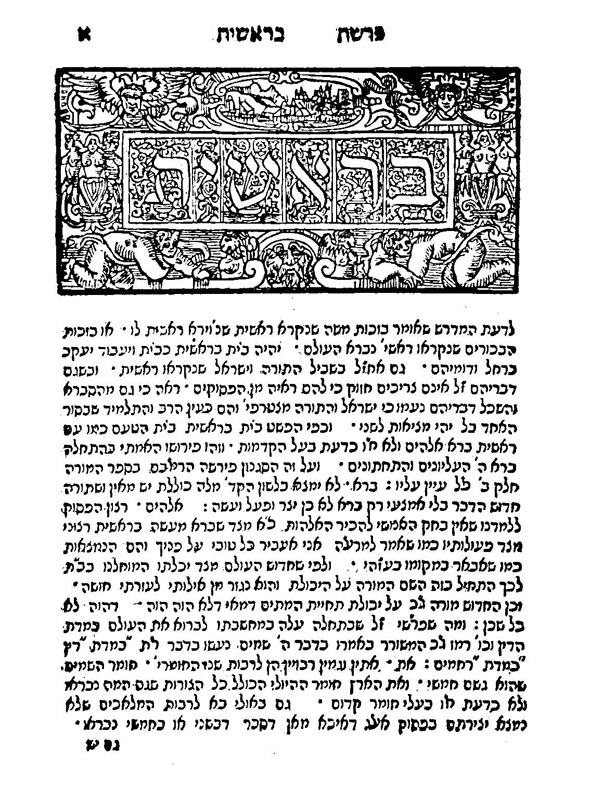
Regarding the sefer Minhah Belulah, at the beginning of each book of the Pentateuch the following “immodest” picture also appears.
As far as I know, hebrewbooks.org has not censored any of the books that appear on the site. (We have previously discussed books that it refuses to put up.) A few years ago the Reich collection of reprints was added to hebrewbooks.org and these have all sorts of interesting title pages. Here is the title page of R. Samuel ben David Ha-Levi’s Nahalat Shivah.
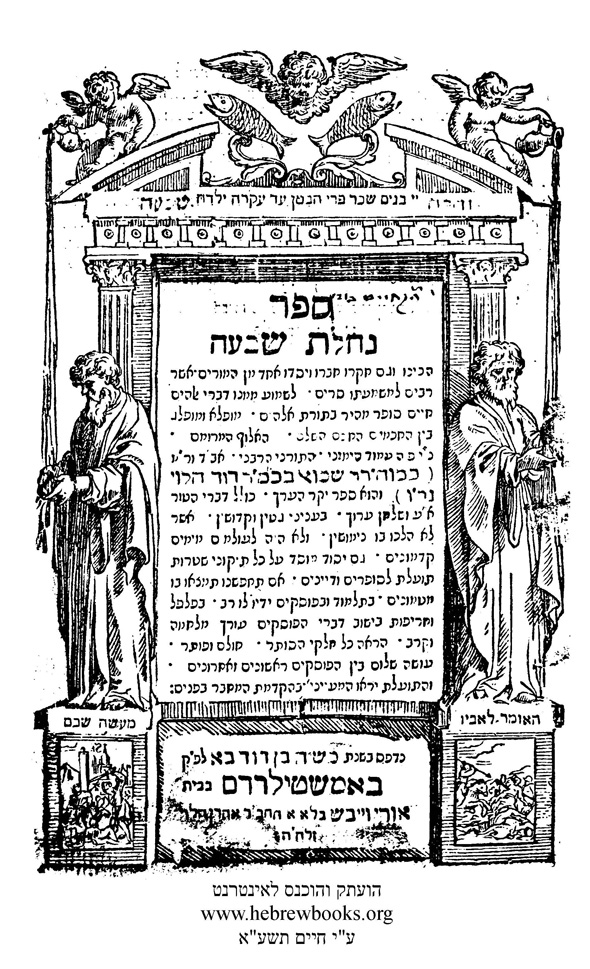
The year is expressed as משיח בן דוד בא. This adds up to 427 (i.e., 5427), and is an allusion towards Shabbetai Zvi. The year 5427 corresponded to 1666-1667, and the convention normally would be to write 1667 (and this is the date given in the Harvard catalog). However, in this case I assume it is more accurate to give the date as 1666. We know that Shabbetai Zvi converted on September 15, 1666. By 1667 this information would have reached Amsterdam and the title page would no longer refer to him as the Messiah. Therefore, I think we can conclude that the book appeared after Rosh ha-Shanah of 1666, but before January 1, 1667. Nevertheless, it is noteworthy that if you look at the end of the book there is a comment by the typesetter from which we see that, despite the date on the title page, the book was not actually ready for publication until the beginning of 1668. In other words, the title page was not changed in the interim, despite Shabbetai Zvi’s apostasy.
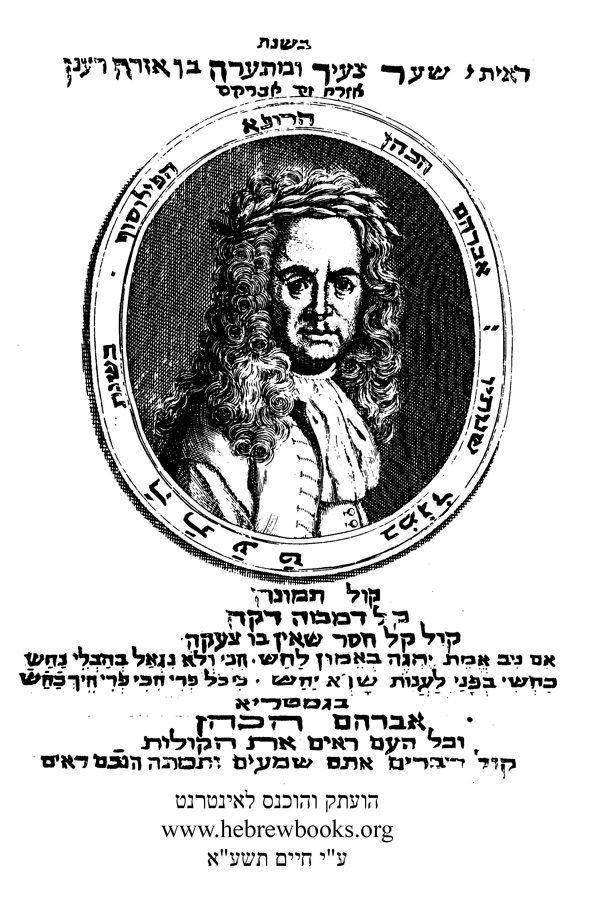
Among the Reich reprints, here is another fascinating title page (actually the first of two title pages in this book). It is from R. Abraham ben Shabbetai’s Kehunat Avraham (Venice 1719).
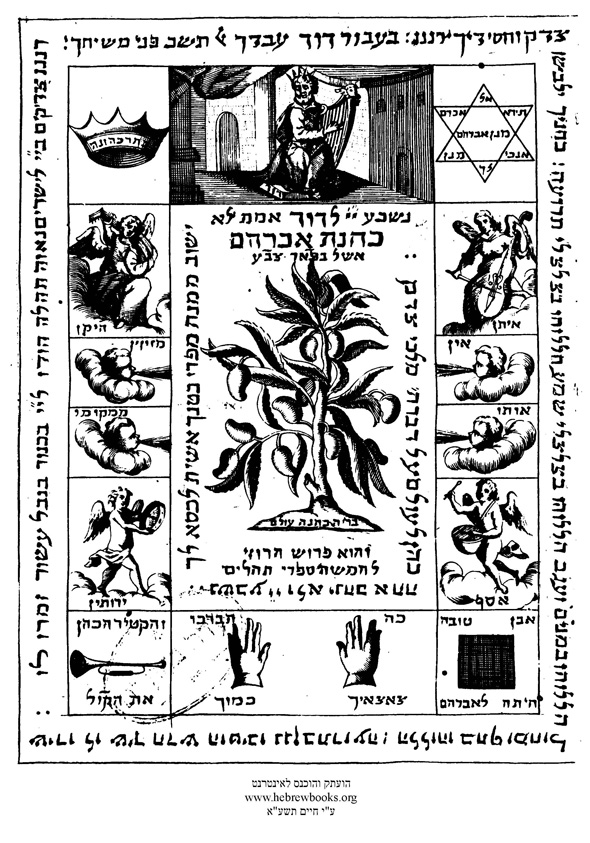
Here is the author’s picture, that appears on the second page. He clearly is wearing a wig.
3. In the previous post I mentioned something I was told by R. Avraham Yosef, the son of R. Ovadiah. He is the chief rabbi of Holon and while a great talmid hakham, unlike his brothers R. Yitzhak and R. David he has not published very much. Here is his picture.
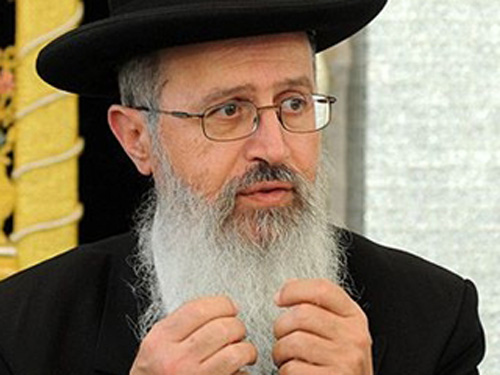
Like his father, R. Avraham is known for some controversial statements. He has also surprised people with his viewpoints. See here, for example, where he expressed his support for Livni becoming prime minister. I have found that he is very accessible and will answer any letter written to him. Since we are approaching Passover, let me share with readers the following.
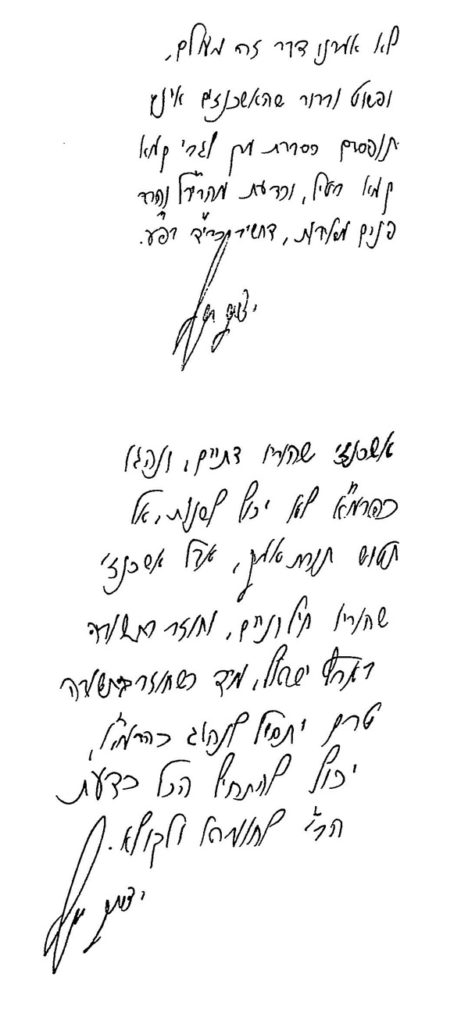
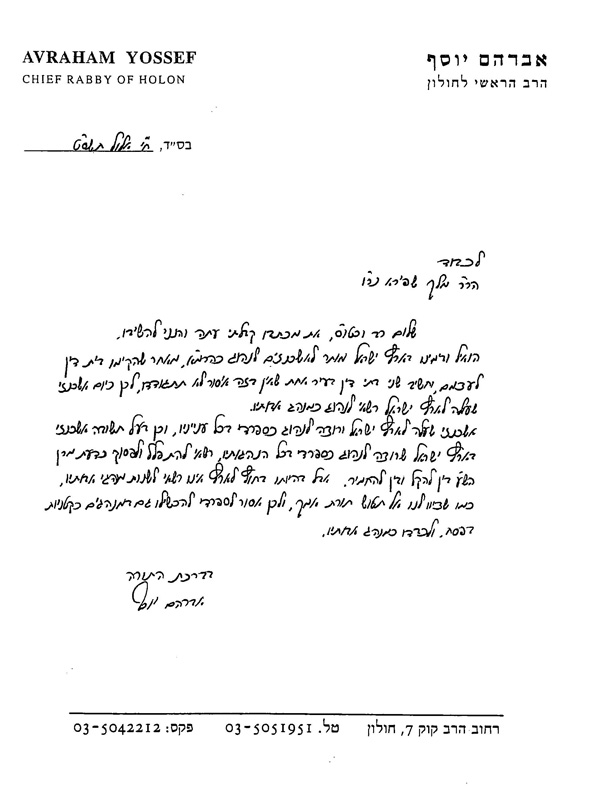
From reading the works of R. Ovadiah Yosef,[20] I have always assumed that in his opinion even Ashkenazim living in Israel are obligated to follow R. Joseph Karo. Despite what R. Yitzhak states in his letter published below, I haven’t seen any convincing explanation as to why the Moroccans and the Yemenites should be obligated in this according to R. Ovadiah, but not the Ashkenazim. And yet R. Ovadiah does not say so openly, perhaps to avoid involving himself in controversy. He also doesn’t say that Ashkenazim should keep their practices in the Land of Israel, except for one issue, namely, kitniyot, where he is explicit that Ashkenazim are obligated to follow their tradition.[21] However, based on my assumptions from reading R. Ovadiah, I assumed that the obligation of kitniyot in the Land of Israel only applied to those who identified as Ashkenazim. If, on the other hand, someone wanted to “convert,” as it were, to Sephardi practice, he would no longer be obligated in kitniyot.
To test my theory, I wrote to three of R. Ovadiah’s sons, R. David, R. Yitzhak, and R. Avraham, asking if it was permissible for an Ashkenazi to adopt Sephardi practices in all areas, meaning that he would no longer have to avoid kitniyot. R. David never replied, but I did receive replies from R. Yitzhak and R. Avraham. Readers might recall how R. David and R. Yitzhak differed about what blessing should be recited over Bamba, and each claimed to have the support of their father. In the kitniyot case as well there is a dispute. R. Yitzhak wrote to me that an Ashkenazi, even in Israel, is bound to his communal practices. The only exception is if he is a baal teshuvah., In this case, he hasn’t yet adopted the Ashkenazic practices, and he can therefore “become Sephardi”. Here is R. Yitzhak’s letter (it was one letter, with two signatures).
However, R. Avraham has a different perspective, believing that he too is properly representing his father’s outlook (and what he writes is what I also assumed based on my own reading of R. Ovadiah). According to R. Avraham, an Ashkenazi in Israel (and only in Israel) is permitted to become Sephardi, בין לטוב ובין למוטב. Here is R. Avraham’s letter.
4. Rabbi Moshe Shamah’s commentary on the Torah has recently appeared. At over one thousand pages, it is titled Recalling the Covenant: A Contemporary Commentary on the Five Books of the Torah. In a future post I hope to deal in more detail with one of Shamah’s essays, but in the meantime I wanted to let readers know about the book’s appearance. Many volumes of Torah commentary appear each year, usually written in the same style. Shamah’s book is different. The sources used and the questions asked will be eye-opening for many. It is not derush and does not psychoanalyze biblical figures. Rather, Shamah’s book is high level Torah scholarship in the tradition of the great peshat commentators, both medieval and modern,. I also found it interesting that the book contains a blurb from the noted biblical scholar Gary Anderson (as well from Yaakov Elman, Barry Eichler, and Jack Sasson).
Just as I was about to send in this post I also received Rabbi Nathaniel Helfgot’s just published Mikra and Meaning: Studies in Bible and Its Interpretation. This is a collection of essays on different themes in Tanakh and is a good example of the Modern Orthodox revolution in the study of Bible. Just as the Rav commented that that it would be impossible today to (successfully) teach Talmud to students who are secularly educated if not for R. Chaim’s approach, something similar can be said regarding Tanakh. For those with a secular education, who have read great books, it is very difficult to connect to Tanakh without the new approach that has been developed in the last forty years or so. As R. Yoel Bin Nun puts in his preface to Helfgot’s book: “It is impossible to study Tanakh in the land of Israel as if we are still residing in Eastern Europe prior to the Holocaust.”[22]
[1] There are, to be sure, opposing passages. See e.g., Bamidbar Rabbah 10:17, where it records that Manoah stated: והנשים אינם בנות הוראה. This text is cited by a number of halakhists to show that women are not to issue halakhic rulings. Both R. Hayyim Hirschensohn, Malki ba-Kodesh, vol. 4 p. 104 and R. Yissachar Tamar, Alei Tamar, Zeraim, p. 151, reject drawing any conclusions from the passage. Both of them claim that one can’t rely on what Manoah said, as he was an am ha-aretz (see Berakhot 61a: מנוח עם הארץ היה). This is an interesting point, but I wonder if it has any validity. It obviously depends on how one is supposed to read Midrash. On the one hand, Manoah may have been an am ha-aretz, but the sage who put this expression in his mouth was not, and neither was the redactor of the text, so perhaps Manoah’s statement should indeed be seen as a rabbinic position. On the other hand, since it was put in the mouth of an am ha’aretz, perhaps it should be regarded as simply that, namely, an uninformed opinion.
It is interesting that the well-known author, R. Aaron Hyman, responded to Hirschensohn in Malki ba-Kodesh, vol. 6, p. 204. He criticized Hirschensohn for writing as if he believed that because the Midrash quoted a statement of Manoah, that the historical Manoah actually said this:
ומה שמביא חתנו הלשון מבמ”ר נשים אינן בנות הוראה, ורוצה אדוני לתלות יען שמנוח ע”ה הי’ אומר דבר זה, חס מלהזכיר שיאמין כבודו שבאמת מנוח אמר דבר זה, האם אמרו חז”ל מדברי נביאות או בקבלה, הלא אך בדרך דרש אמר הדרשן כן וכן והוא דברי הדרשן הי’ מי שהי’ אבל מדרש הוא ואדם גדול קבצם, וכן ידוע כל השקלא וטריא שהיה בין קרח ומשה בענין טלית שכלה תכלת והאלמנה והכבשה, זהו אך מליצה נשגבה אבל לא שבאמת היה כן.
See Hirschensohn’s reply, ibid., p. 209, that his intent was only that the Midrash, בדרך דרש, attributed words to Manoah.
[2] Another irony is that the halakhic textbook written by the most distinguished of these yoatzot turns out to be more stringent, and requires consultation with rabbis more often, than halakhic texts written by men. See Aviad Stollman’s review of Deena R. Zimmerman’s A Lifetime Companion to the Laws of Jewish Family Life in Meorot 6 (2007), p. 5. I can’t imagine that women think that there is an advantage in having halakhic works written by other women if these works actually reduce female autonomy in intimate hilkhot niddah matters and require more consultation with male rabbis.
With regard to calling the women yoatzot and not poskot, Stollman, p. 8, n. 20, believes that “this is merely a tribute to Orthodox political correctness.” Maybe someone who knows the situation better than I can comment on Stollman’s point. That is, are these women really giving halakhic decisions and merely “covering” themselves by using the politically correct term yoatzot?
Regarding Stollman, I should point out that he is an academic scholar, and in addition to articles has published a critical edition and commentary of Eruvin, ch. 10, Ha-Motze Tefillin (Jerusalem, 2008). He has also published a volume of responsa, Pele Yoetz (Jerusalem, 2011). Responsum no. 45 is, I think, unique in responsa literature. Stollman was asked if it is permitted to create Santa Claus dolls that sing Jingle Bells. He rules that it is permissible. If I’m not mistaken, Stollman is the first one since R. Jehiel Jacob Weinberg to combine academic Talmud study with the writing of halakhic responsa.
Returning to yoatzot, I think many will find interesting that in Yemen and in some of the Sephardic world there was never a concept of asking a rabbi intimate niddah questions. This was because the women were embarrassed to do so, seeing it as “untzniusdik”. I mention this only because I have heard rabbis say that in truth there are no tzeniut issues with this, and women shouldn’t be embarrassed. They make it seem that it is only due to modern values that all of a sudden this sort of thing is uncomfortable for women. This is clearly not the case, as we see from what happened in the Yemenite and some of Sephardic worlds, hardly centers of modernity. (I am only speaking of the historical reality, not the wisdom of the Yemenite and Sephardic approaches, which usually meant that any doubt would be assumed to render the woman impure.) R. Yitzhak Shehebar, the Sephardic rav of Buenos Aires, writes as follows in his Yitzhak Yeranen, no. 95 (quoted in Beit Hillel, Tamuz 5769), p. 120:
ואשר לעניין מראות הדמים לא נהגנו בזה כלל, כי מעולם לא ראיתי להרבנים באר”צ [ארם צובה] שטפלו בזה, אך הנהיגו את הנשים שכל מראה הדומה למראית אדמומית שהוא טמא, זולתי אם יהיה כמראה לבן או ירוק שהוא טוהר.
Regarding Yemen, R. Yitzhak Ratsaby writes (Piskei Maharitz, vol. 3, section Be’erot Yitzhak, pp. 339-340):
אצלנו בק”ק תימן יע”א אין שואלין כלל לחכמים בעניין הכרת מראות הדמים, ובכל ספק הנשים מחזיקות עצמן טמאות ויושבות ז’ נקיים [ואפי’ לבעליהן נמנעות מלהראות כדי שלא יתגנו בעיניהן . . .] וכ”ה גם ברב ק”ק ספרדים יע”א . . . האידנא דהשאלה בדרך כלל היא רק לעיתים רחוקות, עי”ז נשתלשל הדבר שנמנעו מלשאול לגמרי מחמת בושתן היתירה וצניעותן המרובה כנודע
Ratsaby points out that this practice developed even though talmudic literature provides plenty of examples showing that in the days of the tannaim and amoraim the Sages did examine ketamim.
Regarding Yemen, see also R. Nachum Eliezer Rabinovitch, Siah Nahum, no. 60. In this responsum, Rabinovitch supports the institution of yoatzot and suggests that this practice, of turning to women in niddah matters, even existed in tannaitic times: כי לפנות לאשה חכמה אין חשש שמא תתגנה
In a note to this responsum, the editor provides further testimony about Yemen.
שמעתי עדות מחכם נאמן, שהיו מקומות בתימן בהם היו זקנות שהיו מוחזקות כבקיאות בעניני מראות, והנשים היו פונות אליהן, ומעולם לא ערער אדם על כך.
R. Moshe Maimon called my attention to the Meam Loez’s discussion of the laws of niddah, addressed to both men and women, and there is no mention there of bringing anything to the rabbi. This omission was rectified by R. Aryeh Kaplan, who in his translation (vol. 1, p. 136) adds: “When in doubt, a competent rabbi should be consulted.”
[3] Mishpetei Uziel, Hoshen Mishpat, no. 5.
[4] For sources on women deciding halakhic questions, see the three responsa in support of Sara Hurwitz’ being ordained as a “Maharat,” authored by Rabbis Yoel Bin-Nun, Daniel Sperber, and Joshua Maroof, available here.
[5] The Hafetz Hayyim, who was a “rabbi” if there ever was one, only received semikhah when he was 85 years old, and that was to satisfy a bureaucratic requirement. See Moshe Meir Yashar, He-Hafetz Hayyim (Tel Aviv, 1958), vol. 1, p. 19. According to R. Isaac Abarbanel, rabbinic ordination as currently practiced arose due to Christian influence. See Nahalat Avot, beginning of ch. 6:
אחרי בואי באיטאליאה מצאתי שנתפשט המנהג לסמוך אלו לאלו. וראיתי התחלתו בין האשכנזים כלם סומכים ונסמכים ורבנים. לא ידעתי מאין בא להם ההתר הזה אם לא שקנאו מדרכי הגוים העושים דוקטורי ויעשו גם הם.
[6] The title “rabbi” is indeed significant. This can be seen by the fact that when Sara Hurwitz was called Maharat there wasn’t any outcry, but when she was given the title “rabba” that is when the controversy really broke out, even though her job description didn’t change in the slightest. Does this mean that there was no objection to a woman functioning as a rabbi as long as she didn’t have the title? Only after she was renamed “rabba” did the RCA adopt a resolution rejecting the “recognition of women as members of the Orthodox rabbinate, regardless of the title.” Yet despite that resolution, there are synagogues where women are still serving, for all intents and purposes, as members of the rabbinate minus the title.
[7] Similar, though not identical, perspectives have recently been offered by Rabbis Norman Lamm, Michael Broyde and Shlomo Brody. See Broyde and Brody, “Orthodox Women Rabbis? Tentative Thoughts that Distinguish Between the Timely and the Timeless,” Hakirah 11 (Spring 2011), pp. 25-58. None of them reject the notion of Orthodox women rabbis at some time in the future. From speaking to many people, my own sense is that a majority of the Modern Orthodox community supports women rabbis (although not necessarily pulpit rabbis). When I say “support,” I mean if asked the question, the reply will be yes. But at the same time, the overwhelming majority of the Modern Orthodox world doesn’t care about this issue at all, and this includes women also. However, I believe that the minority will continue to push this issue, and when women rabbis become a reality, the Modern Orthodox will not reject these women or the congregations that employ them, as we can already see at present with Rabba Hurwitz and other female synagogue rabbis (in everything but name). I think this will happen before the natural development of female poskot who, as already indicated, will by definition be rabbis even without a formal ordination.
One more point that needs to be mentioned with regard to women rabbis is the issue of economic fairness. There are significant tax savings, due to parsonage, that an ordained clergyman receives from the government. While it is true that R. Michael Broyde has written that even women teaching Torah are eligible for this even under current tax laws (see here) and a prominent New York law has firm also expressed this opinion, many yeshiva day schools, acting under the advice of their accountants, have refused to adopt this policy. Some sort of formal ordination for women would settle the parsonage question, and give a financial boost to many of our underpaid teachers.
[8] There are, however, a number of very good articles on halakhah written by women. See e.g., Devorah Koren’s article in the recently published Milin Havivin 5 (2011), available here.
[9] Regarding Lieberman, I would like to call readers’ attention to what appears in the latest Yeshurun, vol. 25. On p. 21 the following footnote appears:
“How Much Greek in Jewish Palestine לגרסאות ופירוש תיבות אלה, ראה דברי הגר”ש ליברמן “
Here Lieberman is given the title due a gadol be-Yisrael. Perhaps this can be seen as making up for the censorship of references to Lieberman (and Louis Ginzberg) in an article by R. Mordechai Gifter that appeared in an earlier Yeshurun. See Saul Lieberman and the Orthodox, p. 32 n. 117. After my book appeared, I was informed by one of the editors of Yeshurun that the censorship of R. Gifter’s piece was carried out by the one who prepared the article for print, and the editors knew nothing about this and were upset when they learnt what had occurred.
On p. 632 of the new Yeshurun there is a letter from R. David Zvi Hillman to Prof. Shlomo Zalman Havlin in which he states the following: In the early volumes of the Encylopedia Talmudit Lieberman was referred to as ר”ש ליברמן, a point I noted in Saul Lieberman and the Orthodox. Yet American rabbis protested and insisted that he not be mentioned. These rabbis are identified with the Rabbinical Council of America: מהסתדרות הרבנים ר”ל המזרחניקים. In response to this, R. Zevin from that point on only mentioned the name of Lieberman’s books but not Lieberman himself. A Bar Ilan search reveals that vol. 13 is the last volume where ר”ש ליברמן is mentioned. (Vol. 15 was the last volume to appear in R. Zevin’s lifetime. See Zevin, Ishim ve-Shitot [Jerusalem, 2007], p. 40 [first pagination]).
Why would R. Zevin agree to this? The answer is obvious: money. The Mizrachi in America was an important source of funds for the Encyclopedia Talmudit.
[10] The term “rabbanit” was primarily used for the wife of a rabbi. See Robert Bonfil, Rabbis and Jewish Communities in Renaissance Italy, p. 77 n. 186. My point is only that it was also used for scholarly women.
[11] The continuation of the shiur is also of great interest, as he explains that if one ends up in a hotel on Shabbat and sees that the lights in the hall go one every time one leaves one’s room, it is still permissible to walk in the hallway and it is not even regarded as a pesik reisha.
[12] See the biography and picture of her here. For pictures of Flora and her family, see also here.
[13] Rivka bat Meir of Prague (died 1605) was another learned woman who was called “rabbanit”, see Frauke von Rohden, ed. Meneket Rivkah (Philadelphia, 2009), pp. 6-7. Rivka authored the Yiddish mussar work Meineket Rivka, published in Prague, 1609. On the title page she is referred to as הרבנית הדרשנית . (In the Altneuschul memorial book it also says that she preached. See Von Rohden, p. 6) Here is the first page of the book, where she is again referred to as “rabbanit”.
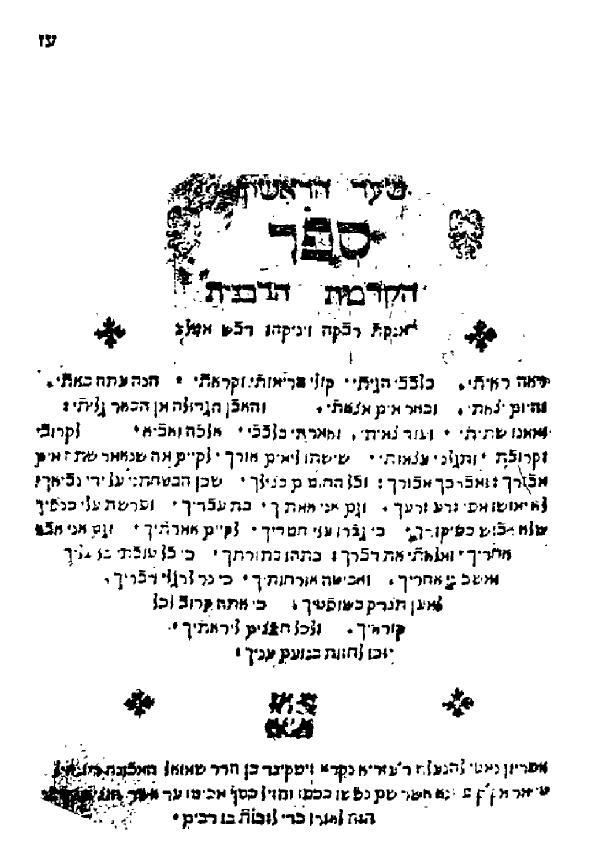
Lest anyone misunderstand, I must stress that Rivka only served as a rabbi and preacher for other women, and was therefore not a prototype for twenty-first century women rabbis. My point in referring to her is to highlight the use of the term “rabbanit” as designating a learned woman.
[14] Teshuvot Pesakim u-Minhagim, vol. 2, ed. Kahana, nos. 155-156.
[15] See Daniel Sperber, Minhagei Yisrael, vol. 1, pp. 65-66.
[16] I originally wrote Levinsohn, and thank a helpful reader for the correction. Loewisohn’s essay originally appeared in his posthumously published Mehkerei Lashon (Vilna, 1849).
[17] Incidentally, the note as it appears in the Vilna Mishnah has also been altered from what appears in the original work. In the original it states אשר אינם על טהרת לשון עבר, and in order that people understand what Loewisohn was saying, these words were altered to read: אשר המה כפי תכונת לשון הארמי
[18] See here.
[19] See here. As one of the commenters pointed out to this post, the women appear to be mermaids. He helpfully provided this link.
[20] For my essay on R. Ovadiah, see here.
[21] See Yabia Omer, vol. 5, Orah Hayyim no. 37, Yehaveh Da’at, vol. 1, no. 9, vol. 5 no. 32.
[22] R. Aharon Lichtenstein also has a preface to the book, where his ambivalence about the new approach comes through very clearly. This short essay deserves its own analysis.


Megillat Sefer Translation: A Review By Pini Dunner

Megillat Sefer Translation: A Review
By Pini Dunner

Rabbi Pini Dunner is a scion of one of Europe’s preeminent rabbinic families. He studied at various yeshivot and then graduated University College London with a degree in Jewish History. Best known as the founding rabbi of the trailblazing Saatchi Synagogue in London’s West End, he is also a prominent collector of, and expert on, antiquarian Hebrew books and manuscripts, and is frequently consulted by libraries, book dealers, and private collectors. In Summer 2011, Rabbi Dunner was appointed Mashgiach Ruchani of the prestigious YULA High School in Los Angeles, where he now resides with his wife and 6 children.

One of the most prolific rabbinic authors of the eighteenth-century, who saw many of his many written works published during his own lifetime, was Rabbi Jacob Emden (1697-1776). Rabbinic scholar and polemicist are probably the two most common descriptions used with reference to this enigmatic scholar. However neither description does justice to a man who was a unique polymath of distinguished descent, and who for many decades of the eighteenth-century was of considerable influence well beyond his own circle of friends and supporters.

R. Emden wrote and published novellae and responsa, the majority of which were original in their construction and in the topics they addressed. He wrote extensively, almost comprehensively, on the laws and customs relating to Jewish liturgy and the duty of prayer. He engaged in literary criticism and scientific enquiry in his published works in a way that sets him apart from his contemporaries, and this element of his output remains to this day remarkable in both originality and boldness. His polemics with crypto-Sabbateans – most famously with his nemesis Rabbi Jonathan Eybeschuetz – and with the purveyors or promoters of what R. Emden perceived as a threat to the integrity of Jewish tradition were unyielding in their vehemence, his words cutting like a knife through the humbug of his opponents. And yet, in other instances, R. Emden was a compromiser, open to change and ready to innovate, often in ways that left his contemporaries astounded, and leaves us to wonder what he was all about. All in all his publications reveal a man of many facets, whose brilliance and self-assuredness come across in every page, and whose long-term mark on the development of Judaism must have already been evident in his lifetime, but which remains equally evident to this day.

One book that was not published during R. Emden’s lifetime was his autobiography. Discovered in manuscript at the Bodleian Library in Oxford in the late nineteenth century, it appeared in print for the first time more than 120 years after his death, and then again, in a variant edition, some 80 years later. For those who may have been, or may be, intrigued by the unique personality of R. Emden, his autobiography is an absolute revelation. Candid and brutally honest, about himself as well as about his interlocutors, it opens a door into the life of this rabbi that no other rabbinic autobiography ever has for any other rabbi in history.

Until now, this memoir, entitled Megillat Sefer, has remained somewhat inaccessible to those who are unfamiliar with rabbinic Hebrew [or French – ed.] In particular, R. Emden was fond of using verses from the Bible, or quotes from the Talmud, to illustrate a point in his narrative, and those unfamiliar with either of these two sources in their original Hebrew or Aramaic would struggle with these references and not get the point, or might simply lose the thread of the narrative in question. In general the Hebrew used in Megillat Sefer was of an advanced vocabulary and style, written as it was by a master of Hebrew grammar. So when I heard last year that a translation of Megillat Sefer into English had been finally published I rushed out to get it as soon as I could. The translation project was originally undertaken by Rabbi Dr. Sidney Leperer (1923-1996), Professor of History and Talmud at Jews’ College in London, and following his death, carried forward by his devoted student Rabbi Dr. Meir Wise of London. The book itself is a one-off vanity publication and, sadly, it falls very short of being a useful contribution to the range of academic literature relating to R. Jacob Emden. (It may be purchased in soft-cover here, or hard-cover here – ed.).

The style of the translation is somewhat stiff, in places almost unreadable. Leperer and Wise – who it is asserted used the original Oxford manuscript as the basis for the translation – chose, it would seem, to stick as closely as possible to the original Hebrew when rendering the narrative into English. This does not serve the narrative well, although the narrative, it has to be said, is absorbing enough to overcome any such impediment, except perhaps to the most casual of readers. Each biblical or talmudic reference cited by the author is identified by the translators in brackets within the text of the narrative, and the translators also chose to transliterate all the Hebrew quoted by Emden into English characters. There is very little by way of introduction, and only the first 3 chapters (of 12, and it should be noted that the final 9 chapters consist of 85% of the total autobiography) have endnotes, and these are not very detailed or deeply researched. The publisher’s introduction (penned by Rabbi Wise?) notes that ‘due to its inherent incompleteness this translation is not intended to be an exhaustive academic work, and readers are encouraged to consult other sources for further research on Rabbi Emden and his life’ (p5). Later on he adds: ‘In this edition, no indexes of sources, places and people appears. Readers are encouraged to consult the Bick edition for such information. While a glossary is included in [sic.] the end of the work which explains some of the terminology, it is not intended to be an exhaustive reference’ (p7).

There are too many petty errors in the translation narrative and annotations to cite in a short review such as this, many of them resulting from the choice made by the translators of which transcript to use, about which more below. It would be a pity however not to share some of them, just so that readers of this review can get some sense of the sloppiness of this work. Some typical misreadings include the following:

p. 30, 6 lines from bottom: Uban [read: Ofen] [Strangely, the translator got it right on p. 35, l. 4.]

p. 34, last paragraph, l. 5: The Gaon Ba’al Sha’ar Ephraim [Actually, the reference is to R. Heschel]

p. 41, l. 3: Rabbi Yaakov Reischer [Actually, the reference is to R. Wolf, Av Bet Din of Bohemia]

p. 51, 3 lines from bottom: a certain R… who could [This is censorship in 2011. The original reads: R. Ber Cohen.

p. 60: line 5: Rabbi M. Bron [The Hebrew should be deciphered : R. Mendel ben R. Natan]

p. 92, last line: Rabbi Wolfe Merles [read: Mirels].

p. 107, l. 10: who then presided over… [The Hebrew reads: who now presides over]

p. 114 , 9 lines from bottom: Israel Pirshut [read: Israel Furst]

p. 161, 10 line from bottom: Popros [read: Poppers]

p. 165, l. 15: My eldest son, Shai [ Here, according to the translation, R. Yaakov Emden’s eldest son was called Shai. Actually, R. Yaakov Emden’s eldest son was R. Meir, later rabbi of Konstantin. Indeed, R. Yaakov Emden never had a son named Shai. The translator read the abbreviated form of שיחיה as the name Shai !

What a pity that a work of such significance was published before it had been properly completed. What a disservice to Rabbi Leperer’s memory! This distinguished teacher, who spent decades turning British novice rabbis into professional, scholarly rabbinic leaders, has seen his life’s work turned into an incomplete, poorly edited book which, since it was not published by an international academic publisher (understandably!), is destined to complete obscurity and irrelevance.

As if this is not enough of an indignity, the transcript of the original memoir used as the foundation for the translation is so flawed, that no scholar of Emden takes it seriously. In the introduction (p.6) the publisher/translator informs the reader that: ‘….the [Bodleian] manuscript was used as a primary source for the translation, with the Bick edition used as a secondary. The Kahana edition was used for comparison purposes only, due to its inherent unreliability’. In a footnote the publisher/translator adds that in the introduction to the Bick edition ‘multiple examples are cited of how the Kahana edition embellished certain matters, omitted others and made up some as well’.

The claim that the original Bodleian manuscript was used is too ridiculous to refute, as it is patently untrue. Clearly the source for this translation is the Bick edition. This decision to rely on the Bick edition of Megillat Sefer, on the basis of Bick’s introduction to his version, is so puzzling as to put into question the depth, if any, of Rabbi Wise’s (and Rabbi Leperer’s?) knowledge of contemporary academic research and opinion regarding Rabbi Emden, and in particular his autobiography.

The most noted contemporary expert on the life of Rabbi Jacob Emden is undoubtedly Rabbi Jacob J. Schacter, whose Harvard PhD dissertation was entitled ‘Rabbi Jacob Emden: Life and Major Works’, and is about as comprehensive a treatment of Rabbi Emden’s life as has ever been written. Furthermore, he is in the process of preparing a full-blown academic, critical treatment of Megillat Sefer, to be published by Merkaz Zalman Shazar in Jerusalem, based on years of research and a comprehensive knowledge of everything ever written by and about his protagonist.

In the late 1990s, Schacter wrote an article for the jubilee festschrift honouring his teacher Yosef Hayim Yerushalmi (1932-2009), entitled “History and Memory of Self: The Autobiography of Rabbi Jacob Emden.” The article quotes from and refers liberally throughout to Megillat Sefer, as might be expected, and in a footnote comments as follows:

“Throughout this essay, I refer to the Warsaw, 1896, edition of Megillat Sefer edited by David Kahane even though it is not a fully accurate transcription of the [Bodleian] manuscript (which itself is only a copy of the original). Acknowledging and claiming to correct some of the mistakes to the Kahane edition, Abraham Bick-Shauli reprinted Megillat Sefer in Jerusalem, 1979, but his version is much worse than Kahane’s. He recklessly and irresponsibly added to or deleted from the text, switched its order, and was generally inexcusably sloppy. As a result, his edition is absolutely and totally worthless.”

In a much more recent article, “Sefer Megillat Sefer,” penned by Rabbi Menachem Mendel Goldstein of Kiryas Joel for the Etz Hayim journal published by the Bobov Hasidim, the same sentiment of disdain for Bick’s edition is expressed, this time in the main text of the article:

‘In the year 5657 (1896) the book [Megillat Sefer] was published in full for the first time in Warsaw by David Kahane, based on the aforementioned [Bodleian] manuscript. He [Kahane] omitted anything that he believed appeared twice in R. Emden’s text, [in terms of] narrative text and subjects, as he explained in his introduction: “I found it necessary to omit any repetition so that his [R. Emden’s] words should not be burdensome for the reader, and I have indicated any such omission in the body of the narrative text itself.” Notwithstanding this admission, his work is defective through [both] inclusion and omission. The latest version is that of Bick-Shauli, the last person to publish the book [Megillat Sefer] (Jerusalem, 5739), who besides for including all the errors of David Kahane[’s edition], added insult to injury and was fraudulent in his work, brazenly including things which do not appear at all in the [Bodleian] manuscript, and it is therefore not possible to rely on this edition at all.’

Another contemporary scholar who has written extensively on the Emden-Eybeschuetz controversy is the frequent contributor to the Seforim Blog, Professor Shnayer Z. Leiman. When he was shown the introduction to this new translation of Megillat Sefer by the editors of the Seforim Blog he responded by email as follows:

“Alas, the pages you sent suffice to indicate that the editors did not act wisely. Bik’s edition is an unmitigated disaster. He inserted materials that appear nowhere in the one extant manuscript, and skewed the remainder of the text beyond repair. Kahana’s edition is infinitely superior, though not without error. If anything, the editors should have relied only on the manuscript, and when in doubt, consulted Kahana. Relying on Bik is like relying on R. Shlomo Yehuda Friedlander for establishing the correct text of a Yerushalmi passage, or like asking R. Yaakov Emden for a letter of recommendation on behalf of R. Yonasan Eibeshuetz. Why didn’t the editors consult someone who knows something about Megillat Sefer, like Jacob J. Schacter?”

A very good question indeed, and one that is more rhetorical than worthy of further investigation or discussion.

Finally, this month, a new edition of Megillat Sefer has been published in the original Hebrew, with extensive annotations by the noted Emden scholar, R. Avraham Yakov Bombach. He is scathing about the Bick edition, about which he writes (p.3, my translation from the Hebrew):

“In [1979] a new edition of Megillat Sefer was published in Jerusalem by R. Abraham Bick-Shauli….This edition is absolutely terrible. It contains numerous omissions and errors. Not only was he sloppy in transcribing the original manuscript, but he also added pieces from his own imagination as if they were written by [Emden].”

Despite these considerable – and frankly unforgivable! – drawbacks, the new translation is a nonetheless interesting addition to the copious published literature concerning R. Emden. As a result of the publisher’s desire for the book to be taken seriously as a full translation, he has deliberately not edited out any embarrassing passages. Incidents which could be deemed controversial by the familiar array of orthodox propagandists and publicists, and perhaps even rather unseemly to those less inclined to hagiography as a literary desideratum, are candidly recounted through this translation into the English vernacular, and are not airbrushed out of the narrative as they might have been in other hands. Countless references to R. Emden’s personal health and unflattering illnesses appear in the text (e.g. p. 123), as does the episode of his unfulfilled marriage hopes to the daughter of a German lay leader known as R. Leib of Emden, following his father’s unequivocal rejection of the match (pp.125-126).

The notorious episode in the narrative where R. Emden overcame his passion for a female cousin appears in full (pp. 162-163), an excerpt of which reads as follows:

‘In Prague I experienced a challenge similar to that of the (Biblical) saintly Joseph, in fact mine was somewhat more challenging. I was then a passionate young individual who had been separated from his spouse for a considerable period. I therefore longed for female company which I had the opportunity of fulfilling in the person of a lovely young lady viz. my cousin, who kept me company and who was audacious enough to evince a special affection for me, in fact she almost embraced me. Indeed when I was resting in my bed she came to see if I was well covered, in other words, she wanted me to embrace her. Had I yielded to my baser instinct she would not have denied me anything. On several occasions I almost succumbed, just as a flame is attracted to stubble, but the Almighty granted me strong willpower as well as an abundance of dignity and courage (cf.Gen.49:3) to prevail over my burning passion.’

The translation retains in vivid detail every episode recorded in the original Hebrew, with R. Emden’s numerous business tribulations, petty disputes, strong opinions and blunt observations presented to us in his own words, through the English rendition. His own personal account of the initial stages of his dispute with R. Eybeschuetz are here, as well as his critical comments regarding R. Ezekiel Katzenellenbogen, author of Knesset Yehezkel and the rabbi of the Triple Community (Altona-Hamburg-Wandsbeck), along with a critique of his fellow-campaigner against crypto-Sabbatean, R. Moses Hagiz.

Take this example of his strident views with reference to R. Katzenellenbogen (p.241):

‘What can one say about R. Ezekiel’s novellae, his interpretations of texts and his sermons? (Except) that they were objects of derision. Even if one were told about them one would hardly believe the foolish statements, the inane observations and ideas that provoked excessive laughter from all who listened to them.’

And this about his father’s erstwhile friend and primary supporter in the infamous Nehemiah Hayun episode of 1713, R. Moshe Hagiz (p.212):

‘His excessive prattling in synagogue also annoyed me for this amounted to a profanation of God in the presence of the general congregation. Much worse was his neglect of praying with a minyan on six days of the week and, this despite the pressing requests of his Shabbat and Yom Tov minyan to meet (for prayer) during the rest of the week.’

These vignettes make the new translation a refreshing read for those English readers interested in a candid account of eighteenth century Jewish life. Perhaps for this reason, and this reason alone, R. Wise can be commended for bringing this work to press. No doubt he overcame many hurdles to see the publishing project to fruition and despite its uselessness as an academic work, or as a fitting tribute to Rabbi Leperer, this book has at least some limited value as an access point for anyone who is curious to gain insight into the life story of R. Jacob Emden, but for whom the Hebrew original is too difficult a read. Through this translation, with all its flaws, you will learn something about the life of R. Jacob Emden, and how he perceived the world around him and those with whom he came into contact and conflict.

[I offer special thanks to Professor Shnayer Z. Leiman and Mr. Menachem Butler for their assistance in preparation of this review essay. P.D.]


The Pesach Drasha of the Rokeach

The Pesach Drasha of the Rokeach
by Eliezer Brodt
By way of introduction, in the Shulchan Aruch it is written that thirty days before Pesach one should learn the halachos of Pesach. As Pesach is fast approaching, it is appropriate to discuss anew a post from five years ago, of which this is an update.
Every once in a while we are privileged to have the venerable printing house Mekizei Nirdamim release something special from the great rishonim (aside from their great journal Kovetz Al Yad).[1] Five years ago they published a critical edition of a Pesach Drasha of R. Eliezer Rokeach of Worms for the first time, edited by Professor Simcha Emanuel. In this post I would like to discuss some of the many things of interest in the work and also comment in general on the great job of Simcha Emanuel did with this work.
One of the reasons why I am updating this post is I was just told by Mekezei Nirdamim that they only have a few remaining copies and it will not be reprinted. I am selling copies for $16, while supplies last. For more information feel free to contact me at eliezerbrodt@gmail.com.
Part of the proceeds of this sale will be going to help support the efforts of the Seforim Blog.
This drasha seems to have been an actual drasha that the Rokeach delivered, although it is pretty obvious from the length that it was not said at one time but probably a compilation of a few derashos recited at different times. The style is mostly halacha, with a bit of aggadah in the beginning and also scattered throughout. He goes through many halachos of Pesach starting with kashering the utensils, getting rid of the chametz, and baking the matzos. He then continues on at great length to discuss all the aspects of the Seder. Then he deals with what to do if one finds chametz on Pesach and he ends with some halachos of Yom Tov in general.
I would like to mention some of the interesting points found in the actual drasha. First, the Rokeach records that his family custom was when they burned the chametz they would do so with the lulavim and hoshanos which they had saved from Sukkos (p.79). [2] While talking about the minhag to bake matzos Erev Yom Tov he writes that one should not bake the matzos for the second night until the second night itself, because of chavivah mitzvah bi’shaatah (p. 92). [3] He states that one should go to the Mikvah before Yom Tov. [4]
The Rokeach writes that if the Yom Tov falls out on Shabbos we do not smell hadassim for besamim on Motzei Shabbos, because there is no loss of the extra soul, as the soul remains for the duration of Yom Tov. (p. 93).[4a] In a note Professor Emanuel points out that others disagree with this point and hold that one does in fact make a blessing on the besamim when Saturday night is still Yom Tov. While talking about the washing for karpas he writes that one should make ‘al nitelas yadaim (p. 96), whereas today we do not. [5] He then goes on to say that we eat a full kezayis for karpas, which is something we also do not do – we purposely eat less than a kezayis. [6] (p. 97, 152). He notes his family minhag was to hold the cup of wine during the recitation of vehi she’amdah (p. 99 and p. 126) [7], the common custom today.
He describes how his family poured out the wine when they said the ten Makkot (p. 101, see also, p. 127). The importance of this last custom is that until the publication of this drasha, although many have recorded this custom in the name of the Rokeach, it appeared in none of his writings (as I plan on discussing at length in a forthcoming article). In regard to washing mayim acharonim at the seder, although others argue he writes one should wash (p. 106). [8]
In addition to all this Professor Emanuel has included extensive notes and comments throughout the drasha, which are excellent. These provide additional sources for various things mentioned in the drasha, also including interesting sources from unpublished manuscripts.
To list some of the topics that he deals with in the notes: Making matzos with pictures on them (pp. 129-134), about the nussach of the Haggdaah that some said רבון עלומים וכו after ביד חזקה (pp. 53- 57) [9], and reasons for the prohibition of kitniyos (p. 51).[10]
One very interesting thing which Emanuel points out is the difference about how a name is spelled in various manuscripts. Specifically, whether the Rokeach’s father-in-law was Eliezer or Elazar. If it was Elazar than it turns out that the Rokeach, whose first name was also Elazar, apparently ignored the will of his teacher, Rebbi Yehuda ha-Hassid – who disallows such marriages in his famous Tzavaah. Although, most likely, the Rokeach was married even prior to coming in contact with Rebbi Yehuda ha-Hassid, his practice demonstrates that people, prior to Rebbi Yehuda ha-Hassid’s pronouncement did not observe or even know of this custom. (pp. 57- 59). Emanuel than brings early evidence that part of the Tzavaah were strictly for the family.[11]
In this work we find an early source not related to Pesach but to Shavous – such as to eat Milchigs (p. 39, 110). [12]
Aside from this small work (152 pp.) containing this very important drasha of the Rokeach it also includes many important pieces of information in regard to the Rokeach in general and especially to two works of his that were unknown. There is a lengthy discussion about a sefer of the Rokeach on shechitah and treifos as well as another sefer – Sefer Ma’aseh Rokeach.
[1] For more information on this special, 150-year old publishing house, see the pamphlet printed by them in 1964, called Chevrat Mekizei Nirdamim.
[2] For further on this custom see Sefer HaMaskil pp. 33-34; the important comment of R. Honig in Yerushaseinu 1 (2007), pp. 208-209; Sefer Kushiyos pp. 168-169 and the notes therein; D. Sperber, Minhagei Yisrael, vol. 2 p. 193. See also what I wrote in Yerushaseinu 2 (2008), p. 219.
[3] For general sources on baking Matzos on Erev Pesach see Rabbi. G. Oberlander, Minhag Avoseinu Beyadeinu, pp. 327-255.
[4] For a very detailed discussion of this topic see my Bein Kesseh Le-assur, pp.48-96.
[4a] See; Shmuel and Zev Safrai, Haggadas Chazal, pp.54-55.
[5] See; Haggadah Shevivei Eish, p. 152; Y. Tabory, Pesach Dorot, pp. 216- 244. See also what I wrote in my Bein Kesseh Le-assur, p. 152.
[6] See; Y. Tabory, Pesach Dorot, pp. 264-265.
[7] See; Haggadah Shevivei Eish p. 109.
[8] See; Tabory, ibid, p. 244-249.
[9] See; Pirush Meyuchas le-Rashi in the Torat Hayyim Haggadah, p. 110; Shmuel and Zev Safrai, Haggadas Chazal, pp. 84-85; Simcha Emanuel, “‘When God Descended to Egypt’: The Story of a Passage in the Passover Haggadah,” Tarbiz 77:1 (2008): 109-132 (Hebrew).
[10] See; Y. Ta-Shma, “Prohibition of Kitniyot on Pesach,” Early Franco-German Ritual and Custom (Jerusalem: Hebrew University Magnes Press, 1992), pp.271-282 (Hebrew); Rabbi. G. Oberlander, Minhag Avoseinu Beyadeinu, pp. 410-438.
[11] On all this see also my Likutei Eliezer, pp. 51-53.
[12] See; Rabbi. G. Oberlander, Minhag Avoseinu Beyadeinu, pp.623-647. I hope to return to this topic shortly.


Purim roundup

Since Purim is almost upon us, here are some older Seforim Blog posts dealing with Purim themes (arranged chronologically):
Purim, Mixed Dancing and Kill Joys (3.06.2006); Mahar”i Mintz permitted cross dressing and mixed dancing on Purim. Also discussed are other rabbinic reactions to Purim merrymaking.
Review of Reckless Rites by Elliott Horowitz (4.07.2006). This controversial book subtitled “Purim and the Legacy of Jewish Violence” discusses incidents of Jewish violence toward non-Jews on Purim and the way Jewish historians sometimes downplayed these incidents.
Tussle Over Horowitz’s Book (10.11.2006) discusses the resulting fallout of this book, whose thesis was disliked by Hillel Halkin in Commentary.
The Origins of Hamentashen in Jewish Literature: A Historical-Culinary Survey (2.28.2007), a classic post by Eliezer Brodt on this relatively recent Jewish custom.
Judah Wistinetzky and Mishloach Manot to his American friends (3.02.2007); Menachem Butler points out a post by Ari Kinsberg about a sefer distributed as a mishloach manot gift to the author’s friends.
Purim and Parodies (3.17.2008) by Eliezer Brodt. Eliezer discusses everything from a humorous Purim piyut included in Mahzor Vitry, to Kalonymus ben Kalonymus’s Massekhet Purim to the very rare Sefer Ha-kundas, a 19th century parody of the laws of trouble-making in the style of the Shulhan Aruch.
The Origins of Hamentashen in Jewish Literature: A Historical-Culinary Survey Revisited by Eliezer Brodt (3.18.2008). Eliezer revisits his post, updated with many additions and corrections.
“‘Most of all you’ve got to hide it from the kids…’ Reading Esther before Bed” by Elliott Horowitz (2.25.2010). This post discusses bible tales adopted for children in softened form.
The Origin of Ta’anit Esther by Mitchell First (3.3.2011). In this recent post, it is argued that this fast’s origin is even later than the original She’iltot (8th century).
***
Also, here are a few Purim posts from fellow-traveller On the Main Line:
A duel fought with swords on Purim, 1891 a duel fought with swords on Purim, between a Jew and a modern-day Haman.
How Moses Montefiore spent his time on Purim – giving matanot la-evyonim.
1841 Purim in New York, to bang at Haman’s name or not to bang?


Between the lines of the Bible by Yitzchak Etshalom – book review

Between the lines of the Bible: Exodus:
A study from the new school of Orthodox Torah Commentary
by Yitzchak Etshalom
a review by Ben Zion Katz, Northwestern University

Ben Zion Katz is the author of the forthcoming book A Journey Through Torah: A Critique of the Documentary Hypothesis (Urim Publications, Fall 2012)

Between the lines of the Bible: Exodus: A study from the new school of Orthodox Torah Commentary, by Yitzchak Etshalom (Urim/OU Press, NY 2012) is a thought-provoking look at the second book of the Torah. One can tell that its author, a Rabbi and Tanakh educator in North America, is a dynamic teacher, because the book is quite engaging. The “new school” of the book’s subtitle seems to refer to a mainly literary approach to Torah, familiar to those who study midrash, and popularized by figures such as Robert Alter, beginning with the Art of Biblical Narrative (Basic Books, NY 1981). Etshalom also seems to be clearly in the “modern” Orthodox camp, as he is not afraid to criticize the patriarchs (eg Jacob for his lack of parenting skills [p. 29], or Joseph indirectly leading to the enslavement of the Israelites [p. 31]), to say that the Bible needs to be interpreted in the context of its time (p. 139) or to be unhappy with an explanation of Rashi and offer his own (chapter 13).

The book begins with a chapter on methodology and then marches through the book of Exodus, with 13 chapters covering Exodus 1-24 and the last 5 chapters dealing with the Tabernacle (Exodus 25-40). Some of the best chapters in the book, which make excellent exegetical observations, include chapter 2 where the author compares Joseph’s brothers casting him into the pit with Pharaoh’s casting the Israelite infant boys into the Nile; how Moses, who was pulled out of the water will pull the Israelites out of Egypt (chapter 3); how Pharoah’s wizards (the hartumim) are foils to both Joseph and Moses (chapter 6); the connections between the paschal offering, tefillin and the brit bein habitarim (covenant between the pieces; chapter 8); the contrasts between the Israelites crossing the Re(e)d Sea with their war against Amalek, and the first plague of blood with the sweetening of the waters at Marah (chapter 10); explaining why the term “a priestly kingdom” is rarely used to refer to the Israelites later in the Bible after its first appearance in Exodus 19 (chapter 11); and explaining the theme of the book of Exodus in the final chapter.

The book is not without its flaws or omissions, however. For example, Ibn Ezra, one of the greatest p’shat (straightforward interpreting) Bible commentators would not agree with Etshalom (see Ibn Ezra’s comments on Exodus 20:1) regarding the differences between the Sabbath commandment as it appears in Exodus and Deuteronomy that “shamor (keep) … and zachor (remember) were said in one voice” is p’shat (p. 141). Defining melakhah as a creative act would go a long way to explaining why these acts are prohibited on Shabbat and derived from the building of the Tabernacle (p. 193). Etshalom argues that Moshe was the first prophet (p. 51) even though the Bible itself refers to Abraham as a prophet (Gen. 20:7). In chapter 9, the author tries to explain one of the most difficult questions in the Exodus narrative: why Moses (and ultimately God) deceived Pharaoh (and perhaps the Israelites themselves) into thinking the Israelites would only be leaving Egypt for 3 days? Etshalom posits that “[t]hey had to see how he (Pharaoh) would respond to their fleeing …to understand that they had no future [in Egypt]…” But how would anyone expect Pharaoh to react when he realized that he had been deceived? Only if Pharaoh had attacked the Israelites after agreeing to let them go permanently would his hypocrisy be self-evident. I am also not sure it is correct to say with Etshalom that the Tabernacle was meant to be “clothed in the mystery of seclusion and private revelation” (p. 190) for then why have it be the locus of the sacrificial service and why make it look like a house with lights (the menorah) and food (the showbread)? Finally, the reason huchal has a negative connotation according to Rashi and Sadia Gaon (but see the comments of Seforno and especially Ibn Ezra) in Gen. 4:26 (p. 206) is because they associate it with the root for “unholy” (hol or hll).

Despite the issues raised in the previous paragraph, however, I learned a lot from the book and it is a pleasure to read. I recommend it to anyone who wishes to gain a deeper understanding of the book of Exodus and look forward to future books in the series.


Summary of Jordan Penkower on reading Zekher or Zeikher Amalek

Summary of Jordan Penkower on reading Zekher or Zeikher Amalek

This post originally appeared here. It is a summary of Prof. Jordan Penkower’s Minhag u-Mesorah: ‘Z-kh-r Amalek’ be-hamesh o be-shesh nekudot by his student Yosef Peretz. It appears here with permission, with some additions by the Seforim Blog editor.

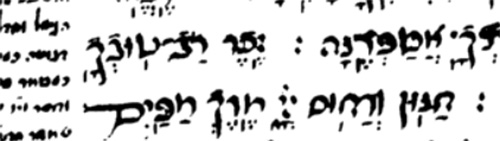
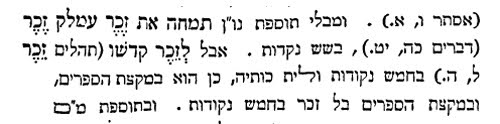
It is common practice in most Ashkenazi congregations to read the words z-kh-r Amalek, in Deut. 25:19, twice: once with a tzere under the zayin (zeikher) and once with a segol (zekher). Sephardic congregations, however, who do not distinguish between the pronunciation of these two vowels, read it only once, and they point it with a tzere. What is the origin of this practice, when did it begin, and is this double reading necessary to fulfill the command of reading these verses of Parshat Zakhor, the special reading on the Sabbath before Purim? These questions are discussed in several articles by R. Mordechai Breuer and Dr. J. Penkower,[1] two of the most eminent among contemporary scholars of the masorah and Biblical text. In their opinion, zeikher with a tzere is beyond a shadow of doubt the original and correct pointing of the text; and that is how the verse should be read in Parshat Zakhor. It must be stressed that the custom itself of a double reading is quite surprising and completely unique in Torah reading, for it was customary to decide in favor of one reading or another whenever there was a conflict between variant readings, pointing of vowels, or assignment of cantillation marks (as in cases of kri and ktiv, where a word is written one way but read another). R. David Kimhi, in his Sefer ha-Shorashim (in the manuscript versions), was the first to note the discrepancies regarding the pointing of these vowels in Sephardic biblical manuscripts. Under the root z-kh-r he says: “‘blot out the memory (zekher) of Amalek’ (Deut. 25:19), with six dots (i.e., segol twice), but ‘praise [in remembrance of (le-zekher)] His holy name’ (Ps. 30:5), with five dots (i.e., a tzere and a segol), and this occurs nowhere else; thus it appears in some books [i.e. manuscripts of the bible containing the Masorah]. But in others, z-kh-r is always pointed with five dots.” In other words, Radak noted that in some books he found z-kh-r pointed with segol and in others, with tzere. In printed editions of Sefer ha-Shorashim, however, beginning with the Venice edition and carrying through the 19th century, Radak’s remark concludes with the words “and this occurs nowhere else.” In other words, he found zekher in Parshat Zakhor always pointed with double segol.[2]
Here is a typical example in a manuscript (from 1481):
And here is the Venice edition:Here is the manuscript text restored in Biesenthal and Lebrecht’s Berlin 1847 edition:
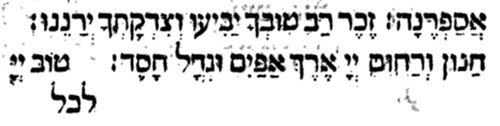
Various prayer books and Pentateuchs published in the 16th, 17th and early 18th centuries were redacted according to Radak’s remark as it appears in these printed editions; for example, the siddur of R. Shabtai Sofer (in the word zekher in the Ashrei prayer and in the prayers on the eve of the New Year), and Meor Einayim, the Pentateuch published by R. Wolf Heidenheim.*
The Basel 1579 Seder Tefillot Mi-kol Ha-shanah (Ashkenaz):
The manuscript of R. Shabtai’s siddur:
In 1832, about fifteen years after publication of Heidenheim’s edition, a book by R. Issachar Baer appeared, entitled Ma`aseh Rav, containing a description of the practices of the Vilna Gaon. The author mentions that the Gaon’s disciples disagreed over the way their teacher used to read the word zekher in Parshat Zakhor. The author attested as follows: “When he would read Parshat Zakhor, he would say zekher, with a segol under the letter zayin. R. Hayyim of Volozhin, however, whose endorsement is on the book, wrote there, `As for his writing that in Parshat Zakhor one should read [z-kh-r] with six dots, I heard from the saintly person [i.e., the Gaon of Vilna] that he read with five dots (=zeikher).’ I do not know whether those hearing him were mistaken, and thought they heard segol twice, or whether he changed his practice in his later years.”
Here is the text, with the footnote referring to R. Hayyim of Volozhin’s testimony:

Here is R. Hayyim’s testimony in his approbation at the beginning of this work:

Approximately eighty years later, R. Israel Meir Ha-Cohen, otherwise known as the Hafetz Hayyim, came out with his Mishnah Berurah on the Shulhan Arukh. Since the special reading of Parshat Zakhor is a command from the Torah, and there was some doubt as to the correct reading, he ruled that the words z-kh-r Amalek should be read twice. In his own words, “Some people say it should be read as zeekher Amalek (Deut. 25:19) with a tzere, and others say that it should be read as zekher Amalek with a segol; therefore the correct practice is to read both ways, to satisfy them both” (Mishnah Berurah 685.18). Later, a variety of customs emerged in this regard. Some readers only repeat the two words, z-kh-r Amalek, while others repeat the entire phrase, timhe et z-kh-r Amalek, and still others repeat the entire verse.[3]
Here is the Mishnah Berurah:
As mentioned above, Rabbi Breuer and Dr. Penkower note that the correct pointing of z-kh-r is with a tzere and the custom of double reading is unfounded. This follows from the arguments they cite from the masorah, from the ancient and highly precise Tiberian manuscripts and teachings of the Masoretes. R. Jedidiah Solomon Norzi, a seventeenth century masoretic scholar, held to be the final arbiter on the text of the Bible,[4] wrote a work entitled Minhat Shai, in which he remarks on inaccuracies that entered all the books of the Bible in the 1547-1548 Venice edition of Mikraot Gedolot and other editions published around then.[5] He says nothing about zekher ,which is pointed with a tzere followed by segol, from which it follows that he agreed with this pointing and had no doubts about it being correct.[6]
Minhat Shai from the first edition (Mantua 1742-4):

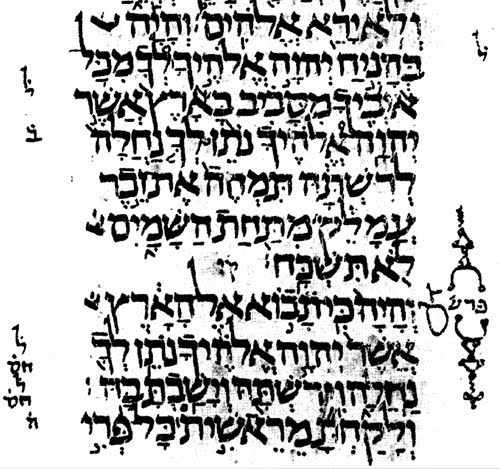
The most conclusive proof is found in ancient manuscripts, dating to the time of the masorah, and held to be very precise in their pointing and cantillation marks: the Leningrad manuscript (known as B19),[7] the Sassoon 1053 manuscript and others. All point z-kh-r with a tzere under the zayin.[8]
Leningrad manuscript:
Today we have in our hands a famous ancient manuscript, the Keter Aram-Tzova,[9] the most ancient and best authorized text of the entire Bible. The pointing and masoretic annotation of this manuscript were done in Israel over one thousand years ago by Aharon Ben-Asher, considered the greatest Masorete of all generations. Due to Ben-Asher’s precision and reputation, Maimonides chose to base his Hilkhot Sefer Torah on Ben-Asher’s work.[10] In the 15th century, at the latest, the Keter manuscript was transferred to Aleppo, Syria, where it was stored in the Sephardic synagogue until the riots against the Jews of Aleppo (Aram Tzova) that broke out in 1948, during which the manuscript was damaged, most the entire Pentateuch being lost, including Parshat Zakhor. Because the Keter manuscript was so special, the Jews of Aleppo did not allow others to photograph the manuscript or to examine it. Whoever wished to clarify a question of variants in the text had to write down the query and the person in charge would relay the version found in the Keter. The most famous of those addressing queries was R. Jacob Saphir, who submitted over five hundred questions, seeking to find out what variant appeared in the Keter. Fortunately, one of his questions pertained to the pointing of z-kh-r in Parshat Zakhor. The question and response were as follows: “(Deuteronomy) 25:19 z-kh-r h”n [question]. Yes [response].” In other words, is the word z-kh-r pointed in the Keter with five dots [h”n = hamesh nekudot, five dots,i.e., tzere followed by segol]? The answer provided by the keeper of the manuscript, R. Menashe Sitton, was” yes”.[11]
The entry in the published version of this manuscript (Rafael Zer Meorot Natan Le-rabbi Ya’akov Saphir, Leshonenu 50:3,4 Nisan-Tamuz 5746):

Dr. Penkower examined the pointing of z-kh-r in dozens of medieval manuscripts and found that in those manuscripts reputed to be more precise (some of the Sephardic ones) it was pointed with a tzere, and in those reputed to be less precise (some of the Sephardic ones and most of the Ashkenazi ones) it was pointed with a segol. These findings led him to note, “If we were to start taking into account the pointing in manuscripts far removed from the precise Tiberian ones, and were to begin reading doubly all instances of variation between them and the precise manuscripts, the Torah reading each week would last an inordinately long time.”[12] All editions of the Bible today point z-kh-r with tzere followed by segol, leaving no vestige of the double segol variant. One cannot but agree with R. Breuer and Dr. Penkower that there is no need for Ashkenazim to read zekher, for zeikher will suffice. To sum up: * R. David Kimhi mentions two methods of pointing which he observed in Sephardic manuscripts: zekher and zeikher. * The disciples of the Vilna Gaon disagreed about how their Rabbi used to read this word in Parshat Zakhor, whether with a tzere or a segol. * Because of uncertainty as to which was correct, the Mishnah Berurah ruled that z-kh-r Amalek should be read twice, once with tzere and once with segol. * The findings presented by R. Breuer and Dr. Penkower prove conclusively that the correct and original pointing of this word is zeikher (with a tzere). Therefore, in their opinion, one should return to the ancient practice, and all Jewish communities ought to read the word only once, as zeikher. [1] M. Breuer, “Mikraot she-yesh lahem hekhre`a,” Megadim 10 (1990), pp. 97-112; J. S. Penkower, “Minhag u-Mesorah: ‘Z-kh-r Amalek’ be-hamesh o be-shes nekudot” (with appendices, in R. Kasher, M. Tzippor and Y. Tzefati, eds., Iyyunei Mikra u-Farshanut, 4, Bar Ilan University Press, Ramat Gan 1997, pp. 71-127. [2] Penkower (loc. cit., p. 80 ff.) discusses at length the differences between manuscript and printed versions of Sefer ha-Shorashim. [3] On other practices, see Penkower, loc. sit., p. 71, n. 1. [4] Y. Yevin, Mavo la-Masorah ha-Tverianit, Jerusalem 1976, p. 101 ff. [5] J. S. Penkower, Ya`akov Ben Hayyim u-Tzmihat Mahadurat ha-Mikraot ha-Gedolot I-II (Dissertation), Jerusalem 1982. [6] R. Jedidiah Solomon Norzi was preceded by another important masoretic scholar, R. Menahem de Lonzano, author of Or Torah. In his book, he remarks on the same editions of Mikraot Gedolot on the system of vowel pointing and cantillation marks, but also says nothing about z-kh-r being pointed with a tzere followed by segol. [7] The printed Bible published for the IDF, prepared by Prof. A. Dothan, is based on this manuscript.[8]For further detail, see R. Breuer’s article (cited in n. 1), p. 110, and Penkower’s article (cited in n. 2), p. 101. [9] This manuscript is also known as the Aleppo Keter, or simply the Keter for short. [10] Several printed Bibles based on the Keter are available today. The most important of these is undoubtedly the Mikraot Gedolot- ha-Keter, redacted and edited by Prof. Menahem Cohen, Bar Ilan University Press, Ramat Gan 1992 and following years. Thus far five volumes have been published, covering the following six books of the Bible: Joshua-Judges (including a general introduction to the edition), Samuel I and II, Kings I and II, Isaiah, and Genesis vol. 1. [11] The manuscript containing these questions and responsa is known as Meorot Natan. See here.
[12] At the Project on Bible and Masorah at Bar- Ilan University, headed by Prof. M. Cohen, dozens of medieval manuscripts of the Bible were examined, and the findings of these studies reinforce Penkower’s conclusions regarding variant pointings in the manuscripts.
* Seforim Blog editor note: the issue is discussed in the En Hakore commentary included by Heidenheim in Humash Meor Einayim, only in the parashah of Amalek in Exodus 17, not in Deuteronomy. En Hakore is a masoretic commentary by R. Yekutiel (or Zalman) Ha-nakdan who lived in Prague in the 13th century. Here is how it appears in Heidenheim’s Humash Meor Einayim. However, it appears to be a misstatement to say that Heidenheim was among those whose work was “redacted according to Radak’s remark,” for while there is no example of Zekher from Psalms to compare with in his Humash Meor Einayim, Zekher is also pointed with tzere , rather than segol, in the Ashrei prayer included in Humash Moda Le-vina. This would seem to indicate that he did not follow the Radak. He merely published En Hakore, which dealt with the issue raised by Radak.