The Rav as a Mechadesh Halacha: One Small Example From Shabbat Rosh Chodesh

The Rav as a Mechadesh Halacha: One Small Example From Shabbat Rosh Chodesh
Michael J. Broyde
In the Koren Rav siddur, in the minhagim of the Rav, in the section dealing with the halachic rules of Rabbi Joseph B. Soloveitchik, זצ”ל it is written:
The Rav posited that if one forgot to recite Ya’aleh VeYavo on Rosh Hodesh during Shaharit, one should not repeat the Amida, but should rather rely upon the reference to the holiday that will be made in the Musaf prayer. The Gemara in Shabbat (24a) states that one who forgot to recite Ya’aleh VeYavo must indeed repeat the Amida and include Ya’aleh VeYavo in that second recital; but the Gemara in Berakhot (30b) qualifies this ruling, teaching that it is not necessary if one intends to recite Musaf subsequently, since the required reference to the special status of the day will take place during Musaf. Even though Rashi there (s.v. betzibbur) cites those who maintain that this dispensation applies only to the Leader in order to avoid any unnecessary delay to the start of the Repetition of the Amida, the Rav felt that we should follow the opinion of the Magan Avraham (Orah Hayyim 126:3) that even an individual should not repeat the Amida of Shaharit and should rely on his subsequent recitation of Musaf.
The rationale behind this view is as follows: When one forgets to recite Ya’aleh VeYavo, the need to repeat the Amida is only in order to be able to make reference to the special day within the context of the prayer. The obligation to recite the Amida per se, however, has in fact already been fulfilled. This second Amida therefore has the status of a tefillat nedava – a voluntary prayer, as it is recited not to fulfill any obligation to pray, but rather only to provide the needed context for the reference to the special day made through Ya’aleh VeYavo. Since it has become the practice to refrain from offering this form of voluntary prayer nowadays, Rav Hayyim Soloveitchik ruled that it is preferable not to repeat the Amida, but to rely upon the recitation of Musaf, if it will be done at the proper time. In light of this understanding, the Rav suggested that when Rosh Hodesh falls out on Shabbat, it would actually be prohibited to repeat the Amida if one forgot to recite Ya’aleh VeYavo, since it is prohibited to offer a tefillat nedava on Shabbat. [Eretz HaTzvi, pp. 43-44.] (Emphasis added)
And one is not surprised to find that this exact recitation is found in R. Tzvi (Hershel) Schachter, Eretz HaTzvi (Yeshiva University Press: New York, 1991).
While at first glance this note is not surprising – it appears that the Rav and his grandfather are adopting the ruling of the Magen Avraham over his peers — upon further examination it is clear that this is an exceptionally innovative ruling, in fact.  Furthermore, the expansion of this ruling by the Rav himself (“the Rav suggested that when Rosh Hodesh falls out on Shabbat, it would actually be prohibited to repeat the Amida if one forgot to recite Ya’aleh VeYavo”) is unprecedented, but logically compelling. A review of the sources is needed.
The Talmudic Sources, the Rishonim and the Codes.
 
The Gemera in Shabbat 24a recounts rather directly:
דתני רבי אושעיא: ימים שיש בהן קרבן מוסף, כגון ראש חודש וחולו של מועד – ערבית ושחרית ומנחה מתפלל שמונה עשרה, ואומר מעין המאורע בעבודה, ואם לא אמר – מחזירין אותו
R. Oshaia taught: On those days when there is a mussaf, such as Rosh Chodesh and Chol Hamoed at the Evening, Morning and Afternoon services, the shemona esrai is recited, and the nature of the day is inserted in the avoda blessing [ya’aleh veyavo] and if one does not insert it, one repeats the Shemona Esrai.
And the gemera in Brachot 30b recounts rather directly what appears to be a slightly different rule.
והתניא: טעה ולא הזכיר של ראש חודש בשחרית[1] – אין מחזירין אותו מפני שיכול לאומרה במוספין, במוספין – אין מחזירין אותו מפני שיכול לאומרה במנחה! – אמר ליה: לאו איתמר עלה, אמר רבי יוחנן, – בצבור שנו.
If one forgot and did not recite yaaleh veyavo in the morning [tefillah], he is not made to repeat [the prayer], because he can say it in mussaf if he forgot it in musaf, he is not made to repeat, because he can say it in mincha? — He said to him: Did you not leave out the rule of Rabbi Yochanan: This applies only to prayer said in a congregation?
Rashi (aware of the possible contradiction between these two sources) seeks a simple resolution with his two sided comments. Rashi in Brachot 30 b states:
בצבור שנו – דאין מחזירין, משום דשמע ליה משליח ציבור, ואיכא מקצת הזכרה, אבל ביחיד צריך לחזור, ובהלכות גדולות מפרש לה בשליח ציבור משום טירחא דצבורא, אבל יחיד הדר.
In a Congregation: One does not repeat davening, since one can hear it from the chazzan, and that is some partial recitation, but an individual must repeat; The Bahag explains that the chazzan is different since otherwise the community will be delayed, but other than the chazzan, one must repeat.
And one of these two resolutions of the contradiction (or both) is – as far as I can see – accepted by every single rishon who comments on
the gemera.  Rambam (Tefillah 10:10-12) states directly:
טעה ולא הזכיר יעלה ויבא אם נזכר קודם שישלים תפלתו חוזר לעבודה ומזכיר, ואם נזכר אחר שהשלים תפלתו חוזר לראש,* * * *. במה דברים אמורים בחולו של מועד או בשחרית ובמנחה של ראשי חדשים, אבל ערבית של ראש חדש אם לא הזכיר אינו חוזר.כל מקום שהיחיד חוזר ומתפלל ש”ץ חוזר ומתפלל אם טעה כמותו בעת שמתפלל בקול רם, חוץ משחרית של ראש חדש שאם שכח ש”ץ ולא הזכיר יעלה ויבא עד שהשלים תפלתו אין מחזירין אותו מפני טורח ציבור, שהרי תפלת המוספין לפניו שהוא מזכיר בה ראש חדש.
Rambam Tefillah 10:10-12
 
If one errs and forgets to mention Ya’aleh veyavo — if one remembers before one has finished one’s amidah, one should return to retzey, and recite it. If one remembers after one has concluded one’s amidah, one must repeat the amidah from the beginning.  * * *When does this rule apply? On Chol Hamo’ed or in the morning or Mincha amidah of Rosh Chodesh. However, in the evening service of Rosh Chodesh, if one failed to mention it one need not repeat one’s prayers. In every case in which an individual is required to repeat his prayers, the chazzan is also required to repeat his prayers if he made that mistake while praying out loud, with the exception of the morning service of Rosh Chodesh, where if the chazzan failed to mention Ya’aleh v’yavo before completing the amidah, he is not required to repeat the amidah because of the delay this would cause the congregation, since the Musaf service is still to be recited and Rosh Chodesh will be mentioned there.
And the same rule is codified in the Shulchan Aruch, with the addition that one can also adopt the approach of the Bahag as quoted by Rashi and instead of praying again, one can hear the prayers from the chazzan.  Shulchan Aruch OC 124:10 codifies the rule in Shabbat 24a and Shulchan Aruch OC 126:3 codifies the exception in Brachot 30b.
שולחן ערוך אורח חיים הלכות תפלה סימן קכד סעיף י מי ששכח ולא אמר יעלה ויבא בר”ח או בחולו של מועד או בכל דבר שצריך לחזור בשבילו, יכוין דעתו וישמע מש”צ כל י”ח ברכות מראש ועד סוף כאדם שמתפלל לעצמו; ולא יפסיק ולא ישיח
Shulchan Aruch OC 124:10
One for forgets and does not recite yaaleh veyavo on Rosh Chodesh or chol Hamoed or any other cases where one must repeat the amidah due to the omission, he can focus himself during the repetition and hear the words from the chazzan of all Eighteen blessings, from beginning to end, like a person who is himself praying without interruption or digression.
שולחן ערוך אורח חיים הלכות תפלה סימן קכו סעיף ג כל מקום שהיחיד חוזר ומתפלל, ש”צ חוזר ומתפלל, אם טעה כמותו כשמתפלל בקול רם, חוץ משחרית של ר”ח, שאם שכח ש”צ ולא הזכיר יעלה ויבא עד שהשלים תפלתו, אין מחזירין אותו, מפני טורח הצבור, שהרי תפלת המוספין לפניו שהוא מזכיר בה ר”ח.
Shulchan Aruch OC 126:3
In every case in which an individual is required to repeat his prayers, the chazzan is required to repeat his prayers if he made that same mistake while praying out loud, with the exception of the morning service of Rosh Chodesh, where if the chazzan failed to mention Ya’aleh v’yavo before completing the amidah, he is not required to repeat the amidah because of the delay this would cause the congregation, since the Musaf service is still to be recited and Rosh Chodesh will be mentioned there.
So far, the halacha is clear and simple.  One must repeat the amidah if one forgets yaaleh veyavo (either by actually repeating it or through listening to it recited by another) except for the rare situation of the Shacharit chazzan who forgets during his repetition.
The Alternative of the Rama MePano: A Different Rule
Rama MePano 25:5 understands the basic flow of the sources in a different way and adds something quite new to the codification of the halacha.  He states:
יחיד ששכח ולא הזכיר קדושת היום בתפלת שחרית ואחר שהתפלל מוסף חזר והתפלל שחרית, ודאי אינו צריך לחזור ולהתפלל מוסף, שאפי’ בקרבנות גופייהו אם הקדים את שאינו תדיר מה שעשה עשוי. ואי לאו דמסתפינא אמינא דלא אמרו בגמרא להחזיר את היחיד שטעה אף על פי שיש לפניו תפלת המוספין אלא קודם שהתפלל מוסף כיון שבידו לתקן יתקן לגמרי, הא אם התפלל מוסף הרי הזכיר קדושת היום ואין צורך לחזור ולהתפלל שחרית, דלא גרע דיעבד ליחיד ממאי דשרינן לכתחלה לרבים, ודברים של טעם הם להלכה מהתם, הגע עצמך שש”צ יהא נזקק להוציא עשרה שאינן בקיאין ידי חובתן ושכח ולא הזכיר שחרית מעין ר”ח ועם תפלת מוסף פוטר עצמו וחבריו לכתחלה ולא אחד בהם חוזר ומתפלל שחרית, לא יהא יחיד הבקי בדיעבד אלא כעשרה שאינן בקיאין ולכתחלה.
An individual, who forgets and does not recite the mention of the day in the Shacharit amidah and then he recites musaf, returns to recite Shacharit.  Certain he does not have to return to recite musaf again, since even with the Bet Hamikdash sacrifices themselves, if one did them out of order, and sacrificed the infrequent first, that which was done, was done.  If I were not uncertain, I would say that that the gemera does not direct an individual who errors to repeat the amidah, only before he has recited musaf, since he can fix this matter, he should do so completely.  But, if he already recited musaf, he has already recited the proper sanctification of the day and he does not have to recite Shacharit again, since the after the fact rule for a single prayer is no worse than that which we permit ideally for the many.  This seems logical and normative as a matter of halacha: Consider for yourself that the chazzan who is connected to the obligation to fulfill the obligation for ten who cannot pray when they are not experts, and yet when he forgets to recite yaalah veyavo in Shacharit, he can fulfill his and others obligations in musaf perfectly. And not of them have to go back and recite Shacharit again.  A single person who can pray for himself after the fact, is no worse than ten who are not experts ideally.
The Rama mePano understand the sources in a new and novel way: really according to the formulation in Brachot 30b (which the halacha follows) one can rule that if one already prayed the proper mussaf before one realized that one forgot to recite ya’aleh vehavo in Shacharit, one need not pray again, since one can be no worse that the chazzan mentioned in the gemera above. And this view is adopted by the Magen Avraham (OC 126:3) as well, who states:
כל מקום – כ’ מ”ע סי’ כ”ה אי לאו דמסתפינא הייתי אומר יחיד שלא הזכיר ר”ח בשחרית והתפלל מוסף אין צריך שוב להתפלל שחרית דלא גרע דיעבד ליחיד מלכתחלה לרבים ודברים של טעם הם להלכה ע”כ, ול”נ דנכון למעשה שלא יתפלל דלא יהא אלא ספק [כ”ה סימן תכ”ב]:
3            Any place.  It is written in the Rama Mepano 25 that if he were not so uncertain he would say that a person who forgets to recite yaaleh veyavo in Shacharit and then recites musaf he does not have to again go back and recite shacharit another time, since the after the fact rule for a single person is not worse that the ideal rule for the many.  This approach has much merit as normative halacha.  In my view, it is proper lemaseh that one should not recite shacharit again, since the matter is in doubt.
Magen Avraham seems to agree with the tentative rule of the Rama mePano and thus decides that if one already recited musaf, then one does
not have to say shacharit again.  Magen Avraham, however, does not claim that one can decide not to recite Shacharit again and intend it rely on this subsequent recitation of musaf.
An Explanation of the Rav’s View
As quoted above, this was not the Rav’s view.  Rather (as the Koren siddur notes) “the Rav posited that if one forgot to recite Ya’aleh VeYavo on Rosh Hodesh during Shaharit, one should not repeat the Amida, but should rather rely upon the reference to the holiday that will be made in the Musaf prayer.” Notice the incredible chiddish the Rav puts forward.  He expands the Rama mePano and Magen Avraham to include the case where one is eventually going to recite musaf, but has not yet done so, and he adds to this that on Shabbat one must adopt this rule, since a teffilat nedava is prohibited.  This chiddish – which to the best of my knowledge is completely unfound in any Rishon at all — is I think built on a totally different approach to the two Talmudic sources from any Rishon and even quite distinct from the Magen Avraham and Rama mePano, although related and derived from it.
Consider how to explain the three basic views adopted:
All Rishonim: Either Brachot 30b is addressing the unique situation of the chazzan or is because one can hear it correctly from the chazzan, but it never applies in the case of a person who is davening alone without a minyan present.  Shabbat 24a is the rule – one who leaves out Ya’aleh VeYavo has to repeat the amida.  No distinction is made between weekday and Shabbat.
 
Rama MePano and Magen Avraham: Shabbat 24a is the rule, but Brachot 30b is the exceptional rule for the chazzan in order to not delay the community.  One who is not the chazzan cannot rely on Brachot 30b.  If one has already prayed mussaf, then one has no choice but to follow the Brachot 30b rules, since he has already after the fact fulfilled his obligation.  Again, no distinction is made between the weekday and Shabbat.
Rabbi Yosef Dov Halevi Soloveitchik: Brachot 30b and Shabbat 24a are in tension since one directs one to repeat amida and one directs one not to.  The halacha follows the rule of Brachot 30b in that one who skips Ya’aleh VeYavo in Shacharit never really has to repeat the amida, except as a voluntary prayer, and when voluntary prayer is prohibited (such as on Shabbat), such a repetition is prohibited too.  This is based on the insight of the Rama MePenao, but is quite an expansion of it.
Allow me to suggest, as a proof to Rabbi Soloveitchik’s understands of the basic Talmudic sources, that one can focus on three basic aspects of the two sugyot to support this chiddish.  First is the fact that that the gemera in Shabbat can reasonably be limited to weekdays (chol) cases where 18 blessings is said, which is why it used the language of shemonah esrai – and on such days, a tefillat nedavah is possible.[2]  Second, the Brachot sugya can reasonably be limited to Shabbat, since it discusses forgetting that it is Rosh Chodesh but yet reciting musaf: when can one forget that it is Rosh Chodesh and yet still recite musaf?  Almost never during the weekdays (since if one did not remember it was Rosh Chodesh, one would not say musaf as a factual matter) but only on Shabbat, when no tefillat nedavah is possible, and yet musaf is recited, even if it is not Rosh Chodesh![3]  Parsing the two sources in their context allows one to see that Shabbat 24a directive is the suggestion for a tefillat nedava and the Brachot 30b rule is actually the rule – no repetition is permitted when no tefillat nedavah is possible.[4]
Finally, it is not difficult to divide the Brachot sugya into two thoughts along a line similar to the Rama MePano (but not identical). The first is the general rule that no repetition for ya’aleh veyavo is needed when one says a subsequent amidah (musaf), and the second view is that of Rav Yochanan that in a tzibbur is different, since one does not actually have to wait until the next amidah to fulfill one’s obligation, but one can fulfill it by listening to the chazzan repeat this davening (as per the main view of Rashi).  Of course, this view concedes, according to Rabbi Soloveitchik, that when one cannot hear it from the chazzan, one still does not repeat the amidah, except when a teffilat nedavah is acceptable (which nowadays is never).  In fact, the Rav must have ruled that whether or not the halacha adopts Rav Yochanan’s view, the rest of the Brachot sugya is correct.  This also makes the Brachot sugya (the “on topic” gemera) normative (lehacha), and the Shabbat sugya (the “off topic” gemera) not normative (shelo lehalacha) – a more compelling read of the sugyot.
It is worth noting that if this explanation of the Rav’s view is correct, another chiddish seems also to be correct.  On Shabbat Rosh Chodesh, when one is davening by oneself without a minyan, and one forgets that it is Rosh Chodesh for both Shacharit and Musaf, and remembers after mincha, one does not repeat musaf again, since one can follow the formulation of Brachot 30b thatבמוספין – אין מחזירין אותו מפני שיכול לאומרה במנחה! and a tefillat nedava is not possible.  The same is true if one forgets it is Rosh Chodesh on Shabbat mincha, but had previously remembered at shacharit and mussaf.


[1] I have deleted the words “בערבית – אין מחזירין אותו מפני שיכול לאומרה בשחרית” since nearly all the rishonim do not have them in their gemera and this makes more sense given the flow of the sugya.
[2] The Gemera in Shabbat 24a states מתפלל שמונה עשרה, ואומר מעין המאורע בעבודה.
[3] Of course, one could also read the Gemera in Brachot as speaking about a case during the weekday when one forgot ya’aleh veyavo in shacharit but recited musaf – but then the sugyot are in flat out conflict.  The approach, which also notes that the term shemona esrai (the weekday amidah) is in Shabbat 24a and not is Brachot 30b, eliminates the ccore onflict between the two sugyot.
[4] This approach has the additional advantage of making the Brachot Talmudic source superior to the Shabbat one, which is more reasonable and in line with the general rule, in that the Brachot source is directly on the topic of ya’aleh veyavo and the Shabbat source is off topic and incidental, following the general Talmudic rule that when Talmudic sources conflict, we prefer to follow the one that is central and not the one that is incidental.


ArtScroll’s Response and My Comments

 ArtScroll’s Response and My Comments
by Marc B. Shapiro 
My recent post here was more popular than my typical post. I base this statement on the fact that I received more emails from readers than usual and the post was picked up by a variety of different websites. The part dealing with the censorship of Rashbam was translated into Hebrew here (with one of the commenters calling for a herem to be placed on ArtScroll)[ and see also here.
ArtScroll has now issued its response. The following has been sent out to those who wrote to ArtScroll about the censorship.
Let us make clear at the outset, ArtScroll has total and uncompromising respect for Chazal and the classic commentators. We do not censor them. Every one of their words is holy, and we have never deigned to tamper with their sacred texts.
For an understanding of the matter under discussion, it is important to present the background of the published versions of Rashbam’s commentary on the Torah.

·      Rashbam’s commentary was first printed in 1705, based on the only existing manuscript of his virtually complete commentary on the Chumash. That manuscript began with Parashas Vayeira.

·      Subsequent editions were based on that 1705 printing.

·      In 1882, David Rosin published a new annotated edition of Rashbam’s commentary.

·   The new edition also included a commentary on the Parshiyos Bereishis, Noach, and Lech-Lecha based on comments culled by Rosin from Rashbam’s other writings as well as selections from other works that cite Rashbam. Additionally, this 1882 edition included material taken from a newly-discovered manuscript containing one page of commentary ascribed to Rashbam, on only the first chapter of Bereishis ending in the middle of verse 1:31.

·      This manuscript fragment includes an exegesis that appears several times – an exegesis that Ibn Ezra, in his famous Iggeres HaShabbos, vehemently condemns, stating, that it had been put forth by “minim” (heretics). Furthermore, a later exegesis in the same manuscript page (on verse 14) directly contradicts that earlier exegesis.
In our Czuker edition of Mikraos Gedolos, we wished to provide the Torah public with the fullest version of the Rashbam’s commentary, so rather than beginning with Parashas Vayeira, we incorporated additional material from the 1882 Rosin edition, from the beginning of Bereishis. However, given Ibn Ezra’s attribution of this exegesis to “minim,” coupled with a completely contradictory exegesis in verse 14, it is questionable whether Rashbam actually proposed the exegesis attributed to him.  Because of these factors we added only those writings attributed to Rashbam whose authenticity have not been questioned. Far from “censorship,” we have added to the older, standard Mikraos Gedolos editions.
Nevertheless, for the sake of clarity, we should have indicated that the basis for our text of Rashbam was the standard Vilna edition of 1898, with emendations from the Rosin edition of 1882. Indeed, this is what we have indicated in our just-published Sefer Shemos volume, and which will be reflected in future reprints of Sefer Bereishis.
* * * *
In my response I will only deal with the matter at hand, that is, the censorship of Rashbam’s commentary, not with the larger matter of whether ArtScroll really has “total and uncompromising respect for . . . the classic commentators.” I have dealt with this latter point in previous posts and offered evidence that contradicts ArtScroll’s assertion.
Let me begin by saying that the one word that best describes ArtScroll’s statement is “chutzpah”. Here we have an explanation from Rashbam that has been discussed and dealt with by some of the greatest Torah scholars for well over a century, yet ArtScroll feels that it knows better than all of them and thus has the authority to simply delete passages from the commentary. If that isn’t chutzpah, I don’t know what is.

Rashbam’s brother, Rabbenu Tam, famously attacked those who deleted or emended passages in the Talmud based on their own understanding.[1] Rabbenu Tam realized that if everyone had the freedom to do with the text as he wished, it wouldn’t be long before the Talmud was irrevocably damaged. As such, anyone who has a suggestion about a mistake in the text is free to add it in the form of a note or in a commentary, but he is not permitted to alter the text itself. The only honest thing would have been for ArtScroll to have included the “objectionable” passages and then explain why they feel that these texts are not authentic.
The fact that ArtScroll sees the passages that it deleted as heretical is irrelevant. Great people have regarded texts of the Rambam, of R. Kook, and of many others as heretical. Does that mean that we can start deleting these texts? There are aharonim and at least one rishon who believe that there are passages in the Talmud that were inserted by people intent on mocking the Sages (details will be in a future post). Does that mean that if ArtScroll shares this opinion it is entitled to delete these passages as well?
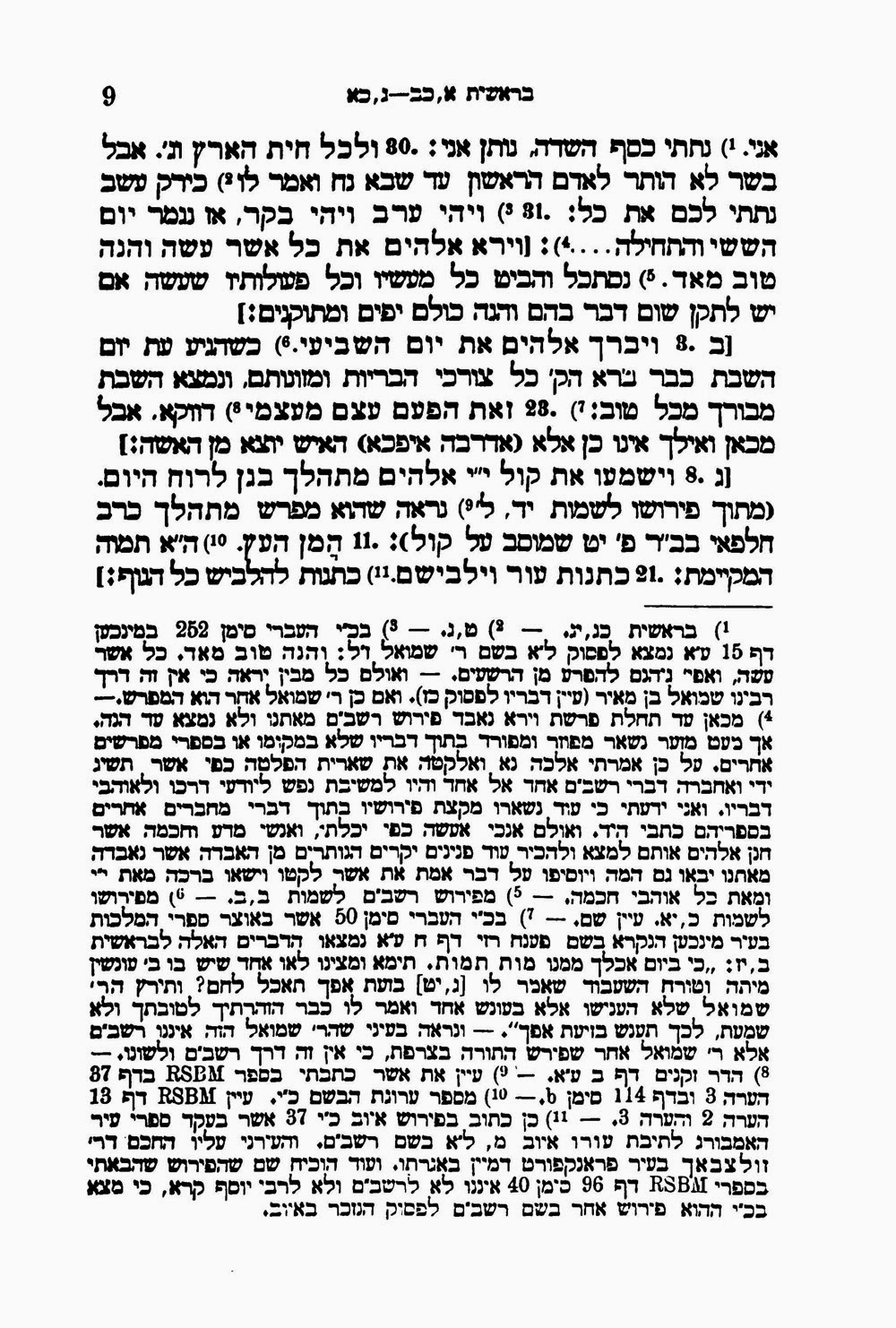
As I mentioned, the chutzpah is seen in the fact that ArtScroll feels that it knows better than such great figures as R. David Zvi Hoffmann[2] and R. Yaakov Kamenetsky.[3] Both of these men were not simply great talmudists but were also great biblical scholars, and they expound Rashbam’s view. It never occurred to them to delete the passages or to claim that they aren’t authentic. Cassuto was another great biblical scholar and he believed that Rashbam’s understanding of the verse is correct.[4]
Every student of Torah is taught the virtue of humility. What this means is that if you don’t understand something you seek out people greater than yourself to hear their perspective. How come ArtScroll didn’t follow this route before taking the drastic step of deleting the comments of Rashbam?
Unfortunately, if ArtScroll’s mikraot gedolot becomes the standard, anyone who uses the commentaries of R. Hoffmann, R. Kamenetsky, Cassuto and so many others will be very confused. These commentaries will cite Rashbam and explain his words, but the reader who opens up his ArtScroll mikraot gedolot to see what Rashbam says “inside” won’t be able to find it. If he doesn’t read the Seforim Blog, he won’t know what is going on.
For over a hundred years people studied Rashbam’s commentary without any problem. Different interpretations were offered, all in order to make sense of Rashbam’s words. Around fifteen years ago a few people, none of whom have any scholarly or religious standing, started making noise that there is heresy in Rashbam’s commentary on Genesis chapter 1.[5] This led a couple of haredi publishers to delete some or all of the “problematic” comments (different editions have different deletions).[6]
ArtScroll has chosen to follow this regrettable path. When this nonsense first began with the haredim in Israel, the great R. Yehoshua Mondshine, whose recent passing is an enormous loss for all, published the following letter in Kovetz Beit Aharon ve-Yisrael.[7]

The disdain he shows in this letter would be magnified if he were writing about ArtScroll, as one would expect ArtScroll to know better. It is unfortunate that ArtScroll did not heed his final words directed towards publishers inclined to censorship.
יש להתרות במו”לים שלא יהיו נחפזים “לצנזר” את פירוש הרשב”ם מכח סברות תמוהות וקלושות, ויחרדו לנפשם מאזהרות הקדמונים דלייטי ליד המגיה בספרים.
Following R. Mondshine’s letter, there appears a very lengthy letter by R. Menahem ben Shimon[8] explaining that Rashbam’s comments at the beginning of Genesis should not be controversial at all. He concludes by comparing censorship of Rashbam to the burning of Maimonides’ Guide of the Perplexed, and adds
יש בזה עזות מצח, וביזוי דברי הקדמונים, והתייחסות לדבריהם כאילו חלילה מדובר בתקליטור עם משחקים חינוכיים “בהכשר הרבנים”, וכיו”ב, וכבר הזהירונו חז”ל להיזהר בכבוד תלמידי חכמים שכל דבריהם כגחלי אש.
I have to acknowledge that some people are having a good chuckle right now at my expense. Call it naiveté, but I was convinced that the response of ArtScroll would be to admit the mistake, blame it on an error in “editing” or something like that, and correct matters in the next printing. That would have been a great outcome. I, more than many others, was shocked by ArtScroll’s response. 
In its response ArtScroll states: “[G]iven Ibn Ezra’s attribution of this exegesis to “minim,” coupled with a completely contradictory exegesis in verse 14, it is questionable whether Rashbam actually proposed the exegesis attributed to him.”
The first thing to note is that in the preface to the Iggeret ha-Shabbat, where Ibn Ezra explains what led him to write the work, he does not attribute this exegesis to “minim”. ArtScroll would have you believe that Ibn Ezra stated that the passages they have deleted are heretical interpolations. Even if this was the case, it would only be Ibn Ezra’s opinion. This would not entitle ArtScroll to delete the passages, just like they don’t have the right to delete other passages that some commentator thought were not authentic. But in this case ArtScroll is simply wrong, and I hope that they are not intentionally misleading people. (I also hope that they informed the sponsor of the new mikraot gedolot that they intended to delete passages from Rashbam.[9])

Here is the text from Ibn Ezra.[10]

As you can see, Ibn Ezra responds very sharply to the interpretation mentioned by Rashbam. Although Rashbam is not mentioned by name, the standard view in traditional and scholarly circles is that Ibn Ezra was indeed directing his words at Rashbam and not at others who shared this perspective. This would explain his use of the words ולא תשא פני איש which would only be used with reference to an outstanding scholar.[11] David Kahana suggests that, as a sign of respect, Ibn Ezra does not mention Rashbam by name and he also does not curse the author of the explanation he is attacking.[12] He only curses the one who reads it aloud and the scribe who writes it. If Ibn Ezra was directing his comment against some heretic, we would expect him to curse this person, so the fact that he does not do so is quite significant and indeed points to Rashbam as the “addressee” of Ibn Ezra’s Iggeret ha-Shabbat.
Ibn Ezra never denies the authenticity of the interpretation he is responding to; he just attacks it. His attack on Rashbam’s view is just like Nahmanides’ attack on Maimonides’ view that the angels who came to Abraham were really just part of a prophetic vision. Nahmanides does not deny that Maimonides said this, but he does say that it is forbidden to accept what Maimonides says. It is the exact same thing here. Ibn Ezra is not denying that Rashbam offered the interpretation. He is simply saying that it is forbidden to accept this approach. (I should also add, since we are discussing a dispute between Ibn Ezra and Rashbam, that by any traditional measure Rashbam must be regarded as a more significant and authoritative figure than Ibn Ezra.)

ArtScroll also states that since Rashbam’s commentary to Genesis 1:14 contradicts what he says in the passages deleted by ArtScroll, this gives weight to their assumption that the other passages were not written by Rashbam but were instead inserted by some heretic. To begin with, since there are five[13] “problematic” comments and one “non-problematic” comment, perhaps it is the “non-problematic” comment to Genesis 1:14 that is to be regarded as inauthentic and should be removed. I say this only tongue and cheek, since ArtScroll should have realized two pretty basic things.
1. Rashbam often offers explanations, even in matters of halakhah, that are in line with the peshat of the text but diverge from the talmudic understanding. I understand that in some contemporary circles this would be regarded as heretical, since they assume that the meaning of the verse, especially in halakhic matters, can only be what the sages of the Talmud declare. Yet Rashbam had a different perspective, and he allowed for a peshat that diverges from what the Talmud states.
2. If you have contradictory explanations in the same chapter, the proper thing to do is to see if they can be reconciled before deciding that some of the comments are not authentic and can therefore be deleted. This was the approach of the great scholars of the last century who discussed Rashbam’s commentary. If ArtScroll had “uncompromising respect” for these figures, who devoted great time to understanding what Rashbam was saying, they would not have dared delete Rashbam’s comments, since by doing so they are in effect claiming that they know better than R. Hoffmann, R. Kamenetsky, and so many others.
Let me cite some other writers, including outstanding Torah scholars, who discussed Rashbam’s comments on when the day begins. In ArtScroll’s eyes this was all a big waste of time, since Rashbam never could have said what appears in his commentary. I guess we should all feel sorry for these Torah scholars that when they wrote they didn’t have ArtScroll around to set them straight. The more important question is why didn’t ArtScroll think that any of the explanations offered by these scholars were enough to save Rashbam’s comments from being deleted? (My own sense is that the individual who made the choice to censor Rashbam did not begin to understand the issue and was unaware of the sources referred to in this post.)
1. R. Menahem M. Kasher discusses Ibn Ezra’s attack on Rashbam and offers an explanation for Rashbam’s position, distinguishing between how the days were structured in the first six days of creation and what occurred afterwards.[14] R. Kasher also cites R. Pinhas Horowitz, Ha-Makneh to Kiddushin 37b, that before the giving of the Torah night came after day, and this can also be an explanation for Rashbam’s approach. In support of his assumption, R. Horowitz cites a verse not mentioned by Rashbam, Genesis 8:22:  ויום ולילה לא ישבתו. As you can see, in this verse night comes after day. (R. Horowitz repeats this explanation in his Panim Yafot to Genesis 8:22.) R. Moses Sofer cites this point from R. Horowitz and notes that even today it is only with regard to Jews that night precedes day, but for non-Jews the halakhah remains that day precedes night.[15]
R. Ezekiel Landau agrees with R. Horowitz that before the giving of the Torah the day did not start at night.[16] In support of this approach, R. Samuel Mirsky refers to Ugaritic literature which he regards as real evidence for Rashbam’s position.[17]
R. Moshe Malka also takes note of R. Horowitz’s position.[18]  Based on it he claims that
נחה שקטה תמיהתו של הראב”ע על הרשב”ם, כי הוא דבר על מעשה בראשית לפני מת”ת
R. Catriel David Kaplin also refers to R. Horowitz’ perspective and explains that Rashbam agrees with it.[19]
R. Kasher further cites R. Isaac Israeli (14th century) as agreeing with R. Horowitz. In his Yesod Olam[20] R. Israeli writes
וכן נהגו כל ישראל ממתן תורה ועד עתה להתחיל קדושת השבת ושאר ימי מקראי קודש מתחילת הלילה . . . ועל העיקר הנכון הזה יסדו לנו קדמונינו וקבעו בחשבון מולדות הלבנה ותקופת החמה.
R. Kasher calls attention to the words ממתן תורה ועד עתה and concludes that R Israeli is telling us that before the giving of the Torah the day began in the morning.
Finally, R. Kasher points to two separate rabbinic texts, one talmudic and one midrashic, that he feels can support Rashbam’s approach.
2. Da’at Mikra to Genesis 1:5 (p. 10 n. 168) explains that Rashbam’s understanding of when the day begins only refers to the six days of creation.
3. A different approach in explaining Rashbam is taken by R. Moshe Schwerd in a recent article in Or Yisrael.[21]
4. The Lubavitcher Rebbe refers to Rashbam’s explanation of when the day begins in order to illustrate how explanations in accord with peshat can contradict the accepted halakhah.[22]
5. R. Chaim Leib Zaks calls attention to the fact that two medieval authorities explain Genesis 1:5: ויהי ערב ויהי בקר, just as Rashbam did, that is, that day comes before night.[23] The first is the commentary attributed to Rashi, Ta’anit 11b, s.v. למחר.[24] The second is the commentary attributed to Rashi, Nazir 7a s.v. התם.[25]
6. R. Eliyahu Katz, who served as rav of Bratislava under the Communists and later as chief rabbi of Be’er Sheva, published a number of interesting books which appear to be completely unknown. In his Emor ve-Amarta[26] he states that R. Judah ha-Nasi might also have held that according to the peshat night comes after day, and that Rashbam might have based his explanation on R. Judah’s opinion. He also points out that Rashi, Genesis 1:14 writes
שמוש החמה חצי יום ושמוש הלבנה חציו הרי יום שלם
This is a strange formulation since Rashi appears to be agreeing with Rashbam that the day – שמוש החמה – comes before the night – שמוש הלבנה.
7. R. Jacob of Vienna, in his commentary to Genesis 1:5, writes[27]:
וא”ת אימא הלילה הולך אחר היום והכי קאמר ויהי ערב של יום הראשון ויהי בקר של יום שני אז נשלם יום שלם
In his note to this passage R. Zvi Rotberg understandably refers to Rashbam, as R. Jacob might indeed be alluding to him here.[28] The editor of R. Jacob’s volume, R. Menasheh Grossberg, refers to R. Pinhas Horowitz’s view mentioned above.
8. R. Shlomo Fisher, without question one of the top Torah scholars in the world, elaborates on the implication of Rashbam’s view that it is only through Torah she-Ba’al Peh, not the peshat of the verses, that we know that day comes after night.[29] A student of R. Fisher asked him about the censorship of Rashbam, and not surprisingly he expressed strong opposition to any such tampering with the writings of rishonim. He also told this student about a contemporary “scholar” who claims that Rashbam was influenced by evil people who caused him to go astray! Talk about chutzpah![30]
10. Michael Landy called my attention to the fact that Abarbanel cites the interpretation mentioned by Rashbam in the name of יש מהמפרשים.[31]
All of these sources that I have quoted, and believe me when I tell you that there are many more, are simply designed to show that the view of Rashbam expressed in his commentary to the first chapter of Genesis is part and parcel of Torah history and literature. Many of our great minds have discussed Rashbam’s view in a variety of contexts. Yet ArtScroll, on its own, has decided that it knows best and chose to remove the words of Rashbam from the public eye. They have no right or authority to do this. Their action is a betrayal of Rashbam and of those who want to study the writings of Rashbam. It is also an incredible display of disrespect to those great Torah scholars who have devoted time to the matter and explained the comments of Rashbam that ArtScroll prefers to view as heretical.
After all we have seen, let us return to the issue of Ibn Ezra’s attack on Rashbam and ask why it was so harsh. After all, what is so terrible about explaining the peshat of the Torah even if it diverges from the accepted halakhah, an approach that is found in numerous commentators?
The significance of the example we have been discussing is that there were indeed sectarians who observed Shabbat from Saturday morning until Sunday morning. Rashbam’s interpretation was thus dangerous as it could have had real world implications by giving support to the anti-halakhic behavior just mentioned.
In his commentary to Exodus 16:25 Ibn Ezra refers to “many people, lacking in faith” who erred in this matter and did not start Shabbat on Friday night. He tells us that they based their mistaken approach on Genesis 1:5: ויהי ערב ויהי בקר. In other words, they interpreted the verse in the same way that Rashbam did. Towards the end of Iggeret Shabbat, p. 171, he also mentions these “minim” who do not observe Shabbat beginning Friday night. It is thus easy to see why Ibn Ezra reacted so strongly and set out to uproot Rashbam’s interpretation.
Who were these sectarians Ibn Ezra refers to? Presumably the Mishawites, a group that we know started Shabbat on Saturday morning.[32] Benjamin of Tudela records meeting sectarians in Cyprus, again presumably Mishawites, who indeed observed the Shabbat in this fashion.[33]
In the last paragraph of the ArtScroll letter it states that from now on they will note that their text of Rashbam is the standard Vilna edition of 1898 with “emendations from the Rosin edition of 1882”. This is clearly obfuscation as we are not dealing here with any “emendations” suggested by Rosin. To repeat what the issue is: Rosin printed from manuscript Rashbam’s commentary to Genesis chapter 1. This section of the commentary does not appear in the standard Vilna edition. ArtScroll chose to include Rashbam’s commentary to Genesis chapter 1 in its recently published mikraot gedolot. However, ArtScroll also chose to delete those sections of the commentary it didn’t like, assuming (without any evidence) that these sections were written by heretics. This is censorship of  Rashbam. That is all people need to know.[34]
ArtScroll has done some great things. They have also done some pretty disappointing things. But as I said in the prior post, nothing comes close to this. Deleting comments of one of the greatest rishonim is simply outrageous. Some have said that what ArtScroll did is unforgivable. I think this is going too far. If ArtScroll acknowledges its error and reinserts that which has been removed, I think that we all would be very happy to put this behind us. One of the most important aspects of a Torah personality is the ability to recognize when one has made a mistake and rectify it. If ArtScroll is able to do this, it would lead to great admiration.

On the other hand, if ArtScroll refuses to acknowledge that it has made a terrible error, even after seeing the evidence presented in this post, then one must conclude that ArtScroll is knowingly suppressing the words of a great rishon. One can only hope that ArtScroll does not wish to have this blemish permanently attached to its name.

[1] ArtScroll and other publishers should pay close attention to the words of Rabbenu Tam, which I would have thought would be enough to scare off the censors. Sefer ha-Yashar, ed. Rosenthal (Berlin, 1898), p. 75:
ומגיהי חנם, בעיני דינם, למדורי גהינם
P. 105:
כי כאשר לא יודעים, העולם מטעים, וכאשר תוהים, הספרים מגיהים. ואתם הרעות מהם, כי הם כותבים ה”ג בהגהותיהם, ולכן ניכר מעבדיהם. ואתה לא כן, אך סותם הגהותיך וסומכים עליך וטועים . . . אין עצה ואין תבונה, רק להעמיד על האמת ולזרוק מרה במגיהי הספרים
Even if they are not scared of מדורי גהינם, one would have thought that they would have seen the wisdom of what Rabbenu Tam writes in the introduction to Sefer ha-Yashar, ed. Schlesinger (Jerusalem, 1985), p. 9:
והדין נותן אם לא ידע אדם הלכה יכתוב פתרונו לפי ראות עיניו אם ירצה אך בספרים אל ימחק שדברי תורה עניים במקומן ועשירים במקום אחר ואם דבר רק הוא ממנו הוא [רק]
                       
[2] Sefer Bereshit, trans. Asher Wasserteil (Bnei Brak, 1969), pp. 26-27. Hoffmann writes as follows:
כמו גם פרשנים חדשים רבים הוא [רשב”ם] סבר, שבימי מעשה בראשית נמנו הימים באופן שונה מדרך מנייתם לאחר מכן, בימי מתן תורה, כשם שגם תחילת השנה לפני מתן תורה שונה – לדעת ר’ אליעזר – מזו שלאחריו.
[3] Emet le-Yaakov (Cleveland Heights, 2007), p. 17.
[4] Umberto Cassuto, A Commentary on the Book of Genesis, trans. Israel Abrahams (Jerusalem, 1998), p. 28.
[5] As far as I know, the first one to assert that Rashbam’s comments are heretical interpolations was R. Yehudah Nachshoni, Hagut be-Farashiyot ha-Torah (Bnei Brak, 1981), vol. 1, p. 262, but this had no impact on the haredi world. Here is the page from Nachshoni.

He writes:
לדעתו יש לחשוש שמא חלו ידי קראים בדברי הרשב”ם
What this means is that Ibn Ezra thought that perhaps Rashbam’s metaphorical interpretation of the commandment of tefillin in Ex. 13:9 is a Karaite interpolation. This is complete nonsense as Ibn Ezra says nothing of the sort. I think, therefore, that there is a typo and the first word should read לדעתי. It is still nonsense but at least now the sentence is understandable. Following this, Nachshoni adds another absurdity, stating that Rashbam’s interpretation of when the day starts is also a Karaite interpolation. (Prof. Daniel Lasker has confirmed to me that all Karaites began the Sabbath on Friday night.)
Now comes the real irony. ArtScroll published a posthumous translation of Nachshoni’s book in 1988. Apparently ArtScroll was embarrassed by what Nachshoni wrote so ArtScroll censored it! Here is the English version, Studies in the Weekly Parashah, vol. 2, pp. 414-415.
In 1988 ArtScroll censored the writings of Nachshoni because he said that Rashbam’s comments were heretical interpolations, but in 2014 ArtScroll accepted this very position and instead censored Rashbam! Can it get any crazier than this?
As an aside, let me also note that I find it strange that ArtScroll does not give Nachshoni the title “Rabbi” on the title page of its translation of his book, even though he is referred to as such in the preface.
[6] It is possible that the haredi publishers who censored Rashbam did so purely for financial reasons. After putting a lot of money into their editions, a pashkevil directed against them, incited by some extremist, could be financially devastating. In the haredi world it is often enough to say that there is a “problem” with a book for people not to buy it. The masses won’t have a clue about the issue, but if there is a choice between two competing mikraot gedolots, they will feel safer buying the one which has not had any questions raised about it.
[7] (Kislev-Tevet 5760), p. 150.
[8] Ibid., pp. 151-155.
[9] I don’t have the newly published ArtScroll mikraot gedolot on Exodus (and will refuse to buy it until Rashbam’s commentary is fixed). I was curious if Rashbam on Ex. 13:9 appears in full or if it too was censored. Here Rashbam states that the commandment of tefillin in this verse: והיה לך לאות על ידך ולזכרון בין עיניך, is to be understood metaphorically. Ibn Ezra, in his commentary on Ex.13:9, harshly criticizes the metaphorical interpretation. A friend sent me a copy of this page of Rashbam and the commentary appears in full. I did notice, however, that in the following verse in Rashbam, Ex. 13:10, it reads חוקת הפסח with a dagesh in the kuf. This is a mistake, and in the next printing the dagesh should be removed.
If ArtScroll is looking for something to censor in the newly released volume, Or ha-Hayyim to Ex. 31:16 probably fits the bill. In this controversial passage Or ha-Hayyim states that we don’t violate Shabbat to save the life of someone who will not live until the next Shabbat. This contradicts an explict talmudic passage, Yoma 85a, that one violates Shabbat even for hayyei sha’ah. See R. Ovadiah Yosef, Hazon Ovadiah: Shabbat, vol. 3, pp. 296ff. R. Judah Aryeh Leib Alter, Sefat Emet: Likutim (New York, 1957), p. 77a (Ki Tisa), already suggested that an “erring student” wrote these words in Or ha-Hayyim.
[10] It appears in Kerem Hemed 4 (1839), pp. 160-161.       
[11] See Aharon Mondshine, “Li-She’elat ha-Yahas she-Bein Perusheihem shel R. Avraham Ibn Ezra ve-Rashbam la-Torah: Behinah Mehudeshet,” Teudah 16-17 (2010), p. 17.
[12]  Rabbi Avraham Ibn Ezra (Warsaw, 1894), vol. 1, part 2, p. 45 n. 4.
[13] In the previous post I noted four examples of ArtScroll’s censorship with regard to Rashbam’s peshat  understanding of when the day begins: Gen. 1:4, 5, 8, 31. I neglected to mention Rashbam’s commentary to Gen. 1:6 which is also censored by Artscroll. Regarding why Rashbam’s commentary to the first three parashiyot of Genesis were missing from the manuscript, see Itamar Kislev in Tarbiz 73 (2004), p. 229 n. 12.
[14] Torah Shelemah, vol. 10-11, pp. 276-279.
[15] Hiddushei Hatam Sofer to Shabbat 87a. R. Akiva Eger points out that R. Horowitz’s position leads to a very interesting conclusion. Here is the summary in R. Yaakov Moshe Shurkin’s commentary to Teshuvot Rabbi Akiva Eger (Lakewood, 2003), vol. 2, p. 769 (Pesakim, no. 121):
וכתב רבינו דלפי חידושו של הפנים יפות הנ”ל, דדין עכו”ם ששבת חייב מיתה הוא ביום ולילה שלאחריו, יש להמליץ זכות על אלו שבאו להתגייר ומרגילים את עצמם לשמור את השבת גם קודם שנתגיירו כנ”ל, די”ל שאינם עוברים בזה באיסור דעכו”ם ששבת, דסגי להו אם יעשו מלאכה במוצאי שבת, וכדברי הפנים יפות הנ”ל. ואין צריך למחות בשפחות הנ”ל מלשבות בשבת.
[16] Tziyun le-Nefesh Hayah to Pesahim 116b.
[17]  “Midot ha-Parshanut ha-Mikrait,” Sura 1 (1954), p. 396.
[18] Be’er Moshe (Lod, 1994), p. 14. He also questions R. Horowitz’s position by citing Mishnah, Hullin 5:5:
                  
מה יום אחד האמור במעשה בראשית היום הולך אחר הלילה
Rashbam could easily reply that the Mishnah is not speaking in terms of peshat. However, I am surprised that neither R. Horowitz nor R. Landau discuss this text which would appear to contradict their approach, as they assume that the Talmud agrees that before the giving of the Torah night came after day.
[19] Keter Nehora (Jerusalem, 2004), p. 114.
[20] (Berlin, 1848), vol. 1, p. 35 (2:17).
[21] “Hagdarat Zemanei ha-Yom ve-ha-Laylah al pi Halakhah u-Mahashavah” Or Yisrael (Nisan 5770), pp. 226ff.
[22] Sihot Kodesh (1967), part 2, sihah from 12 Tamuz 5727, p. 284.
[23] “Be-Inyan ha-me-Et le-Et shel Ma’aseh Bereshit,” Ha-Maor (Oct. 1957), pp. 4ff.
[24] This source was also noted by R. Abraham Elijah Kaplan. See Divrei Talmud (Jerusalem, 1958), vol. 1, p. 42 n. 97:
וזה מזכיר דברי רשב”ם שנלחם בם ראב”ע במחברתו אגרת השבת
[25] Kaplin, Keter Nehora, p. 115, also refers to this commentary to Nazir.
[26] (Be’er Sheva, 1994), vol. 1, pp. 26-27.
[27] Peshatim u-Ferushim (Mainz, 1888),  pp. 9-10
[28] Le-Misbar Kera’e (Bnei Brak, 2005),  p. 49.
[29] Derashot Beit Yishai (n.p., 2004), p. 48 n. 11.
[30] E-mail of this student to me.
[31] Commentary to Genesis, p. 33 in the standard edition.
[32] Regarding the Mishawites, see Zvi Ankori, Karaites in Byzantium (Jerusalem, 1968), pp. 372-416. Regarding whether the Dead Sea Sect started the Sabbath on Saturday morning, see Lawrence Schiffman, The Halakhah at Qumran (Leiden, 1975), pp. 84-85. See also Jacob Z. Lauterbach, Rabbinic Essays (Cincinnati, 1951), pp. 446ff.
[33] See The Itinerary of Benjamin of Tudela, ed. Adler (London, 1907), pp. 17-18 (Hebrew), p. 15 (English).
[34] Here is the page listing the texts used in preparation of the ArtScroll mikraot gedolot for the Book of Genesis.

There is no mention of the Mossad ha-Rav Kook editions, perhaps because of copyright concerns. But there is no doubt that in preparing its text of the mikraot gedolot, an important source for ArtScroll for the commentaries of Ibn Ezra, Ramban, Hizkuni, R. Bahya ben Asher, and Sforno were the Mossad ha-Rav Kook editions (and perhaps also Bar Ilan’s Mikraot Gedolot ha-Keter).
For instance, look at the description of Hizkuni. The page from ArtScroll states that its text is based on the first printing and the manuscript thought to be from the author. This is exactly what one finds in Chavel’s edition of Hizkuni published by Mossad ha-Rav Kook. Does anyone really think that ArtScroll compared, line by line, the first printed edition to the manuscript? This work was already done by Chavel. All ArtScroll had to do was use the text provided by Mossad ha-Rav Kook. So how come ArtScroll can’t tell us this, and instead puts on this charade?

ArtScroll does not mention consulting manuscripts with any of the other texts included in its mikraot gedolot, only with the ones already published by Mossad ha-Rav Kook. ArtScroll also says that its edition of Hizkuni is based on the first printing, Cremona 1559. Yet the first printing was in Venice 1524. ArtScroll simply repeated Chavel’s mistake. See Chavel’s introduction to his edition, p. 11.
The title Hizkuni (which I don’t italicize since it is now used as a personal name) comes from the author’s introductory poem to the work. Here is the relevant page from the Chavel edition and on line 7 you can see the word vocalized.

Louis Jacobs, Jewish Biblical Exegesis (New York, 1973), p. 69, claims that the word should be vocalized as Hazekuni, which is the piel plural imperative (“strengthen me”; dagesh in zayinsheva under zayin). R. Chaim Mordechai Brecher made the same point. See G. Kressel, ed., Ha-Ahim Shulsinger (Jerusalem, 1986), p. 119. I don’t see why this is preferable as Hizkuni is also correct, as the kal plural imperative, and the kal imperative is actually much more common in the Bible than the piel imperative. Furthermore, Hizkuni rhymes better with yizkeruni, the parallel word in the poem. Finally, look at the sentence in its entirety
ויקרא שמו בישראל חזקוני, למען קוראיו בשמו יזכרוני
This means that one who pronounces the title of the book, Hizkuni, will be reminded of the name of the author, Hizkiyah. This mnemonic only works if the title of the book has a hirik under the het, like in the author’s name. See A. Ben Ezra in Kressel, ed. Ha-Ahim Shulsinger, p. 119.
Here is the introductory poem from ArtScroll’s edition. The word חזקוני is missing a dagesh in the zayin which means that ArtScroll understood it as an imperative. (Chavel places a dagesh in the zayin, meaning that he understood it as  piel plural perfect.)

Look at the third line from the bottom on p. 8 where ArtScroll has
ומבואר [נ”א: ומכוער]
Anyone who understands Hebrew can see that ומבואר is incorrect (and this error also appears in the Venice 1524 edition). When ArtScroll prepared its mikraot gedolot it had Chavel’s edition in front of it. Chavel’s edition is based on what appears to be the manuscript of the author. In this manuscript (which ArtScroll claims to have consulted) one finds the reading ומכוער. So how come this is not the word that appears in the text published by ArtScroll? This is the original reading, not a נוסח אחר. (At best, ArtScroll could have put ומבואר in brackets, but why would this even be necessary in a non-critical edition?) If ArtScroll thinks that it is important to cite the Cremona reading, then how come immediately following this it doesn’t have כי מי ימצא בו דבר חכמה מפואר. As you can see, this is what appears in the Cremona text, and again, one who knows Hebrew will realize that it doesn’t make much sense.

In the manuscript, which is the basis of Chavel’s version, the text reads אשר ימצא בו דבר חכמה מפואר. This is what appears in ArtScroll, with no indication that there is an alternative text. So why did ArtScroll feel the need to add [נ”א: ומכוער] in the previous part of the sentence? Is this just a way of showing the reader that ArtScroll is “scientific” and has examined the different versions?
If you compare ArtScroll’s version of the introductory poem to that which appears in Chavel’s edition, which is based on the manuscript, you will find that other than the example just mentioned, ArtScroll relies entirely on the mistaken text from the Cremona edition instead of using the correct version from the manuscript. Just skimming through the commentary I found other examples where ArtScroll ignores the manuscript reading in favor of the Cremona edition. I don’t know why ArtScroll did this, but it again shows that ArtScroll’s new edition of mikraot gedolot was not properly edited. 

I also found what I think is a punctuation mistake in ArtScroll’s edition of the poem. See the page from Chavel printed above, the second column, second to last line: ובעיני א-להים יישר. Chavel punctuates יישר as a pual imperfect. ArtScroll punctuates it as a kal imperfect. Because of the rhyming, I think Chavel is correct.

The issue of how ArtScroll uses works of prior scholarship requires a more detailed study than I can provide here. I would, however, like to point to one problematic aspect. Let us look briefly at ArtScroll’s Five Megillos, the earliest ArtScroll publication. ArtScroll is very proud of the fact that it only uses traditional rabbinic sources. On the first page of the commentary to each of the five megillot, we are informed that all material in square brackets is a comment from the author, which we are to assume is an original insight.
Here is ArtScroll’s commentary to Ruth 4:10.

Now read what appears in the Soncino commentary to Ruth 4:10.

ArtScroll’s entire comment is lifted from Soncino. Quite apart from the plagiarism, I find it troubling that ArtScroll feels that Soncino is good enough to be used, just not good enough to be mentioned by name. (When ArtScroll changed some of Soncino’s wording, a mistake crept in. Soncino has “sacred duty of building a home.” ArtScroll intended to change this to “sacred task of building a home,” but instead of “task” it reads “text”.)
After David Farkas called this example to my attention, it did not take me long to find other examples, of which I offer two. Here is Soncino’s commentary to Ruth 4:1.

Now look at ArtScroll on this same verse.

It is obvious that Soncino is the basis for what is found in ArtScroll. (Note the words “fairly large edifice” in both Soncino and ArtScroll.) 
Here is Soncino’s commentary to Esther 2:20.

Now look at ArtScroll on this same verse

Again, it is obvious that Soncino is the basis for what is found in ArtScroll. (Note the words “filial piety” in both Soncino and ArtScroll.)


Abraham’s Chaldean Origins and the Chaldee Language

ABRAHAM’S CHALDEAN ORIGINS AND THE CHALDEE LANGUAGE

by Reuven Chaim (Rudolph) Klein
Rabbi Reuven Chaim Klein is the author of the newly published Lashon HaKodesh: History, Holiness, & Hebrew [available here]. His book is available online and in bookstores in Israel and will arrive to bookstores in America in the coming weeks. Rabbi Klein published articles in various journals including Jewish Bible Quarterly, Kovetz Hamaor, and Kovetz Kol HaTorah. He is currently a fellow at the Kollel of Yeshivas Mir in Jerusalem and lives with his wife and children in Beitar Illit, Israel. He can be reach via email: historyofhebrew@gmail.com.
For the purposes of this discussion, we shall divide the region of Mesopotamia (the area between the Tigris and Euphrates Rivers) into two sub-regions: the southern region known as Sumer (Shinar in the Bible) and the northern region known as Aram. Under this classification, Sumer incudes Babylon and the other cities which Nimrod (son of Cush son of Ham) built and ruled in southern Mesopotamia (Gen. 10:8–10). The northern Mesopotamian region of Aram includes the city of Aram Naharaim, also known as Harran, and Aram Zoba, also known as Aleppo (Halab). Both regions of Mesopotamia shared Aramaic as a common language.

ABRAHAM WAS BORN IN SUMERIAN UR

In painting the picture of Abraham’s background, most Biblical commentators assume that Abraham was born in Ur and that his family later migrated northwards to Harran. The Bible (Gen. 11:28; 11:31; 15:7; Neh. 9:7) refers to the place of Abraham’s birth as “Ur Kasdim,” literally “Ur of the Chaldeans.” Academia generally identifies this city with the Sumerian city Ur (although others have suggested different sites).[1]
According to this version of the narrative, Abraham’s family escaped Ur and relocated to Aram in order to flee from the influence of Nimrod. The reason for their escape is recorded by tradition: Nimrod—civilization’s biggest sponsor of idolatry—sentenced Abraham to death by fiery furnace for his iconoclastic stance against idolatry.[2] After Abraham miraculously emerged unscathed from the inferno, his father Terah decided to relocate the family from Ur (within Nimrod’s domain) to the city of Harran in the Aram region, which was relatively free from Nimrod’s reign of terror (Gen. 11:31). It was from Harran that Abraham later embarked on his historic journey to the Land of Canaan (Gen. 12).
Josephus in Antiquities of the Jews mentions a similar version of events. He quotes the first-century Greek historian Nicolaus of Damascus who wrote that Abraham, a “foreigner” from Babylonia, came to Aram. There, he reigned as a king for some time, until he and his people migrated to the Land of Canaan.[3]

NAHMANIDES: ABRAHAM WAS BORN IN HARRAN

Nahmanides (in his commentary to Gen. 11:28) offers a slightly different picture of Abraham’s origins and bases himself upon a series of assumptions which we shall call into question.
He begins by rejecting the consensus view that Abraham was born in Ur Kasdim by reasoning that it is illogical that Abraham was born there in the land of the “Chaldeans” because he descended from Semites, yet Chaldea and the entire region of Sumer are Hamitic lands. He supports this reasoning by noting that the Bible refers to Abraham as a “Hebrew” (Gen. 14:13) not a “Chaldean.”
He further proves this point from a verse in Joshua (24:2) which states, Your forefathers always dwelt ‘beyond the River’, even Terah, the father of Abraham, and the father of Nahor. The word always (m’olam) in this context implies that Abraham’s family originated in the “beyond the river” region, even before Terah. Similarly, he notes, the next verse there (24:3) states And I took your forefather Abraham from ‘beyond the river’ and led him throughout all the land of Canaan, which also implies that Abraham is originally from the region known as “beyond the river.” For reasons we shall discuss below, Nahmanides assumes that the term “beyond the river” favors the explanation that Abraham was originally from Harran, not Ur Kasdim.
Nahmanides further proves his assertion from the fact that the Bible mentions Terah took Abram his son, and Lot the son of Haran, his grandson, and Sarai his daughter-in-law, his son Abram’s wife and he went forth with them from Ur Kasdim to go into the land of Canaan and they came unto Harran and dwelt there (Gen. 11:31). In this verse, the Bible only mentions that Terah travelled to Harran with Abraham, Sarah, and Lot, yet elsewhere, the Bible mentions Nahor lived in Harran (see Gen. 24:10 which refers to Harran as the City of Nahor). Nahmanides reasons that if Abraham’s family originally lived in Ur Kasdim and only later moved to Harran without taking Nahor with them, then Nahor would have remained in Ur Kasdim, not in Harran. Hence, the fact that Nahor lived in Harran proves that the family originally lived in Harran, not Ur Kasdim.
Elsewhere in his commentary to the Bible (Gen. 24:7), Nahmanides offers another proof that Abraham was born in Harran and not Ur Kasdim. He notes that when Abraham commanded his servant to find a suitable bride for his son Isaac, he told him, Go to my [home]land and the place of my birth (Gen. 24:4), and the Bible continues to tell that the servant went to Harran, not to Ur Kasdim, implying that Harran is the place of Abraham’s birth. He further notes that it is inconceivable that Abraham would tell his servant to go to Ur Kasdim to find a suitable mate for Isaac, because its inhabitants—the Chaldeans—were Hamitic and are therefore unsuitable to intermarry with the family of Abraham (who were of Semitic descent).

Abraham’s early travels according to Nahmanides

In light of his conclusion that Abraham was born in Harran, not in Ur Kasdim, Nahmanides offers a slight twist to the accepted narrative. He explains that Abraham was really born in Aram, which is within the region known as “beyond the river,” and is well within the territory of Shem’s descendants. He explains that Terah originally lived in Aram where he fathered Abraham and Nahor. Sometime later, Terah took his son Abraham and moved to Ur Kasdim, while Nahor remained in Aram in the city of Harran. Terah’s youngest son, Haran, was born in Ur Kasdim. Based on this, Nahmanides explains that when the Bible says Haran died in the presence of his father Terah in the land of his birth, in Ur Kasdim (Gen. 11:28), the Bible means to stress that Ur Kasdim only was the city of Haran’s birth, but not the city where Abraham and/or Nahor were born. After living in Ur Kasdim, Terah and his entourage eventually left and returned to Harran (when Abraham was en route to the Land of Canaan).
The Talmud (TB Bava Batra 91a) mentions that Abraham was jailed in the city Cutha and identifies that city with Ur Kasdim. Nahmanides also cites Maimonides (Guide to the Perplexed 3:29) quotes the ancient gentile author of Nabataean Agriculture[4] who writes that Abraham, who was born in Cutha, argued on the accepted philosophy of his day which worshipped the sun, and the king imprisoned him, confiscated his possessions, and chased him away. Nahmanides explains that researchers have revealed that the city of Cutha is not in Sumer, the land of Chaldeans, but is, in fact, located in the northern Mesopotamian region of Aram between Harran and Assyria. This city is considered within the region of “beyond the river” because it lies between the Euphrates and Tigris Rivers (making it “beyond the Euphrates” if the Land of Israel is one’s point of reference).[5] Thus, argues Nahmanides, the Talmud also shares his view that Abraham was born in Aram, not Sumer.
Based on his view of Abraham’s early life, Nahmanides explains an inconsistency addressed by the early commentators. When God commanded Abraham to go to the Land of Canaan, He told him to leave from your [home]land and from the place of your birth and from the house of your father (Gen. 12:1). The early commentators (see Rashi and Ibn Ezra ad loc.) address the following question: If Abraham had already left Ur Kasdim, the presumed place of his birth, and had moved with his father to Harran, then why did God tell him again to leave the place of his birth? Nahmanides answers that according to his own understanding, this question does not even begin to develop because Abraham was not born in Ur Kasdim, he was born in Harran and later moved to Ur Kasdim, only to return to Harran from where God commanded him to go to the Land of Canaan.
In addition to what Nahmanides wrote in his commentary to Genesis, he repeats this entire discussion of Abraham’s origins in his “Discourse on the words of Ecclesiastes.”[6]

QUESTIONING NAHMANIDES’ ASSUMPTIONS

As we have already mentioned, Nahmanides’ position is based on several assumptions, each of which needs to be examined. Firstly, Nahmanides asserted that it is illogical to claim that Abraham was born in Ur Kasdim because the inhabitant of Sumer were Hamitic peoples, yet Abraham was a Semite. This claim is unjustified because there is no reason to assume that only Hamites lived in Sumer, only that Sumer was, in general, a Hamite-dominated principality. Furthermore, even according to Nahmanides’ own internal logic, this argument is certainly flawed because Nahmanides himself admits that Abraham and his family did live in Ur Kasdim at some point, thus he clearly concedes that Semites could live there.
Secondly, Nahmanides maintains that while Terah and his two eldest sons were born in Harran, he later relocated with Abraham alone to Ur Kasdim. Nahmanides fails to explain Terah’s rationale for moving with Abraham Ur Kasdim and why he did not take Nahor with him. This vital part of the story should have been explained by the Bible or at least by tradition. Abarbanel (to Gen. 11:26) raises this issue as one of five difficulties with Nahmanides’ approach. He compounds the difficulty by arguing that if Terah’s family originally lived in Harran and only later moved to Ur Kasdim, then the Bible should read and he went forth with them from Ur Kasdim to go into the land of Canaan and they returned to Harran and dwelt there, to imply that they had once lived in Harran. Yet, instead the Bible says and they came unto Harran and dwelt there, implying that they reached Harran for their first time.
Furthermore, Nahmanides proves that Abraham’s family originated in Harran not Ur Kasdim from the fact that after Terah took Abraham, Sarah, and Lot from Ur Kasdim to Harran—leaving Nahor where he was—Nahor was also found in Harran, even though he did not come there with his father. However, this proof is also unjustified and had already been addressed by Ibn Ezra (in his commentary to Gen. 11:29). Ibn Ezra writes that it is likely that Nahor arrived to Harran either before or after his father and for that reason he is not listed amongst Terah’s entourage when relocating from Ur Kasdim to Harran. In fact, there is Biblical precedent for Ibn Ezra’s first suggestion, for when Jacob and his family relocated from the Land of Canaan to Goshen in Egypt, Judah was sent there ahead of the rest of his family (see Gen. 46:28). In the same vein, it is likely that when Terah relocated his family from Ur to Harran, Nahor was sent ahead of everyone else.
In addition, Nahmanides proves from Abraham’s incarceration at Cutha that he lived in Aram at the time; however, contemporary scholars seem to agree that Cutha is actually in Sumer, not in northern Mesopotamia as Nahmanides mentions in the name of other researchers.[7]
Nonetheless, to Nahmanides’ credit, there is some proof that Cutha is in northern Mesopotamia, not in Sumer: The abovementioned Talmudic passage (TB Bava Batra 91a) notes that in addition to his incarceration at Cutha, Abraham was also jailed at Kardu. Where is Kardu? When the Bible tells that the Ark of Noah landed at the mountains of Ararat (Gen. 8:4), all the Tagumim (Onkelos, Jonathan, Neofiti, and Peshitta) explain that Ararat is Kardu. This leads to the conclusion that the location of Abraham’s imprisonment was Armenia, north of Assyria and northeast of Aram, the region in which the Ararat mountains lie (in present-day Turkey). In fact, the name Kardu is preserved by a contemporary nameplace in that region: Kurdistan and its inhabitants who are called Kurds.[8] Based on this, one can argue that if Abraham was incarcerated at Kardu, then Cutha is also likely in that same general area, placing the city closer to Aram than to Sumer.

R. NISSIM OF GERONA AND ABARBANEL DISAGREE WITH NAHMANIDES

R. Nissim of Gerona (1320–1376), in his commentary to the Torah, quotes Nahmanides and then proceeds to disagree. He argues that even if Ur Kasdim is in Sumer as Nahmanides assumes, the verse Your forefathers always dwelt ‘beyond the River’ is still not true. This is because the word always implies that Abraham’s family never lived elsewhere, yet even Nahamanides freely admits that the family lived in Ur Kasdim, which he does not consider within the region of beyond the river. R. Nissim reasons that if Haran and Lot were born in Ur Kasdim, then Terah’s family must have stayed there for at least thirty years (a reasonable age of fatherhood in the post-Babel era, see Gen. 11:10–26) for Haran to be born, mature, and father Lot.
Instead, R. Nissim proposes that Ur Kasdim is, in fact, considered beyond the river. Accordingly, he understood that Ur Kasdim is actually located in northern Mesopotamia [9] and Abraham was born there, as were Haran and Lot, before the family relocated to Harran, which is also within the same region. According to this explanation, Your forefathers always dwelt ‘beyond the River’ literally means that Abraham’s family never left that region, even when they lived in Ur Kasdim.[10] This view is also adopted by Abarbanel.[11]
In addition to the two difficulties mentioned above and R. Nissim’s question, Abarbanel points out two more difficulties with Nahmanides’ approach. He quotes the verse And Abram and Nahor took for themselves wives… (Gen. 11:29) and notes that by grouping together Abraham and Nahor’s respective marriages, the Bible implies that Abraham and Nahor married their wives together—at the same time and place. If so, this passage is at odds with Nahmanides’ explanation who understood that at that time, Nahor was in Harran while Abraham was in Ur Kasdim.
Abarbanel’s fifth and final difficulty is with Nahmanides’ assumption that Ur Kasdim is not considered beyond the river. He cites two Biblical verses which together imply that Ur Kasdim is considered beyond the river. When God identified Himself to Abraham He said unto him: ‘I am the LORD that brought thee out of Ur Kasdim, to give thee this land to inherit it’ (Gen. 15:7). Quoting God, Joshua says I took your father Abraham from beyond the River, and led him throughout all the land of Canaan, and multiplied his seed, and gave him Isaac (Josh.24:3). When analyzing these two verses collectively, one concludes that Ur Kasdim and beyond the river are synonymous, casting suspicion on Nahmanides’ view that Ur Kasdim is not considered beyond the river. (Nahmanides himself addresses this issue by differentiating between being “brought out of” Ur Kasdim and being “taken” from beyond the river, a distinction which Abarbanel rejects.)

WHO WERE THE CHALDEANS?

Another issue with Nahmanides’ abovementioned explanation (although not necessarily crucial to his position on Abraham’s birthplace) is his assumption that the Chaldeans were Hamites who did not live together with Semites and would certainly not marry them. This assumption is clearly at odds with other early commentators who assume that the Chaldeans were indeed Semitic peoples. Furthermore, the Bible never explicitly mentions the “Chaldean” people in connection with Sumer until the time of King Nebuchadnezzar of Babylon; thus, there is no reason to assume that the Chaldeans occupied Sumer in the time of Abraham.
The notion that the Chaldeans are Semitic peoples has its roots in early works. Josephus writes in Antiquities of the Jews that the Chaldeans descend from Arphaxad, the son of Shem,[12] an assertion echoed by R. Gedaliah Ibn Yahya (1515–1587).[13] Interestingly, the last three letters of Arphaxad’s name (KHAF-SHIN-DALET) spells Kesed (Chaldea), the eponym of the Kasdim (Chaldeans).
Ibn Ezra (to Gen. 11:26) writes that while Abraham was born in Ur Kasdim, the city was not yet known under that name in his time because Kasdim are descendants of Abraham’s brother Nahor.[14] It seems that Ibn Ezra understood that in Abraham’s time, the Chaldeans had not
yet developed into a nation. Similarly, Radak (to Gen. 11:28) writes that Ur Kasdim was not actually called “Ur of the Chaldeans” at the time that Terah’s family lived there because the Chaldeans did not yet exist. He explains that the Chaldeans are descendants of Terah’s grandson Kesed, son of Nahor (mentioned in Gen. 22:22, see Radak there) who was born later. Radak mentions this a third time in his commentary to Isaiah 23:13 where he notes that the Chaldeans, who descend from Kesed, son of Nahor, conquered the cities originally built by Assur and his descendants.
Maharal of Prague (1520–1609) explains[15] that the Chaldeans were mostly descendants of Assur (a son of Shem, see Gen. 10:22) but were called “Chaldeans” because the descendants of Kesed conquered them. Maharal also equates the Chaldeans with the Arameans, implying that the Chaldeans were not a Hamitic nation, but rather a Semitic nation descending from Aram, another son of Shem (see Gen. 10:22). By equating the Chaldeans with the Arameans, Maharal understood that the Chaldeans were not a Hamitic nation; but were Semitic. Maharal elsewhere[16] also identifies the Chaldeans with the Arameans and notes that his explanation is inconsistent with the words of Nahmanides in Parshat Hayei Sarah, but does not specify what Nahmanides says or even to which passage in Nahmanides he refers. Given our discussion, it seems that Maharal refers to the passage in question in which Nachmanides writes that the Chaldeans are descendants of Ham. In fact, Maharal in his commentary to the Torah (Gur Aryeh to Gen. 24:7) explicitly rejects much of what Nahmanides there writes.[17]
In short, most commentators understand that the Chaldeans were actually Semitic peoples, unlike Nahmanides’ assumption that they were Hamitic. Nonetheless, there is some support for Nahmanides’ position in the apocryphal Book of Jubilees (11:1-3) which tells that Reu, the great-grandfather of Terah, married the daughter of Ur, son of Kesed, who founded the city Ur.[18] While according to Radak, the Chaldeans descend from Kesed, a grandson of Terah, Jubilees seems to maintain that the Chaldeans descend from an earlier person named Kesed who already lived in the time of Reu, Terah’s great-grandfather, and merely married into the Semitic family.[19] Either way, there is certainly no validation of Nahmanides’ assertion that the Hamitic Chaldeans and the Semites were completely separate.

NEBUCHADNEZZAR THE CHALDEAN WAS A HAMITE

There is one Talmudic source which, by reasonable extension, might serve as a source for Nahmanides’ assumption that the Chaldeans were Hamitic peoples. The Talmud (TB Hagiga 13a) states that Nebuchadnezzar was “a son of a son of Nimrod.” As explicitly noted in the Bible, Nimrod was a Hamite (a son of Cush, son of Ham).[20] Prima facia, the Talmud explains that Nebuchadnezzar was a grandson of Nimrod, thereby making Nebuchadnezzar a Hamite. Although the Bible never mentions explicitly that Nebuchadnezzar was a Chaldean, it certainly implies such by calling his subjects in Babylonia “Chaldeans.” Furthermore, the Talmud calls Nebuchadnezzar’s granddaughter Vashti a Chaldean (see below), implying that Nebuchadnezzar himself was also Chaldean. All of this together raises the likelihood that the Talmud understood that Chaldeans are Hamites.
Rashi (to TB Pesahim 94b) endorses a somewhat literal reading of the Talmud and explains that Nebuchadnezzar was not really Nimrod’s grandson; he was simply a descendant of Nimrod (a view shared by Tosafot to TB Yevamot 48b). Rabbi Aryeh Leib Ginzberg (1695–1785) favors this approach in his work Turei Even (to TB Hagiga 13a), giving credence to the notion that Nahmanides took this Talmudic passage literally as well.
However, the Tosafists (there) reject a literal reading of the Talmud. They argue that since there is no source to the notion that Nebuchadnezzar was a descendant of Cush (Nimrod’s father), then the Talmud must not mean that Nebuchadnezzar was literally a grandson or even descendant of Nimrod.[21] Instead, the Tosafists explain that the Talmud was simply drawing an analogy between Nimrod, who was a wicked ruler of Sumer and persecuted Abraham, and Nebuchadnezzar, who was also a wicked king there and persecuted the Jews, as if to imply that Nebuchadnezzar was his “spiritual” heir. Furthermore, there is a Jewish legend which states that Nebuchadnezzar descended from the union of King Solomon and the Queen of Sheba.[22] According to this legend, Nebuchadnezzar was certainly not paternally Hamitic.[23]
Finally, some commentators understand that the Talmud does not mean that Nebuchadnezzar was literally a genealogical descendant of Nimrod, rather that he was a reincarnation of Nimrod.
All in all, there is no clear proof from the Talmud’s assertion about Nebuchadnezzar that the Chaldeans were Hamites.

THE LANGUAGE OF THE CHALDEANS

We shall now turn to a discussion concerning the Chaldean language, which may help us better understand the origins of the Chaldean people and whether they were Hamitic or Semitic.
The prophet Isaiah relates that God said, I will rise up against them—the word of God, Master of legions—and I will discontinue from Babylonia its name and remnant, grandchild and great-grandchild—the word of God (Isa. 14:22). The Talmud (TB Megillah 10b) tells that R. Yonatan would expound this verse as an introduction to the Book of Esther. The Talmud understood that this verse refers to the Chaldeans (the people of Babylonia) who destroyed the First Temple. R. Yonatan would explain that its name refers to their script, remnant refers to their language, grandchild refers to their monarchy, and great-grandchild refers to Vashti—the last scion of the Babylonian royal family who was wed to the Persian king Ahasuerus and was executed at the beginning of the Book of Esther. Accordingly, declares the Talmud, the Chaldeans are a nation that has neither script nor language.[24]
However, in actuality, the Chaldeans did have a language, for the Chaldeans spoke Aramaic. Why then does the Talmud not reckon with the fact that they spoke Aramaic? This question is asked explicitly by the Tosafists (to TB Megillah 10b, Avodah Zarah 10a) and is addressed by many commentators.
Rashi[25] explains that the Talmud does not mean that the language spoken by the Chaldeans would cease to exist, but rather that the Chaldeans borrowed their language (Aramaic) from other people (Arameans). According to this understanding, the Chaldeans were the inhabitants of Southern Mesopotamia (i.e. Sumer, where Babylon lies), while the Arameans were the inhabitants of Northern Mesopotamia (i.e. Aram) and are not the same people, they simply shared a common language. Although Rashi fails to explain the significance of the fact
that the Chaldeans borrowed Aramaic from the Arameans, his explanation does shed light onto the Talmud’s declaration that the Chaldeans do not have a language; the Talmud means that the Chaldeans do not have their own language.
The Tosafists (there) offer another answer. They explain that the when the Talmud states that the Chaldeans have neither language nor script, this does not refers to a common language and script, but rather to a royal language and script. That is, the Talmud acknowledges that the Chaldeans spoke Aramaic, but understood that they are to be “discontinued” in that their royal class would no longer have a special language of its own. It seems that the Babylonian royalty originally spoke a separate language (perhaps Akkadian[26] or the even older Sumerian) than did the rest of the nation, and this language was eventually lost as punishment for their role in the destruction of the First Temple.[27]
R. Shlomo Alkabetz (1500–1580) proves this explanation in the introduction to his work Manot HaLevi (a commentary to the Book of Esther). He shows from the fact that Nebuchadnezzar and all the Babylonian kings after him spoke Aramaic—by then the dominant language in the Ancient World—that the original Chaldean language fell into disuse. In fact, he notes, the Bible tells that the Chaldean language had to be taught to members of the royal household (see Dan. 1:4), proving that it was by then relegated to obscurity. It is unlikely that the “Chaldean Language” referred to is actually Aramaic because one would assume that members of the royal court in Babylon already knew Aramaic![28] R. Alkabetz further notes that by the time of Ahasuerus, king of Persia, the Chaldean language was almost extinct and with the demise of Vashti, the language completely died, allowing Ahasuerus to declare each man shall rule over his house and speak the language of his nation (Est. 1:22), marking the utter end of the language of Babylon.
Interestingly, R. Moshe Ashkenazi Halpern (c. 1555)[29] writes in his work Zikhron Moshe (to Est. 1:22) that Vashti justified her impudence by claiming not to understand the language of Ahasuerus. He explains that this is the meaning of the verse the queen Vashti refused to come at the king’s commandment (Est. 1:12) which can super-literally be translated as the queen Vashti refused to engage in the king’s words. Because of this, upon executing Vashti, Ahasuerus proclaimed that each man should be able to speak the language of his nation, i.e. without his wife claiming not to understand him.
Maharsha and R. Yehuda Aryeh Leib Alter (1847–1905)[30] reject a literal reading of the Talmud and instead explain it esoterically. They understand, in slightly different ways, that when the Talmud mentions that the language of the Babylonians would be discontinued, it does not refer to their actual language but to the “essence” of their existence, which their language represents. They are therefore not bothered by the question of the Tosafists that Aramaic continued and continues to exist as a spoken and written language because they understood that the Talmud was not actually talking about the discontinuation of their language, it was discussing the discontinuation of their core essence. Once their core essence disappeared, they needed to adopt the “essence” of other nations in order to continue to exist, thereby losing their own identity. If this meta-physical reality was mirrored by physical reality (a point which is unclear in those sources), it would probably mean that the Chaldeans originally spoke Akkadian and/or Sumerian, but when their “essence” was lost, they needed to borrow Aramaic from the Arameans, their northern neighbors (similar to the understanding of Rashi).
However, Maharal, who similarly interpreted this passage esoterically[31] and understood that the Chaldeans and Arameans are one and the same (as mentioned above), would certainly not agree with this theory. Instead, Maharal cites a Talmudic passage (TB Sukkah 52b) which relates that God “regretted” that He created the Chaldeans. Because of this “regret,” the Chaldeans are considered non-existent, personae non grata. If the Chaldeans do not exist, then their language, Aramaic, is to be considered equally non-existent, lingua non grata. For this reason, explains Maharal, Aramaic is not counted in the seventy languages.[32]

THE CHALDEAN LANGUAGE IN PERSPECTIVE

To summarize, according to Maharal, the Chaldeans and the Arameans are one and the same, so the Chaldean language is to be identified with Aramaic. This explanation precludes the view of Nahmanides who maintains that the Chaldeans were Hamitic people (as opposed to the
Arameans who were Semitic). In fact, we have already shown that Maharal explicitly disagrees with Nahmanides on this issue.
On the other hand, Rashi (and perhaps others) understood that the Chaldeans took Aramaic from the Aramean inhabitants of northern Mesopotamia. According to this explanation, the Chaldeans are a distinct people from the Arameans. This explanation leaves open the possibility for Nahmanides’ view that the Chaldeans were the original Hamitic inhabitants of Sumer, albeit their Semitic neighbors to the north influenced them linguistically.
Similarly, according to the Tosafists, the Chaldean language was spoken by the royal court in Babylon in tandem with Aramaic. This explanation also leaves open the possibility for Nahmanides’ explanation that the Chaldeans were the Hamitic inhabitants of southern Mesopotamia, and despite their acceptance of Aramaic (which originated from their neighbors to the north and had spread throughout most of the civilized world), they also maintained a distinct Chaldean language to be used by the ruling class.

IN SUMMATION

In short, Nahmanides proposes a new theory that Abraham was actually born in Harran (in the northern Mesopotamian region of Aram), before his family relocated to Sumerian Ur and eventually returned to Harran. Nahmanides offers several justifications for his theory, most significant of which is the notion that Sumerian Ur, which was inhabited by the Chaldeans, was Hamitic territory and it is therefore unlikely that Abraham’s family, who were Semitic, originated there. We cast doubt on this proof by noting that even if the Chaldeans occupied Sumer at that time, they were not necessarily Hamitic peoples and certainly there is no justification for arguing that non-Hamitic families could not live there. Additionally, we explored the possibility of Hamitic origins for the Chaldean by surveying various commentators’ understandings of the “Chaldean Language” mentioned in the Talmud. While some of those explanations definitely allowed room for Nahmanides’ position, none of them directly support it. Finally, each of the proofs that Nahmanides offers for his view is based on certain assumptions and we have shown that each of those assumptions is not universally agreed upon.


[1] A. Marcus, Keset
HaSofer
(Tel Aviv, 1971) pgs. 296–297 writes that Ur Kasdim was definitely
in the southern region of Mesopotamia, close to the Persian Gulf.

[2] TB Pesachim 118a, Bereishit Rabbah §38:13, Targum Jonathan
(to Genesis 11:28), and more.

[3] See Kitvei Yosef ben Matityahu, Kadmoniut
HaYehudim
Vol. 1 (Jerusalem: Reuven Mass, 1939) pg. 31.

[4] The work Nabataean
Agriculture
was written in Arabic by the 9th century Muslim
philosopher Ibn Wahshiyya. It is supposedly an Arabic translation of an ancient
Syriac text describing the beliefs of the Sabian religion. However, academia
believes this work to have been forged (at least in part) by Ibn Wahshiyya
himself.

[5] Interestingly, several
popular maps place Ur Kasdim southwest of the Euphrates River, meaning that it
is on the same side of the Euphrates as is the Land of Israel, technically
outside of Mesopotamia, albeit still within the same general vicinity. This lends
credence to Nahmanides’ view that Aram is considered “across the river”
while Ur Kasdim is not, even though both are in the general region of
Mesopotamia. See A. Kaplan, The Living Torah (New York: Maznaim
Publishing Corporation, 1985) pg. 42; Ramban Al HaTorah Bereishit
Vol. 1 (Artscroll/Mesorah Publications, 2004) pg. 593; and Y. Elitzur & Y.
Keel (eds.), Atlas Da’at Mikra (Jerusalem: Mossad HaRav Kook, 1998) pg.
66.

[6] C. Chavel (ed.), Writings
of the Ramban,
Vol. 2 (Jerusalem: Mossad HaRav Kook, 1963) pp. 202–203.

[7] M. Berenbaum and F.
Skolnik (eds.), “Cuth, Cuthah,” Encyclopedia Judaica 2nd ed.
Vol. 5. (Detroit: Macmillan Reference USA, 2007) pp. 344–345.

[8] Y. Elitzur & Y.
Keel (eds.), Atlas Da’at Mikra (Jerusalem: Mossad HaRav Kook, 1998) pg.
386.

[9] P. Berlyn, “The Journey
of Terah to Ur-Kasdim or Urkesh,” Jewish Bible Quarterly Vol. 33:2
(Jerusalem: Jewish Bible Association, 2005) suggests that Ur mentioned in the
Bible is actually Urkesh, an ancient city in Northern Mesopotamia. Other than
that, she accepts the narrative proposed by Nahmanides (that Terah
originally lived in Harran where Abraham was born, relocated to Ur, and later
returned to Harran), without mentioning him by name.

[10] L. A. Feldman (ed.), Pirush
HaRan Al HaTorah
(Jerusalem: Machon Shalem, 1968) pp. 153–154.

[11] See there for an
explanation of why Ur is associated with the “Chaldeans” if it is located in
Aram. Rabbi Eliezer Ashkenazi (1512–1585) disagrees with Nahmanides’
narrative and instead proposes that Abraham never lived in southern
Mesopotamia. He argues that Abraham’s family moved from within northern
Mesopotamia from Aram Naharim to Harran (which he understands to be two
separate places) and all references to Ur of the Chaldeans do not refer to a
southern Mesopotamian city named Ur but rather to the Chaldean (Sumerian?)
dominion over northern Mesopotamia in Abraham’s time. See Ashkenazi’s Maasei
HaShem
(Warsaw, 1871) pp. 78a–79a .

[12] Kitvei Yosef ben
Matityahu, Kadmoniut HaYehudim
Vol. 1 (Jerusalem: Reuven Mass, 1939) pg.
27.

[13] Shalshelet
HaQabbalah
(Jerusalem, 1962) pg. 218.

[14] A. Marcus, Keset
HaSofer
(Tel Aviv, 1971) pgs. 296 criticizes Ibn Ezra for confusing Kesed
son of Nahor with Kesed of the family of Arphaxad.

[15] Gur Aryeh to
Deuteronomy 32:21.

[16] Gevurat HaShem (Ch.
54).

[17] See also “Galut
V’Geulah”
(by Rabbi Chaim Wallin of Baltimore) printed in Kovetz
Yeshurun
Vol. 7 (New York-Jerusalem: Machon Yeshurun, 2000) pg. 572 who
elaborates on what Maharal writes there.

[18] E. Yassif (ed.), The
Chronicles of Jerahmeel
(Ramat Aviv: Tel Aviv University, 2001) pg. 121
gives “Milcah bat Ruth” as the name of Reu’s wife.

[19] Nonetheless, Jubilees
(9:4) mentions that Arphaxad’s land includes Chaldea, which implies that the
Chaldeans are descendants of Arphaxad (as Josephus understood).

[20] Rabbi Gershon Chanoch
Heinich Leiner (1839–1891) discusses Nebuchadnezzar’s lineage in light of his
previous position at the court of the Assyrian king Sannechreb. See Rabbi
Leiner’s Petil Tekheilet, (Lublin, 1904) pp. 137–138.

[21] R. Hayyim Yosef
David Azulai (1724–1806) in his work Petah Einayim (to TB Hagiga 13a) notes that a contradiction
between selections of Tosafot to differing tractates is not considered a
contradiction because they were authored by different people. However, Tosasfot
HaRosh
, which was ostensibly written by one person, namely R. Asher ben Yehiel
(1250–1327), also contains this contradiction: In Tosafot HaRosh to TB Hagiga
13a, he writes that Nebuchadnezzar was not literally a descendant of Nimrod,
while in Tosafot HaRosh to TB Yevamot 48a, he writes that he was. This
contradiction has yet to be resolved.

[22] See Rashi to I Kgs.
10:13 and J.D. Eisenstein (ed.), Otzar Midrashim (New York, 1915) pg. 46
and Rabbi David Yoel Weiss’ Megadim Hadashim (to TB Hagiga
13a).

[23] Nonetheless, it is
possible that his Hamitic lineage comes from his maternal genealogy, for Sheba
is listed as a grandson of Cush (Gen. 10:7). However, it is equally plausible
that the Queen of Sheba herself was Semitic as the name Sheba also appears
twice in Semitic genealogies, namely as a son of Joktan (Gen. 10:28) and as a
grandson of Abraham (Gen. 25:3).

[24] The Talmud elsewhere
(TB Avodah Zarah 10a) makes a similar comment about the Romans (who destroyed
the Second Temple), see the commentators there.

[25] To TB Megillah 10b, as
explained by R. Yosef Hayim of Baghdad (1832–1909) in his Talmudic work Ben Yehoyada (there).

[26] If, in fact, the
“lost language” to is Akkadian, then it is much easier to understand
how and why Aramaic suddenly superseded Akkadian as the lingua franca of the
Ancient world and why rabbinic literature seemingly never refers to that
language.

[27] Azulai in Petah
Einayim (to TB Megillah 10b) quotes
an anonymous scholar who explains the juxtaposition of the lack of a royal
language and the death of Vashti. He explains that because Vashti rejected
Ahasuerus’ request to appear before him unclothed by publicly responding to him
a disrespectful way, Ahasuerus had no choice but to execute his wife in order
to save face. Had there been a royal language used internally by the ruling
class, Vashti’s insolence would not have created such an impact because she
would have responded to her husband in that language, limiting the knowledge of
her disrespectful response to her husband and his royal courtiers, while the
other attendees at the party would not have realized what transpired.

[28] Ibn Ezra (Daniel 2:4)
writes that when the Bible says that Nebuchadnezzar’s necromancers spoke to him
in Aramaic, this refers to the Chaldean language, which was spoken by the king.
See also M. Amsel, Shut Hamaor Vol. 1 (Brooklyn, 1967) pp.
472–474.
[29] R. Halpern was either
the father-in-law or brother-in-law of the more famous scholar R. Shmuel
Eliezer Eidels (Maharsha). See Zikhron Moshe (Jerusalem: Zichron
Aharon  Publications, 2003) pp. 7–9 for
further discussion.
[30] Sfat Emet (to TB Megillah 10b).
[31] In the introduction to Ohr Hadash (a commentary to the Book of Esther).
[32] See Tiferet Yisrael (Ch. 13), Gevurat
HaShem,
(Ch. 54) and Chiddushei Aggadot (to TB Sotah 33a).


How many children did Michal have? Explanation of a Talmudic passage in light of the writings of Josephus Flavius

How many children did Michal have? Explanation of a Talmudic passage in light of the writings of Josephus Flavius[1]
 By Chaim Sunitsky
The following Talmudic passage appears in Sanhedrin 19b (we are using mostly Soncino translation):
R. Yossi was asked by his disciples: How could David marry two sisters while they were both living? He answered: He married Michal after the death of Meirav. R. Yehoshua ben Korha said: His marriage to Meirav was contracted in error, as it is said, Deliver me my wife Michal whom I betrothed unto me for a hundred foreskins of the Philistines. How does this prove it? — R. Papa answered: Because he said, My wife Michal but not ‘my wife Meirav’. Now, what was the error in his marriage [with Meirav]? [It was this:] It is written, And it shall be that the man who kills [Goliath], the king will enrich him with great riches and will give him his daughter. Now he [David] went and slew him, whereupon Shaul said to him: I owe you a debt, and if one betroths a woman by a debt, she is not betrothed. Accordingly he gave her to Adriel, as it is written, But it came to pass at the time when Meirav, Shaul’s daughter should have been given to David, that she was given to Adriel the Meholatite to wife. Then Shaul said to David, ‘If you still wish me to give you Michal to wife, go and bring me hundred foreskins of the Philistines.’ He went and brought them to him. Then he said: ‘You now have two claims on me, [the repayment of] a loan and a perutah’. Now, Shaul held
that when a loan and a perutah are offered [as kidushin], he [the would-be husband] thinks mainly of the loan; but in David’s view, when there is a loan and a perutah, the mind is set on the perutah. Or if you like, I will say, all agree that where a loan and a perutah [are offered], the mind is set on the perutah. Shaul, however, thought that [the hundred foreskins] had no value, while David held that they had value at least as food for dogs and cats. How does R. Yossi interpret the verse, Deliver me my wife Michal? He explains it by
another view of his. For it has been taught: R. Yossi used to interpret the following confused passage thus: It is written, But the king took the two sons of Rizpah the daughter of Ayah whom she bore to Shaul, Armoni and Mephiboshet, and the five sons of Michal, the daughter of Shaul, whom she bore to Adriel the son of Barzillai, the Meholatite etc. But was Michal really given to Adriel; was she not given to Palti the son of Layish, as it is written, Now Shaul had given Michal, David’s wife, to Palti the son of Layish . . .? But Scripture compares the marriage of Meirav to Adriel to that of Michal to Palti, to teach that just as the marriage of Michal to Palti was unlawful, so was that of Meirav to Adriel. Now as to R. Yehoshua ben Korha, surely it is written, And the five sons of Michal the daughter of Shaul whom she bore to Adriel. R. Yehoshua [b. Korha] answers thee: Was it then Michal who bore them? Surely it was rather Meirav who bore them! But Meirav bore and Michal brought them up, therefore they were called by her name. This teaches you that whoever brings up an orphan in his home, Scripture ascribes it to him as though he had begotten him.
The accepted understanding of this passage is that according to Rabbi Yossi David married Michal only after her sister had five children from Adriel and died. Michal later brought up the five children as her own. The commentators[2] ask how Meirav could possibly have five children within just two and a half years of Shaul’s reign and answer that she was pregnant with twins twice, and once with the fifth child.  However, according to the calculation of all the events that had to occur before David married Michal and after he ran away from Shaul, there is not enough time left for three pregnancies of Meirav[3]. We need to look for a simpler understanding of the Talmud.
The difficulty of the Gemara is with the following verse from the end of David’s life (Shmuel 2:21:8): “And the king [David] took two sons of Rizpah daughter of Ayah whom she bore to Shaul, Armoni and Mephiboshet, and the five sons of Michal, the daughter of Shaul, whom she bore to Adriel the son of Barzillai, the Meholatite …” Five children of Michal and Adriel are mentioned in this verse. All the commentators follow the explanation of our Gemara that the children were born to Meirav and Michal only raised them. But a careful reading seems to reveal that R. Yossi is not the one who holds that the five children were Meirav’s. This explanation is provided by the Gemara later according to Rabbi Yehoshua ben Karcha. If so, R. Yossi must hold that indeed Michal was the one to have the five children. Since David only took her back seven years after he became king, there was plenty of time for her to give birth to five children. But Michal was never married to Adriel, she was “married” to Palti. It’s important to understand what Rabbi Yossi is implying by his words “confused passage” (מקראות מעורבין literally mixed up verses). Apparently he means that while Michal married Palti, the verse is using the expression “married to Adriel” to teach us that the marriage of Michal to Palti was just as sinful as the marriage of Meirav to Adriel. Both marriages were based on an incorrect decision of Shaul and his Bet Din. David’s Kidushin with Meirav was declared invalid and his later Kidushin with Michal was declared invalid again[4]. Indeed Josephus Flavius (Antiquities 7:4:3) says that Michal had five children from Palti.
Now we can offer a simple understanding of the entire Talmudic passage. The students asked R. Yossi, how could David marry two sisters? They are obviously assuming that some form of Kidushin was involved when Shaul offered his (presumably older[5]) daughter to the one who kills Goliath[6]. If David was technically married to Meirav he could not marry Michal even if Meirav was incorrectly given to a different man. R. Yossi answered that Meirav died before David married Michal. R. Yehoshua ben Karcha however holds that there was no kosher Kidushin between David and Meirav. He learns it from the words in a verse: “my wife Michal”, meaning only Michal is my wife, Meirav is not. The Gemara goes into the technical explanation of why Michal’s Kidushin was valid and not Meirav’s according to R. Yehoshua ben Karcha. R. Yossi however only learns from this verse that Michal was David’s wife meaning her Kidushin was valid just as Meirav’s, and giving her to Palti was incorrect. He learns that the verse (Shmuel 2:21:8) describing David’s giving five children of Michal and Adriel to Givonim[7] were really Michal’s children from Palti and is using the expression “mixed up verses” to teach us that Michal’s Kidushin with David was valid just like Meirav’s was.[8] R. Yehoshua ben Karcha however says the verse in Shmuel 2:21:8 is not talking about Michal’s children but about Meirav’s children whom Michal raised. The Gemara goes on to give other examples where children raised by someone are considered like one’s own children.


[1] Note that this article does not claim to research the words of Tanach but only the Chazal’s explanation of it. In particular we are trying to offer a novel explanation of R. Yossi’s shita in the Gemara. We will use a novel idea supported by Yosef ben Matityahu. While he was a controversial person at best, he had excellent Jewish education and his traditions are largely reliable and generally represent the opinions of Tanaim of his time. He is quoted numerous times in Daat Sofrim and other traditional commentaries.
[2] Yad Ramah, Tosafot Harosh.
[3] See Margoilyot Hayam. He therefore concludes that we must accept the shitah of Rabeinu Yeshaya on Shmuel (1:13:1) that the two and a half years that Shaul had ruled are only considered until the time David was anointed. However this shitah is in contradiction with Seder Olam which is a product of Rabbi Yossi himself. In the commentary of Gaonim on Sanhedrin another possibility is offered that Shaul himself did not realize that Meirav had been married to Adriel when he offeredher to David. Incidentally modern scholarship supposes that Shaul ruled over Israel for more than two years and possibly the word “thirty” is missing in Masoretic text before the word “two” in Shmuel 1:13:1: “[thirty] two years he ruled in over Israel.” Abarbanel has a different explanation of our text according to which Shaul also ruled longer.
[4] It is also possible (though this is not R. Yossi’s shita) that Palti was the same person as Adriel and Shaul first gave Meirav to Adriel and later when she died soon after this marriage and David was running away from Shaul and was considered a rebel, Meirav’s sister Michal was given to Adriel who was now called Palti.
[5] See Tosafot Kidushin 52b.
[6] As to the nature of this Kidushin, we do find some cases where “work” performed is counted as Kidushin as well as saving from danger (see Kidushin 8b, in particular “saving from a dog” in 30:11). Apparently both R. Yossi and his students don’t question that some kind of Kidushin happened here, and if Meirav was no longer minor it must be that she either agreed on Shaul’s proposal or made Shaul her shliach to accept such a Kidushin as saving from a “dog” (incidentally Goliath is in fact compared to a dog, see Sota 42b).
[7] Note that according to David these children were mamzerim.
[8] As mentioned previously neither R. Yossi nor his students had any doubt that Meirav’s Kidushin was valid. Therefore the verse used that Kidushin to compare to Kidushin of Michal and emphasize that giving Michal to Palti was just as sinful as giving Meirav to Adriel. The verse therefore means: “And the king took two sons of Rizpah daughter of Ayah whom she bore to Shaul, Armoni and Mephiboshet, and the five sons of Michal, the daughter of Shaul, whom she bore to [Palti to whom she was given incorrectly just like Meirav was given to] Adriel the son of Barzillai, the Meholatite”. This may be similar to Chazal’s explanation of Zecharia 12:11: “On that day the mourning will be as great in Yerushalaim as the mourning of Hadadrimon in the valley of Megiddo”. There is no known tragic incident in our history that is related to Hadadrimon and the valley of Megiddo. The Talmud (Megilah 3a) quotes the Targum adding a number of words and relating this verse to two different events: “On that day the mourning will be as great in Yerushalaim as the mourning of [Ahab who was killed by] Hadadrimon [and the mourning of Yeshayahu who was killed] in the valley of Megiddo.


Self-Censorship in the Arukh ha-Shulhan, ArtScroll’s Latest Betrayal, and Other Assorted Comments

Self-Censorship in the Arukh ha-Shulhan, ArtScroll’s Latest Betrayal, and Other Assorted Comments
Marc B. Shapiro

1. R. Mordechai Rabinovitch has recently published the second volume of his commentary on the Arukh ha-Shulhan, dealing with the laws of Hanukkah. I strongly encourage anyone who prepares for the holiday by studying the halakhot in the Arukh ha-Shulhan to use R. Rabinovitch’s valuable work.
Interestingly, R. Rabinovitch vocalizes the work as Arokh ha-Shulhan. This is based on the fact that these words, with this vocalization, appear in Isaiah 21:5. Yet this is incorrect. As R. Eitam Henkin has pointed out, when the work was published by R. Epstein himself, the title in Russian also appeared on the binding. R. Epstein knew Russian very well, and the Russian reads “Arukh”. Henkin also notes that in the edition published in Vilna by his daughter, the title appeared in Latin letters. Once again we see that it was pronounced “Arukh”.[1] This latter point might have been known to some long-time readers of the Seforim Blog, as this page with the Latin letters was reproduced in this post from 2007. Here it is again.

The Arukh ha-Shulhan was the subject of a dispute between R. Shaul Yisraeli, a member of the Supreme Rabbinic Court (Beit Din ha-Gadol) and Menachem Elon, of the Israeli Supreme Court. The context was that France had requested that Israel extradite a criminal. Elon argued that this was permitted according to Jewish law. In support of this he cited Arukh ha-Shulhan 388:7, which states that there is no law of mesirah when dealing with a civilized government and legal system, such as in Czarist Russia[!] and England. Here is the text.

When challenged by R. Shaul Yisraeli that the text in the Arukh ha-Shulhan was written with an eye to the anti-Semitic government, Elon defended his position that the text is R. Epstein’s authentic opinion.[2] I don’t wish to get into this dispute at present,[3] and readers interested in the topic can consult R. Michael Broyde’s article “Informing on Others for Violating American Law: A Jewish Law View”, available here
R. Rabinovitch’s new commentary is also relevant to this debate, since he identifies examples of what he regards as self-censorship in the Arukh ha-Shulhan, and these are in areas not as potentially problematic as the halakhot dealing with mesirah. In his discussion of the Hanukkah story, Arukh ha-Shulhan 670:3, R. Epstein writes: שכשנכנסו אנשי אנטיוכס להיכל. Yet in the Talmud it states שכשנכנסו יוונים להיכל. R. Rabinovitch suggests that this is an example of self-censorship.[4] At first I thought that this was somewhat far fetched. I didn’t think that there was any reason to fear that government officials would be offended by a simple historical description that mentions the ancient Greeks. However, S. wrote to me as follows.

Yevanim was a particularly loaded term in Russia (for historical purposes this includes regions outside of Russia proper, like Ukraine), because Jews called the non-Jews Yevanim. They did so because many Ukrainians were of the Ukrainian Greek Catholic Church (the Russian Orthodox Church is an Eastern Orthodox Church and in that way ‘related’ to Greece as well). It is for this reason that Hanover called his account of the Khmelnitzky massacres Yeven Metzula, and refers to the Cossacks as yevanim – but we can see it from other sources, too. For example, see attached for a horrifying account of a massacre on the second day of Pesach 1655. You can see he calls the Cossacks yevanim (from here).

Supposedly it was also a play on the name Ivan, but I’m not sure if that’s just folk etymology. But more importantly, we can see that some works took it seriously and changed yevanim to something else, to avoid offending the censor. See here where changing yevanim to “yehirim” in Maoz Tzur was a somewhat common change.

And see here where it documents in the 1840s that Jews called the Russians yevanim  – and doubtless you can show it from many Yiddish sources, too. See here where I discuss how the Slavuta Talmud actually changes a gemara; “Rabbi said, why speak Syriac in Eretz Yisrael? Speak Hebrew or Greek!” to “Speak Hebrew or Akum!” 

So in my view the Arukh Ha-Shulchan definitely deliberately wrote Antiochos.

We can argue about whether this or that particular halakhah in the Arukh ha-Shulhan is an example of self-censorship, but there can be no doubt about the basic fact that R. Epstein did indeed censor himself for fear of the Czar. All one needs to do is see his fawning essay “Kevod Melekh”, at the beginning of Arukh ha-Shulhan, Hoshen Mishpat, to get a sense of the environment he had to operate in. In this essay he tells the reader how much the Jews love the Czar, and that is why they pray for him and his family every Shabbat and Yom Tov.
R. Eliyahu Zini,[5] whose books I hope to discuss in a future post, points to a clear example of the Arukh ha-Shulhan’s self-censorship in Orah Hayyim 329:9. There he writes:
לסטים שצרו על בתי ישראל אם באו על עסקי ממון . . . אבל אם באו על עסקי נפשות להרוג ולאבד או אפילו באו סתם והיינו שאין ידוע לנו על מה באו הוה ג”כ כבבירור על עסקי נפשות דסתם לסטים הם הורגי נפשות יוצאים עליהם בכלי זיין ומחללין עליהם את השבת ובזמן הקדמון בזמן שבהמ”ק היה קיים ובאו לעיר העומדת על הגבול. . . .
This halakhah is derived from Eruvin 45a, but in this text there is no mention of bandits – לסטים. Rather, the Talmud is speaking of non-Jews – נכרים (an alternate reading cited by Dikdukei Soferim is גוים). Secondly, there is nothing in the Talmud about the last halakhah I quoted only applying in the era when the Temple stood. These changes made by R. Epstein were due of fear of creating problems with the government. I think this is as clear as it can be, which makes it very surprising that R. Ovadiah Yosef took the Arukh ha-Shulhan at face value that the latter halakhah only applied in the days of the Temple. R. Ovadiah then points out that the Shulhan Arukh disagrees, seeing the halakhah as also applying in contemporary times.[6]

R. Zini cannot contain himself at this (mis)understanding of R. Ovadiah, and as he often does, he rejects R. Ovadiah’s point very strongly.[7]
ומי פתי הוא זה שלא יבין שבעל ערוך השלחן “צינזר את עצמו” מפחד הצאר, כפי שעשה בעשרות מקומות בספרו זה . . . ופלא נשגבה ממני איך הגר”ע יוסף שליט”א לא הבחין בכך?!
As mentioned already, the Talmud, Eruvin 45a, uses the word נכרים. This means non-Jews, and only non-Jews. Imagine my surprise, therefore, when I saw that the Soncino translation has the following: “If foreigners besieged Israelite towns.” Since there is no way that the translator, who was a learned man, could have made such a mistake, I can only assume that this translation was also designed to avoid any non-Jewish ill will.
Since the author of the Arukh ha-Shulhan, R. Jehiel Michel Epstein, was the brother-in-law of R. Naftali Zvi Judah Berlin, now is a good place to note the problem with one of the titles of R. Berlin’s works. His commentary to R. Ahai Gaon’s She’iltot is העמק שאלה. How should these words be pronounced? Some scholars write Ha-Amek She’alah, basing themselves on Isaiah 7:11. However, Gil S. Perl argues that the correct pronunciation is Ha-Amek She’elah. As he puts it, if the pronunciation in Isaiah was intended, “the title would mean ‘sink to the depths,’ the ‘depths’ (from the word she’ol) being a reference to the netherworld or Hell—a rather strange title for a work of halakhic commentary.” Perl therefore suggest that the Netziv “intended his title as a play on those words from Isaiah pronounced Ha’amek She’alah, meaning ‘delve into the question” or perhaps ‘delve into the She’ilta.’”[8]
Speaking of proper pronunciation of titles, ArtScroll might play a positive role in this. Since today so many people studying Talmud are using ArtScroll, they will see that the tractates are pronounced “Arachin”, not “Eruchin”, and “Horayos”, not “Horiyos”. So I hope that these yeshivish pronunciations will soon be a thing of the past, at least among English speakers, and if so this will be thanks to ArtScroll. Furthermore, since their edition of the Midrash Rabbah has started to appear people in yeshiva circles will begin to use it, and slowly the pronunciation “Medrish” may go by the wayside (at least we can hope so). Now if we could only rid people of the pronunciation “ikrim” instead of “ikarim”.
Having said all this, it is also the case that general convention can sometimes trump proper grammatical pronunciation. For example, take the words נודע ביהודה which appear Psalms 76:2. These words are pronounced Noda Bihudah, yet when referring to the book by this title the convention is to write Noda bi-Yehudah, even though this is not the correct pronunciation.
For those who want to see a bit of “Sephardic supremacy” when it comes to pronunciation, see this video where R. Ovadiah really lets the Ashkenazim have it.

Returning to the Arukh ha-Shulhan, its significance has declined in the last two generations. While figures such as R. Joseph Elijah Henkin, R. Moses Feinstein, and R. Yaakov Kamenetsky regarded the Arukh ha-Shulhan as more authoritative than the Mishnah Berurah,[9] not many poskim still have this perspective. Whereas the Arukh ha-Shulhan used to stand on its own, in our day we have seen the publication of an edition of the Arukh ha-Shulhan accompanied by the pesakim of the Mishnah Berurah, the point of which is to let the reader know that while one can study the Arukh ha-Shulhan as a theoretical work, when it comes to practical halakhah one must follow the Mishnah Berurah.[10]
The truth is that one can use the Arukh ha-Shulhan as a work of practical halakhah just like one can use the Mishnah Berurah. This reminds me of an experience I had many years ago when I believe I was still in high school. I was at a shiur where the rabbi was learning Mishnah Berurah. After reading one halakhah in the Mishnah Berurah he pointed out that “we don’t hold like this”. A member of the audience asked how one who learns the Mishnah Berurah by himself is supposed to know when that is the case, that is, when “we don’t hold” like it. The rabbi replied that this is why it is important to have a rav, so that you will know when we follow the Mishnah Berurah and when we don’t.
Even though I was quite young I thought that this was a mistaken reply, and the many years subsequent have not changed my mind. It is of course important to have a rav, but not for the reason the rabbi said. There is absolutely nothing wrong with someone learning the Mishnah Berurah (or Arukh ha-Shulhan) and following everything in it. One doesn’t need, and it would be an impossible task, to ask his rabbi about each and every halakhah if this is what “we follow”. One who lives in an Orthodox community will learn that sometimes the community practice is more lenient than what appears in these works, and sometimes it is more strict. It is in those circumstances that I think that one should consult one’s rav, and ask him if despite common practice it makes sense to be lenient in accord with either of these texts, or if one should be strict as recommended by either the Mishnah Berurah or Arukh ha-Shulhan even though the common practice is not like this. But as a general rule, and I have never had a teacher who thought otherwise, one can rely on either of these classic halakhic texts.
2. Many people were distressed to see the sources from great pre-modern poskim that spoke about all sorts of physical mutilation, including R. Asher ben Jehiel agreeing that an adulteress’ nose could be cut off. I have mentioned in the past, but it bears repeating here, that the various punishments seen were also found in the contemporary non-Jewish society.[11] I know this may be troubling to some readers, to see that leading rabbis had an approach to punishment that today people regard as barbaric. Yet there really is no alternative, as to a certain extent, every generation reflects the general values of society at large. Halakhah and Jewish thought are often likewise affected in this way. I have provided numerous examples of this throughout the years, so there is no need to go through it again.[12]
3. In a question “ripped from the headlines”, I was asked if I know of any past examples of someone secretly observing women in the mikveh. I don’t of any such cases, although in the anti-hasidic text Shever Posh’im[13] it quotes a hasidic author as follows:
ואני אומר דראוי לעמוד בשעת טבילה. ויאמין לי שפעם אחת עמדתי בעת שטבלה אשה אחת וראיתי באותו מקום ודי עלי כאוות ולא כלום. ולאחר שהלכתי משם שרי עלי קדושה גדולה.
I have never heard of such a mikveh, where men would bathe on one side and women immerse on the other. In fact, I wouldn’t pay this text any mind, since I find it hard to believe that anyone who examines the citations from the work, which are supposedly notes on the Tur, will not conclude that it is a forgery designed to make the Hasidim look bad.[14] There are so many outrageous things said in the text that nothing else makes sense. Did any hasid, even the most extreme, ever say that one who prays properly need not fast on Yom Kippur ?[15]
כתב הטור: יוה”כ אסור באכילה ושתי’. וכתב המין: ומי שיוכל לכוין בתפלה כתיקונה מותר בכל, ואין אכילה רק שיהא עם רוחניות ולא עם גשמיות כידוע ליודעי חן.
It is difficult even to record the following shocking text,[16] but we are not in the business of censorship here, and as mentioned, I have no doubt that this is a forgery.
כתב הטור: דבעל קרי מותר האידנא בתפילה . . . וה”ה אף להוציא זרע מחמת גודל החימום הק”ש והתפילה כי זהו העיקר לכבוד השי”ת, כידוע לחכמים השלימים.
Speaking of authentic texts, however, R. Joseph Hayyim does deal with a case of voyeurism and prescribes a teshuvah for this. I don’t want to get any more explicit, so for those who read Hebrew here is the text from Od Yosef Hai: Halakhot, parashat Shofetim, no. 51[17].

I am aware of only two times that a woman (other than one’s wife) can be seen without her clothes. One is the sotah, when her top is removed.[18] R. Judah states that if her breasts are attractive, they are not exposed,[19] but his opinion is not accepted. The other time is that the kohen must examine both men and women for tzara’at, and in both cases they are to be naked.[20]
As for the current controversy about whether dayanim need to see a female convert immerse, no one has yet referred to the following responsum from Kitvei R. Weinberg, vol. 1, no. 10. When I published this book I decided to have this short responsum translated from German, although I wasn’t sure if it was worth the trouble since all R. Weinberg was doing was repeating the halakhah as it appears in the Shulhan Arukh. Recent attempts to alter the traditional method of womens’ conversion, by arguing that the dayanim should not see the actual tevilah, show that even a simple responsum like this one can have value. I am very happy that it was translated and included in the sefer, so that it can now be part of the public conversation. 

Regarding the sources that have been cited in support of changing the traditional practice, no one has yet referred to a responsum by R. Isaac Herzog in which in the specific case he discusses (and I don’t think it can be used le-khathilah for other cases) he allows that only women see the tevilah.[21]
Also worth noting, even though in my opinion it has no halakhic significance, is Masekhet Gerim 1:4 which states:
האיש מטביל את האיש והאשה מטבלת את האשה
R. Hayyim Kanievsky points out, in his commentary ad loc., that this implies that men did not see any part of the immersion (unlike the current practice).
משמע שהאנשים לא יראוה כשהיא טובלת . . . משמע שאין רואין טבילתה רק הנשים.
R. Aryeh Leib Grossnass, Lev Aryeh, vol. 2, no. 11, argues that the beit din does not actually have to see the immersion in order for the conversion to be valid. It is this responsum that R. Moses Feinstein is responding to in Iggerot Moshe, Yoreh Deah vol. 2, no. 127.

S. also called my attention to this document from 1844 signed by Isaac Leeser and currently on auction at Sotheby’s (link). It records how the conversion of a girl was only witnessed by two women, not by the beit din.

4. Simcha Goldstein was kind enough to send me these pictures from a Passover Haggadah sent out to donors by Yeshiva Torah Vodaath. It hardly needs to be said that such pictures (check out how the women are dressed), not to mention the Zionist theme as a whole, would never appear today in anything sent out by this yeshiva. 

Regarding Yeshiva Torah Vodaath, in the book Mi-Pihem shel Rabbotenu (Bnei Brak, 2008), p. 49, there in an interview with R. Don Ungarischer who states that when R. Reuven Grozovsky came to the United States during World War II, Torah Vodaath was the only yeshiva in America. This is incorrect and I am not just referring to the existence of Yeshivat R. Yitzchak Elhanan or Beit ha-Midrash le-Torah in Chicago, as Yeshivat R. Chaim Berlin also existed during this period. 
5. The second volume of Haym Soloveitchik’s collected essays has just been published. This is a very important work, especially since nine of the essays have never before appeared in print. Among these newly published essays are those that put forth a new thesis about the origins of Ashkenazic religious culture. There is so much learning in this book, and it is written in such an engaging style, that anyone with an appreciation for the history of halakhah will be spellbound.
The essay “The ‘Third Yeshivah of Bavel’”, where Soloveitchik elaborates on his new thesis, is a particular favorite of mine. It could be that in the end the scholarly community will reject his position. Yet just to read how he develops his argument, and attempts to create an entirely new paradigm, is a treat. Here is one lengthy paragraph from the essay that I found quite significant (p. 161).
Shift back now to the mid-tenth century and the original characteristics of Ashkenaz. I have noted that the new settlers saw no difference between the aggadic sections of the Talmud and the halakhic ones and exegeted both in equal detail. We take this, too, for granted because we find a commentary on both sections on every printed page of the Talmud that we have seen since early youth. Think, however, what this entails lexically. The halakhic portions of the Talmud are strongly formulaic, as is any unpunctuated text. If one knows some thirty to forty idiomatic phrases in Jewish Babylonian Aramaic, most halakhic passages will pose few linguistic problems. (Understanding their legal content is a different matter.) However, the aggadic narratives entail a wide-ranging and detailed knowledge of the Aramaic language—all the terms of different household utensils, farm equipment, agricultural practices, domestic animals, flora and fauna, to mention just a few areas of life that are reflected in the narratives of the aggadeta. We are talking about a vocabulary of some 10,000-12000 words, if not more. (Actually, much more, as one should count meanings rather than words or roots [shorashim]. Most words have multiple meanings, and commanding a language means precisely controlling the numerous meanings of its words, as well as its idioms.) Unless these settlers had a vast dictionary, alongside which the Sefer he-Arukh would seem a Berlitz phrase book, and unless this enormous dictionary and even the memory of it got lost in the Mainz academy within one generation, we must conclude that these immigrant founders of Ashkenazic culture were Aramaic speakers. Precisely because Aramaic was their native tongue, they could readily undertake what the scholars of Kairouan, Fez, and Lucena (all native Arabic speakers) could only attempt with trepidation, namely, to exegete the entire Talmud, leaving no phrase, halakhic or aggadic, unexplained.
6. The most recent issue of Milin Havivin has appeared. My article “Torah im Derekh Eretz as a Means of Last Resort” can be seen here.
I also published a letter from R. Jehiel Jacob Weinberg and part of another letter he wrote.

These are important letters as they show R. Weinberg’s strong belief that in the modern world rabbis need to have a secular education in order to be effective. Those who read Hebrew will see very clearly where R. Weinberg stood on this issue, and that for all his love and respect for the haredi roshei yeshiva, intellectually and spiritually he was not part of their world.
7 Finally, we come to what I have termed ArtScroll’s latest betrayal. These are harsh words, but I believe them to be entirely justified. It is one thing to censor R. Zevin, or to cut out passages from other recent works. But to do this with rishonim is a completely different matter. After my book appears, I will discuss a number of examples of censorship that for one reason or another I did not include in the book, as well as examples that I only became aware of after the book was in press. However, this is such an important example that I did not want to wait. Its importance is such that I have no doubt that according to halakhah, anyone who demands a refund from ArtScroll is entitled to his money back, as what I will show you is nothing less than a betrayal not only of the reader, who paid good money to get what he thought was a complete mikraot gedolot chumash, but also of one of the greatest rishonim, R. Samuel ben Meir (Rashbam).

Soon after Rosh ha-Shanah 2014, ArtScroll released the first volume of its mikraot gedolot chumash. It is a beautifully typeset edition, completely punctuated. The response was so positive that within a month the volume was reprinted, and it would not be a surprise if the ArtScroll mikraot gedolot became the new standard.
One of the new elements of this edition is that Rashbam to Genesis chapter 1 is included, which is not the case with the old mikraot gedolot chumashim. (It is found in the Mossad ha-Rav Kook Torat Hayyim mikraot gedolot). As you can see on this page, the Rashbam’s commentary is taken from the Rosin edition (which is where the commentary to Gen. ch. 1 first appeared).

In his commentary to chapter 1 Rashbam advances the notion that according to the peshat of the Torah, the day does not start in the evening, but in the morning. This is only one of many examples where Rashbam’s commentary explains biblical verses in accordance with the peshat, and in opposition to the rabbinic understanding. He even states that according to the peshat the commandment of tefillin in Exodus 13:9 is not to be understood literally.[22] Of course, Rashbam put on tefillin, but in this case he was only explaining what he thought the peshat was. Similarly, he began Shabbat in the evening, not in the morning, but this did not stop him from offering a peshat that differed from the halakhah.
For some reason, ArtScroll finds this difficult to take, and therefore decided to delete all of Rashbam’s “problematic” comments regarding the beginning and end of the day. I repeat, since I know this will be hard for people to believe: ArtScroll omitted portions of Rashbam’s commentary from its mikraot gedolot.

Here is Rashbam’s commentary on Gen. 1:4 and 1:5 in the Rosin edition.

Now look at ArtScroll’s version of Rashbam’s commentary to Gen. 1:4 and 1:5. Entire sections of his commentary to each of the verses have been omitted!

Here is Rashbam’s commentary to Gen. 1:8 in the Rosin edition.

Here is how the commentary to Gen. 1:8 appears in ArtScroll.

Again you can see that a section of the commentary has been deleted.
Here is Rashbam’s commentary to Gen. 1:31 in the Rosin edition.

ArtScroll completely omits this short comment.
It is not only in Genesis chapter 1 that Rashbam’s that has been tampered with. I only skimmed a few other places and I found the following problem with Gen. 49:16. The first words in ArtScroll’s version of Rashbam commentary are המפרש על שמשון.

Yet look at the Rosin edition where the first word is המפרשו.

Small emendations such as this are obviously not acceptable, but they are in an entirely different category than the censorship in Genesis chapter 1.
I also found problems with ArtScroll’s punctuation of Rashbam. For example, in his commentary to Gen. 37:2, which is one of his most famous passages, Rashbam states that he heard from his grandfather (Rashi) that if he had time he would write new commentaries לפי הפשטות המתחדשים בכל יום. The word הפשטות is to be vocalized as ha-peshatot, i.e., the plural of peshat. ArtScroll has the mistaken vocalization ha-pashtut. Later in this verse Rashbam writes (in the Rosin version) לפי דרך ארץ קורא אחיו. ArtScroll has קרא, changing the verb from participle to perfect. I have not gone through even one chapter of the book, comparing Rosin’s edition to ArtScroll (not to mention other commentaries). If I were to do so, I am sure many more such examples would be revealed.
This post does not need any long conclusion, as the evidence speaks for itself. I would only add that when modern publishers feel that they can start deleting commentaries of rishonim, then we have reached a new low. Will students of Torah, those who treasure the words of Rashbam, tolerate this betrayal? I think (hope) not, which is why it is imperative that in the next printing ArtScroll reinsert the words of Rashbam.

[1] “Sifrei Arukh ha-Shulhan – Seder Ketivatam ve-Hadpasatam,” Hitzei Giborim 7 (2014), p. 518.
[2] See Elon, “Dinei Hasgarah be-Mishpat Ivri,” Tehumin 8 (1987), pp. 263-286, id. “Bisus ha-Ma’arekhet ha-Mishpatit al Dinei ha-Torah,” ibid., pp. 304-309; R. Yisraeli, “Hasgarat Avaryan le-Shiput Zar,” ibid., pp. 386-297. (also found in Yisraeli, Havot Binyamin, no. 23). R. Eliezer Waldenberg agreed with Elon. See Tzitz Eliezer, vol. 19, no. 52 (end).
[3] Among those who agree with R. Yisraeli is R. Menasheh Klein, Mishneh Halakhot, vol. 17, no. 108. (Look who this responsum is addressed to.)

Since I just mentioned R. Klein, let me present another responsum of his, from 1987, which unlike the others he sent me was not included in Mishneh Halakhot. It is published here for the first time.

The reason he did not include it in his responsa was undoubtedly because the “letter” he disputes is by none other than R. Kook, and R. Klein did not want to be associated with R. Kook even if he disputes with him. That explains why he won’t even mention his name here. In fact, when R. Klein cites a book published by Mossad ha-Rav Kook, he simply writes הוצאת קוק. See Mishneh Halakhot, vol. 10, p. 382. See also vol. 8, p. 78 where he writes הוצאת רמב”ן קוק.
Here is the letter from R. Kook to which R. Klein is responding (Iggerot ha-Re’iyah, vol. 1, pp. 99-100).

[4] See also p. 20 n. 13, where R. Rabinovitch points to another example where he thinks that R. Epstein’s formulation was influenced by fear of the government.
[5] Eretz Hemdatenu (Haifa, n.d.), p. 139.
[6] Masa Ovadiah (Jerusalem, 2007), p. 341.
[7] Eretz Hemdatenu, p. 139.
[8] The Pillar of Volozhin (Boston, 2012),  pp. 17-18, n. 37. This too is perhaps not the best transliteration, as in most texts the ayin in העמק has a sheva. In a minority of texts it has a hataf patah.
[9] Regarding R. Henkin, see my post here.

After that post appeared a member of R. Moshe Feinstein’s family wrote to me as follows:

I spent a great deal of time learning with and talking to Reb Moshe, both on the East Side and in the mountains.  He unambiguously told me exactly what you quote from Rav Henkin.  He explained that the Aruch Hashulchan was a Rav, while the Mishna Berura was a Rosh Yeshiva, and the psak of a Rav is better authority.  Therefore, when he was unwilling to make his own determination, he would follow the AH over the MB.  I mentioned this story to Rabbi Dovid Zucker, Rosh Kollel of Kollel Zichron Shneur in Chicago, and he told me that he heard precisely the same thing from his Rebbi, Rav Yaakov Kaminetzki.

R. Yehudah Herzl Henkin wrote to me as follows:

I notice in Seforimblog from Jan. 26 ’08 that you quote R’ Ratzabi, concerning the superiority of MB [Mishnah Berurah] over AH [Arukh ha-Shulhan], as stating  that the CI [Chazon Ish] wrote that MB is ‘like the Sanhedrin.’ He is undoubtedly referring to Igrot CI pt. 2 no. 41 which is widely misquoted in this regard. The CI says only that a ruling of the Bet Yosef and MA and MB all together– and that no one disagrees with– is like a ruling of the Sanhedrin, ayen sham. (The CI could hardly have thought that MB alone is like the Sanhedrin, as he disagrees with him in practice dozens of times.) By coincidence, I wrote this in Hatzofeh on Feb. 8 ’08. Incidentally,  R’ Menashe Klein, in comments in BB [Bnei Banim] vol.1 p. 225, attributed the popularity of MB almost to a bat kol. I expressed my surprise. Later when he reprinted his comments in Mishne Halachot he omitted the term.

[10] See R. Eitam Henkin’s (unsigned) review of this edition in Alonei Mamre 120 (2007), pp. 119-124. The Hafetz Hayyim was aware of the fact that the popularity of the Mishnah Berurah led to a decline in study of the Magen Avraham. See Meir Einei Yisrael (Bnei Brak, 2004), vol. 5, p. 403.
[11] One reader called my attention to Tory Vandeventer Pearman, Women and Disability in Medieval Literature (New York, 2010), p. 80, who discusses how cutting off the nose of an adulterous woman was a common punishment and parallel to male castration. R. Menachem Sheinkopf reminded me of Hut ha-Meshulash (Munkacs, 1984), p. 38a, which records how the Hatam Sofer in his youth witnessed the sentencing to death of an informer. This text was deleted from the next edition of Hut ha-Meshulash. See Meir Hildesheimer, “The Attitude of the Hatam Sofer toward Moses Mendelssohn,” PAAJR 60 (1994), p. 155 n. 50. It is also reported that as a youth, the Hatam Sofer personally killed an anti-Semite. See Siah Sarfei Kodesh (Bnei Brak, 1989), vol. 4, p. 154. (I don’t think that this report has any substance).
[12] One example I have often given to illustrate this was that today every rabbi will be happy to speak about how Judaism opposes slavery, and that the slavery mentioned in the Torah was far removed from the slavery in pre-Civil War days. Yet two hundred years ago, plenty of rabbis would have found nothing objectionable with Southern slavery. (When I write “every rabbi” in the first sentence of this note, it is an exaggeration. See my post here. See also R. Avigdor Miller, Q&A, vol. 2, p. 12, that it was a mistake for Lincoln to free the slaves, as they could have used another 50 or 100 years of slavery in order to “civilize” them.)
[13] Published in Mordechai Wilensky, ed., Hasidim u-Mitnagdim (Jerusalem, 1970), vol.. 2 p. 117. This strange passage is mentioned by David Biale, Eros and the Jews (Berkeley, 1997), p. 125.
[14] Wilensky leaned in this direction, see ibid., p. 112.
[15] Ibid., p. 120.
[16] Ibid., p. 119.
[17] (Jerusalem, 1910), p. 51b (second pagination)
[18] Mishnah, Sotah  1:5.
[19] Ibid. Although the Mishnah states אם היה לבה נאה this is obviously a euphemism for breasts. As is to be expected, R. Jacob Emden, Lehem Shamayim, ad loc., has something to say on this passage. How does the kohen know that she has attractive breasts, to know whether or not they can be revealed? Emden states that he heard as much from her husband. But this answer does not satisfy him, for סתם אשה כל יופי שלה שם הוא. As support for this notion, he cites Berakhot 10b שאחזה בהוד יפיה, which Rashi explains to mean “breasts” If he was more of a fan of the Zohar perhaps he would have cited Zohar, Bereshit 45a: ושפירו דאתתא באינון שדים . Zohar, Shemot 80b, states
ר’ אבא פתח (שיר השירים, ח,ח) אחות לנו קטנה ושדים אין לה מה נעשה לאחותנו ביום שידובר בה. אחות לנו קטנה דא כנסת ישראל דאקרי אחות לקב”ה. ושדים אין לה היינו דתנינן בשעתא דקריבו ישראל לטורא דסיני לא הוה בהון זכוון ועובדין טבין לאגנא עלייהו דכתיב ושדים אין לה דהא אינון תקונא ושפירו דאתתא ולית שפירו דאתתא אלא אינון
See also R. Yitzhak Ratsaby, Olat Yitzhak, vol. 2, p. 390. The second quote from the Zohar shows the importance of understanding the literal meaning of Song of Songs in order to appreciate the allegory.
[20] See Mishneh Torah, Tum’at Tzara’at 9:12.
[21] Pesakim u-Khetavim, Yoreh Deah no. 99 (p. 327). On this page R. Herzog also states we should require all ba’alei teshuvah, especially public Sabbath violators, to immerse themselves in the mikveh. This is the upshot of the Vilna Gaon’s comment to Shulhan ArukhYoreh Deah 268:30.
[22] Commentary to Ex. 13:9.


Was Professor Saul Lieberman “Orthodox” or “Conservative”? [1]

Was Professor Saul Lieberman “Orthodox” or “Conservative”? [1]
by David Golinkin
Saul Lieberman (1898–1983) is universally regarded by Talmud scholars as the foremost talmudist of his generation, and some regard him as one of the foremost talmudists of all times.
Immanuel Low wrote to him in Hebrew in 1938: “In the depth of your articles there are many sparks of the spirit of the Gaon of Vilna.” E. S. Rosenthal wrote in Hebrew in 1963: “… until we can almost say about him: there was no king like him before him, according to his custom and his method.” Jacob Neusner, who later attacked Lieberman after Lieberman had panned Neusner’s Yerushalmi translation, wrote to Lieberman on December 10, 1981: “I am enjoying Hayerushalmi Kifshuto so much, that I wanted to tell you so…. It reminds me of why I have long ago concluded you are the greatest exegete of rabbinic texts of the twentieth century and among the true greats among the ones I have studied and used—of all times.” Yitzhak Rafael wrote in Hebrew in 1983: “I am not authorized nor do I dare assert that Professor Rabbi Saul Lieberman z”l was the greatest Talmud scholar in recent generations, but it seems that no one would attempt to dispute this assertion.” David Weiss Halivni wrote in 1986: “Professor Lieberman was not only a yahid b’doro, unique in his generation, but a yahid b’dorotav, unique in all generations.” Elijah Schochet wrote in 1988: “Rabbeinu Eliyahu, the Gaon of Vilna, was born on the first day of Pesah, 1720. Rabbeinu Shaul, our own Gaon, was laid to rest on the eve of Pesah, 1983. Between them, there was no other like Saul Lieberman.”[2]
Finally, in 2002, Israel Ta-Shema recounted an amazing story that took place in 1981, in which he asked Professor Lieberman a riddle about the Yerushalmi. Ta-Shema had heard the riddle from Rabbi Shlomo Goren in 1961 and since then had been unable to find the answer. Professor Lieberman spent about three minutes in silence, during which he opened one volume of the Yerushalmi and closed it. Finally he returned to the bookshelf, pulled out Yerushalmi Sotah 2:1, and showed Ta-Shema the correct answer. Lieberman later explained to Ta-Shema that “in my youth, I would have answered immediately that the answer is not in the Yerushalmi at all. But now that I am old, I do not rely on my memory, which is already weakened; and therefore I decided to flip through all the pages of the Yerushalmi in my mind, in order to make certain that it is not found in any place. And when I arrived at chapter 2 of Sotah, I found the place and showed you.” Ta-Shema concluded the story: “I had the merit over the course of the years to be a frequent visitor to the houses of quite a few of the greatest talmidei hakhamim [scholars] of the generation and among the beki’im [those who possess encyclopedic knowledge] in their generation … but [bekiut] of such magnitude I have never seen, not before and not after, and the memory of that Shabbat has not departed from me until today.”[3]
In addition to his amazing memory and breadth of knowledge, Lieberman was one of the most prolific Talmud scholars of all times. He published 225 books and articles, for a total of approximately 11,500 pages—devoted, for the most part, to the explication of rabbinic texts.[4] Finally, he published books and articles related to almost every area of Jewish studies, including Bible, Dead Sea Scrolls, Mishnah, Tosefta, Yerushalmi, Bavli, ancient piyyut, Hellenism, Greek, Latin, and medieval rabbinic literature.[5] Therefore, it is not surprising that over eighty books and articles have been devoted to Lieberman and his œuvre between 1948 and 2008.[6] Indeed, three entire books have been published about Lieberman since 2002.[7]
This essay will respond to the most recent monograph, Marc Shapiro’s Saul Lieberman and the Orthodox.[8] Professor Shapiro has shown in his writings that he is adept at archival research.[9] This monograph is no exception; it quotes and/or publishes at least twenty-five letters related to Lieberman. Indeed, it should be entitled “What the Orthodox Thought of Saul Lieberman,” since it quotes the opinions of Rabbis Yaakov Halevi Herzog, Yitzhak Nissim, Shlomo Goren, Isser Yehuda Unterman, Abraham Isaac Hakohen Kook, Meir Ben-Zion Hai Uziel, Ḥayim Ozer Grodzinsky, Isaiah Karelitz, Pinchas Hirshprung, Meshulam Rathe, Mordechai Gifter, Yehiel Yaakov Weinberg, Yehudah Leib Maimon, Yaakov Yisrael Kanievsky, David Zvi Hillman, Yaakov Kamenetski, Aaron Kotler, Menahem Mendel Kasher, Shlomo Yosef Zevin, Menahem Mendel Shneerson, Ze’ev Wolf Leiter, Samuel Belkin, Yosef Dov Soloveitchik, and She’ar Yashuv Cohen. We are in debt to Marc Shapiro for this very useful anthology based on archival sources.
However, it would appear that Shapiro has missed the mark regarding three critical points: (1) the character of the Jewish Theological Seminary from 1940 and following, (2) Lieberman’s motives for accepting a position at JTS and remaining there, and (3) whether Lieberman consider himself “Orthodox” or “Conservative.” This essay will address these three critical issues in Lieberman’s biography.
The Character of the Jewish Theological Seminary from 1940 and Following

Shapiro’s basic assumption is that Lieberman was “Orthodox” and JTS was “Conservative.” Thus, he writes: “It can be imagined what a shock it was for the Orthodox when in 1940 the internationally renowned Jerusalem illui Saul Lieberman accepted an invitation to join the Seminary faculty.”[10] This assumption about JTS, which repeats itself throughout the monograph, is basically incorrect, for the following nine reasons:
1.   During most of the years that Lieberman taught at JTS (1940–1983), almost all of the Talmud faculty at JTS were “Orthodox” or strictly observant Jews, including Rabbis Alexander Marx, Louis Ginzberg, Louis Finkelstein, Moses Hyamson, Abraham Sofer, Moshe Zucker, H. Z. Dimitrovsky, A. S. Rosenthal, Yehezkel Kutscher, Mordechai Margaliot, Jose Faur, David Weiss Halivni, Dov Zlotnick, Israel Francus, and Shamma Friedman.
2.   During the 1940s and 1950s, most of the students at JTS were observant Jews; a large percentage of them came from Orthodox homes and/or were graduates of Yeshiva College. This point is stressed by Schochet and Spiro in their recent biography of Lieberman, and more importantly, it is stressed by Shapiro himself: Between 1946 and 1957, 60% of JTS rabbinical students came from Orthodox homes and 30% were graduates of Yeshiva College.[11] Similarly, both Rabbi Isaac Klein and my father, Rabbi Noah Golinkin z”l, began their studies at Yeshiva University in the 1930s and then transferred to JTS. Rabbi Klein said that he did so in order to learn the critical methodologies of Professor Louis Ginzberg. Indeed, he received s’mikhah yoreh yoreh yadin yadin from Ginzberg. He certainly was not looking for a more lax halakhic approach.[12]
3.   From 1940 to the late 1950s, the division between Orthodox and Conservative Judaism was not at all clear. Indeed, this was pointed out by Shapiro himself as well as by other scholars, such as Jonathan Sarna.[13]
4.   Beginning in the 1950s, the mehitzah become the main dividing line between Orthodox and Conservative Judaism,[14] but the Seminary synagogue maintained separate seating for men and women from the days of Solomon Schechter until Professor Lieberman passed away in 1983.[15]
5.   During all of the years that Lieberman taught at JTS, the Seminary synagogue did not use any of the siddurim produced by the Rabbinical Assembly and edited by Rabbis Silverman, Hadas, or Harlow. It used, instead, a rather obscure Orthodox prayer book edited by Rabbi A. Th. Philips. Indeed, I was informed by someone who prayed in the Seminary synagogue with Professor Lieberman for nine years that at one point, two of the students told Professor Lieberman that the Philips siddurim were falling apart. They, of course, wanted to replace Philips with a more modern siddur. Professor Lieberman said that he would take care of the problem. He then proceeded to purchase two boxes of brand new Philips siddurim! [16]
6.   From 1940 until 1959, Higher Criticism of the Bible was not taught at JTS.[17] This opposition began way back in the days of Sabato Morais, who headed JTS from 1887 until 1897.[18] Solomon Schechter, who served as president of JTS from 1902 until 1915, called Higher Criticism “Higher Anti-Semitism.”[19] Cyrus Adler, who was president of JTS from 1915 until 1940, was also opposed to Biblical Criticism; in his day, Bible was taught at JTS with medieval Bible commentators.[20] Finally, Louis Finkelstein, who headed JTS from 1940 until 1972, was also opposed to Higher Criticism.[21] In 1944, he asked Lieberman to “gently” tell H. L. Ginsberg to write his article on biblical history in a proposed volume entitled Judaism and the Jews “from an extremely conservative point of view,” so as to “avoid various pitfalls of higher criticism.”[22]
7.   Furthermore, in the 1940s when Lieberman started teaching at JTS, the rabbinical students dressed just like rabbinical students at Yeshiva University.[23]
8.   More importantly, Louis Finkelstein, who together with Louis Ginzberg invited Lieberman to teach at JTS in 1940, saw JTS—as had Solomon Schechter and Cyrus Adler before him[24] —as an institution for k’lal yisrael, the collective Jewish people, and not just of the Conservative Movement. Finkelstein stated in 1941: “If someone calls us traditional, orthodox or conservative, it is he who makes a division in Judaism, not us … I think that the members of the faculty generally prefer the term ‘traditional Judaism’….”[25] After quoting this passage, Schochet and Spiro add: “Finkelstein preferred viewing JTS as an umbrella institution for all traditional Jews, which he hoped would attract to it Orthodox Jews, rather than one reflecting a specific denominational ideology. Finkelstein made no secret of the fact that he hoped that Orthodoxy would eventually find a home at the Seminary. He would therefore counsel his associates, ‘Let’s not be too Conservative; let’s not prevent [Orthodox Jews] from coming.’”[26]
Indeed, Shapiro himself stresses[27] that when Haim Zalman Dimitrovsky came to study with Lieberman at JTS in 1951, he did not even know that JTS had a connection with the Conservative Movement!
9.   Finally, Shapiro himself[28] quotes a letter written by Rabbi Yehiel Yaakov Weinberg in 1948, when he was informed by someone supposedly “in the know” that Finkelstein was interested in him joining the faculty, alongside Ginzberg and Lieberman. Weinberg wrote to his friend Samuel Atlas (in Hebrew): “How could it be possible that they are asking me, when they have two great teachers like L. Ginzberg and Sh. Lieberman?” Weinberg did not say that he could not teach at JTS because it was Conservative or heretical; he simply said that they did not need him, because they already had Ginzberg and Lieberman.
Thus, from 1940 when Lieberman began to teach at JTS, until 1959—and, to a large extent, until 1972, when Louis Finkelstein retired—it was difficult to call JTS a Conservative institution. The faculty and students were mostly Orthodox or traditional; the lines between the movements were not clearly drawn; the Seminary synagogue maintained separate seating and used an Orthodox prayerbook; Higher Criticism was not taught; and the students at JTS even dressed like the students at YU. Louis Finkelstein viewed JTS as an institution for k’lal yisrael and even Rabbi Weinberg had no ideological objections to teaching at JTS.
Thus, there is no basis for Shapiro’s surprise that an “Orthodox” Jew like Lieberman accepted a position teaching at a “Conservative” institution.
Lieberman’s Motives for Leaving Israel, Accepting a Position at JTS, and Remaining There Until the End of His Life

Shapiro says[29] that Lieberman’s main motives were economic security, which he did not have in Jerusalem, and a desire to draw the students at JTS nearer to Torah and Judaism. These points are undoubtedly true, but I believe that there are at least six reasons why Lieberman left Israel, came to JTS, and stayed there for forty-three years:
1.   Saul Lieberman could not earn a living in Jerusalem. This is what Rabbi Meir Bar-Ilan, Lieberman’s father-in-law, told Rabbi Aaron Pechenik and others,[30] and this was the reason that Lieberman later gave Pechenik for remaining there.[31] Indeed, while in Israel (1927–1940), Lieberman worked as a clerk at the Tel-Aviv Chamber of Commerce, as a teacher in Herzlia, as a part-time lecturer at the Mizrahi Teachers Institute.[32] as a secretary at Yeshivat Shaar Hashamayim, as a Talmud teacher at Hebrew University (from 1932–1937, a position from which he was fired and only received severance pay a year later),[33] and as Dean of the Harry Fischel Institute for Talmudic Research.[34]
2.   Shapiro also says that Lieberman wanted to draw the students at JTS closer to Torah and Judaism,[35] as indicated by his brother Meir, by Pnina Herzog, and in a letter to Gershom Scholem from 1941. Furthermore, Lieberman himself said this in a Hebrew letter to Hapardes in 1945, which Shapiro published in 2003. There he says: “Young Jewish men are innocent (t’mimim) and there is nothing that will influence them more than the light of Torah planted by a teacher who believes in the holiness of the Torah.”36] 
3.   At Hebrew University, Lieberman’s Talmud course in the 1930s shrank from six to two students, he was fired, and Hebrew University refused to award him a Ph.D. for Talmuda Shel Kisrin or Tosefet Rishonim.[37] The Harry Fischel Institute, which Lieberman headed for five years, was not an academic institution. Indeed, Lieberman himself spelled out in 1937 the requirements for Talmud scholarship; the students at Harry Fischel did not possess many of those qualifications.[38] In other words, at Hebrew University he had scholars to talk to but no job, while at Harry Fischel he had a job but no one to talk to. Thus, in 1940, JTS was the only serious academic center of Jewish studies in the world, as Lieberman himself wrote to Louis Ginzberg in Hebrew on April 30, 1940: “And I also hope that I could bring benefit to your Bet Midrash, which is now the only scientific institution [i.e., of Jewish studies] in our world.”[39]
4.   In 1940, and for most of the years that Lieberman taught there, JTS had the best Jewish library in the world, with a large collection of manuscripts and Genizah fragments.[40] Schochet and Spiro relate that Seminary librarian, Nahum Sarna, advised Menahem Schmelzer, his successor, to open the Rare Book Room at any time so that Lieberman could consult the thirteenth-century manuscript of the Mishneh Torah, which was placed on a table there especially for his use.[41] 
5.   Lieberman had a very warm relationship with Louis Ginzberg of JTS.[42] They met in 1929 when Ginzberg served as visiting lecturer at Hebrew University and Ginzberg asked Lieberman to prepare for publication Ginzberg’s lecture, “The Significance of Halakhah for Jewish History.” They then corresponded from 1930 to 1940. Louis Finkelstein explicitly praised Ginzberg for his indefatigable efforts to persuade Lieberman to come to JTS. This special relationship is evident from a Hebrew letter from Lieberman to Ginzberg from 1940.[43]
6.   Finally, Lieberman had an incredibly close relationship with Louis Finkelstein, who gave Lieberman whatever he needed and treated him like a king. Their relationship has been dealt with at length by Schochet and Spiro.[44] A few examples will suffice: Rabbi Bernard Mandelbaum, long-time Vice President of JTS, said: “Finkelstein gave Lieberman whatever he needed.”[45] Lieberman said as much in his Hebrew introduction to Hilkhot Hayerushalmi in 1947: “And last but not least is my friend, Rabbi E. A. Finkelstein, the President of our Bet Midrash, who provides me with special conditions for Talmud Torah and work with all possible convenience.”[46]
But their relationship went way beyond one of providing scholarly needs. Finkelstein viewed Lieberman as the most important Talmud scholar in the world and he told him so, both privately and publicly, on a regular basis. He referred to Lieberman’s arrival in the United States as “a historic one in the development of American Judaism … Even if the Seminary across the years had done nothing else than lay the foundation for such a work [=Tosefta Kifshutah on Zera’im], the institution would have justified itself.”[47] Finkelstein further stated that “Professor Lieberman does not exist for the Seminary; the Seminary exists for Professor Lieberman.” Faculty member Professor Judah Goldin once said, “Finkelstein believed in God and worshipped Lieberman.”[48] 
On December 1, 1959, Finkelstein informed Lieberman that he would become Rector of JTS, with all the powers and no administrative responsibilities: “It seems obvious to me that with your increasing preoccupation with the Tosefta Kifshutah (which …will turn out to be probably the most significant single accomplishment of the Seminary) …”[49] In a letter to Edward B. Lawson, American Ambassador to Israel, in 1955, Finkelstein introduced Lieberman as “Professor of Talmud in the Seminary and one of the most learned men in the world.”[50] Finally, when Finkelstein got Lieberman involved in the agunah dilemma in 1953, he introduced the Lieberman ketubah at the Rabbinical Assembly Convention in hyperbolic terms and compared it to the accomplishments of the tannaim.[51]
Thus, it appears that Lieberman came to JTS and stayed there for six reasons: because he could not earn a living in Jerusalem; in order to draw the students closer to Torah and Judaism; because JTS was the only scientific institution of Jewish studies in the world; because JTS had the best Jewish studies library in the world, to which he had open access at all times; because of his warm relationship with Louis Ginzberg between 1929 and 1953; and because of his unique relationship with Louis Finkelstein from the 1930s until 1983.
Did Lieberman Consider Himself “Orthodox” or “Conservative”?

Shapiro claims that Lieberman “regarded himself as an Orthodox Jew”[52] and he faults me[53] for categorizing Lieberman as a Conservative rabbi,[54] but he himself writes: 
In 1959, Lieberman became rector of the Seminary, and one of his responsibilities was “guarding the general religious policy of the institution.” Thus, there is certainly justice in the assertion that whatever his personal religious commitments, Lieberman had become part and parcel of the Conservative Movement and was assisting it at the time that the Orthodox were attempting to expose what they regarded as the Conservatives’ distortion of halakhah.[55]
Shapiro’s confusion is well-justified; I myself have debated whether Lieberman considered himself Orthodox or Conservative.[56]
On the one hand, he taught at the only Conservative rabbinical seminary from 1940 until 1983, and he served as its rector from 1959 until 1983. When he proposed his takkanah regarding the ketubah to the Conservative Rabbinical Assembly in 1953, he attacked “the Orthodox rabbis”:
I saw that some of you were accused of being frightened by the Orthodox rabbis. I want to tell you that I am not frightened by them at all. I want, therefore, to give you a point of information. In truth, they were frightened, and I want you to know why they were frightened. They weren’t afraid that the Bet Din would issue some takkanot. No, not at all. They were afraid that the Bet Din will issue takkanot in accordance with the law.
As a matter of fact, one of the very important members of the Orthodox rabbis said so in many words: If this Bet Din of the Rabbinical Assembly will issue atakkanah, that will be takkanato kalkalato. It will be a great misfortune because they will get authority and that is the reason why they oppose this. Many of them think that [if] that Bet Din will begin to move in this line, the movement can become strong and it will affect them.[57] 
When, during the negotiations about a Joint Bet Din, the Orthodox insisted that the RA sanction rabbis who perform a wedding even without aget, “Lieberman’s spontaneous response was that the Conservative Jews do not like inquisitions …”[58] He also wrote a letter that enabled Rabbi Theodore Friedman, a leading Conservative rabbi, to receive permission to perform weddings in Jerusalem, and another letter to Chief Rabbi Unterman in 1964, which defended the gittin performed by Rabbi Israel Silverman and other Conservative rabbis.[59]
On the other hand, Schochet and Spiro cite an undated interview in the Jerusalem Post in which “Lieberman explicitly stated that he himself was not a Conservative Jew; however, he praised Conservative Jews for their sincerity and their success in appealing to young people.”[60] Furthermore, in 1974, the Israeli daily Maariv published an article claiming that Golda Meir had asked Lieberman to influence the Conservative Movement to accept a compromise on the “Who Is a Jew” issue. Lieberman was described there as “one of the leaders of the Conservative Movement and as the Vice-President of the Jewish Theological Seminary in New York.” Lieberman wrote an indignant letter to the editor in Hebrew in which he denied the whole story and in which he said:
I am not one of the heads of the Conservative Movement and I am not, nor have I ever been, the Vice President of the [Jewish] Theological Seminary. I teach Torah to the Jewish people and I don’t understand much about politics.[61]
Finally, when a group of Seminary professors, graduates, and students held a “Conference on Halakhic Process” in 1979 in order to urge JTS not to ordain women, Lieberman wrote a letter to the Conference praising them for deciding to discuss “how to guard the last spark of the halakhah, that it should not be extinguished.”[62]
There are three possible ways to interpret this contradictory data. The first approach is followed by Hillel Goldberg, who, in a nasty review of Schochet and Spiro’s biography, would have us believe that Lieberman was Orthodox and taught and stayed at JTS simply because it was a cushy job which allowed him to do his research.[63] This approach contradicts everything we know about Lieberman’s piety and integrity, and barely merits a response. The second approach is put forth by Marc Shapiro, who maintains throughout his monograph that Lieberman was “Orthodox.” When he defended Conservative rabbis during the attempts to set up a joint Bet Din, “Lieberman was only reflecting on the mindset of the Conservative rabbinate, not describing his own feelings.”[64]
There is, however, a third way to interpret the data. I agree with Shapiro that Lieberman did not consider himself “Conservative.” However, neither did he consider himself “Orthodox.” An “Orthodox” Jew would not have spoken about Orthodox rabbis in the third person and in such a critical tone as Lieberman used in the 1950s. Furthermore, neither Shapiro nor Schochet and Spiro adduce even one text in which Lieberman himself calls himself “Orthodox.” Shapiro[65] simply refers to Schochet and Spiro.[66] but the latter offer no such proof. They quote Rabbi Berel Wein, who said that Lieberman “was personally an observant Jew.” They quote Rabbi Emanuel Rackman who said that Lieberman was “a Jew whose Orthodoxy was beyond question.” They themselves say: “These citations from prominent Orthodox rabbis reflect the common perception that Saul Lieberman was indeed ‘Orthodox’ in his religious practices” (emphasis added). They then cite numerous instances of “his firm adherence to halakhic practice and accepted custom.” They later quote someone who said that Lieberman “stressed that he wanted to be known as ‘Orthodox’ (note 266), but Lieberman himself never wrote such a thing.”
Furthermore, Shapiro mistranslates a key passage in Lieberman’s important Hebrew letter to Hapardes from 1945, which Shapiro himself published in 2003. Shapiro writes:
In his letter, Lieberman states that at the Seminary he is permitted to teach what he wishes. He also mentions that if another two or three Orthodox teachers joined the faculty (italics added), they could turn it into a wonderful place.[67]
However, that is not what Lieberman wrote. He wrote:
זהו מוסד חשוב שלו היו נכנסים לשם עוד שנים שלשה מורים משלומי אמוני ישראל היו מהפכים אותו לבית ספר למופת
This is an important institution. If two or three teachers “who seek the welfare of the faithful in Israel” [cf. II Samuel 20:19] would enter it, they would turn it into an exemplary school.[68]
Similarly, in his 1964 letter to Rabbi Unterman defending the gittin of Rabbi Israel Silverman.[69] he states that “Rabbi Silverman, when he was my student, observed Torah and mitzvot as is fitting.”
היה שומר תורה ומצוות כראוי וכיאות
He goes on to say
that it is essential to arrange matters related to gittin in America, and if there is good will on all sides, it is possible to arrive at a mutual agreement. Otherwise, I am afraid that chaos will take over this profession too and we will come to a similar situation to giving a hekhsher to a treif kitchen in an Israeli boat. And behold this hekhsher was not given by the Conservatives (who rejected the offer with disgust), but by an irresponsible group which calls itself Orthodox, and this group also performs gittin!
The picture that emerges from Lieberman’s letter to Hapardes in 1945, from his attempt to set up a joint Bet Din in 1953, and from his letter about gittin in 1964, is that Lieberman meant exactly what he said in his letter to Maariv in 1974: “I teach Torah to the Jewish people and I don’t care much about politics—that is: I am neither ‘Orthodox’ nor ‘Conservative.’ There are “Conservative” rabbis who are halakhic and there are ‘Orthodox’ rabbis who are not. I care that the teachers at JTS should be sh’lomei emunei yisrael and that the students and graduates should beshomrei torah u-mitzvot ka-rauy v’khayaut.” Lieberman did not care about labels but rather about substance, and in this he was a true disciple of Rabbi Judah the Prince who said: Al tistakkeil ba-kankan, ella b’mah she-yeish bo—do not look at the vessel, but rather at its substance.[70] 
Notes

[1] This article is based on a lecture given in Hebrew in Jerusalem on Professor Lieberman’s 30th Yahrzeit, 9 Nisan 5773 (2013). It originally appeared in Conservative Judaism 65 (Summer 2014), pp. 13-29, published here with the permission of The Rabbinical Assembly.
[2] The first quotation is from Elijah J. Schochet and Solomon Spiro, Saul Lieberman: The Man and His Work (New York: Jewish Theological Seminary, 2005), p. 303 (and cf. pp. 53, 139). The other quotations are from David Golinkin, “The Influence of Seminary Professors on Halakhah in the Conservative Movement, 1902–1968,” in Jack Wertheimer, ed., Tradition Renewed: A History of the Jewish Theological Seminary, vol. 2 (New York: Jewish Theological Seminary, 1997), p. 473, n. 36. For Lieberman’s attack on Neusner’s translation of the Yerushalmi, see Journal of the American Oriental Society 104:2 (April–June 1984), pp. 315–319. For Neusner’s counterattacks against Lieberman, see History and Theory 27:3 (1988), pp. 241–260 = Jacob Neusner, Wrong Ways and Right Ways in the Study of Formative Judaism (Atlanta: Scholars Press, 1988), pp. 3–27; and idem, Why There Never Was a Talmud of Caesarea: Saul Lieberman’s Mistakes (Atlanta: Scholars Press, 1994).
[3] Ta-Shema in Meir Lubetski, ed., Saul Lieberman (1898–1983): Talmudic Scholar and Classicist (Lewiston, Queenston, Lampeter: The Edwin Mellen Press, 2002), pp. 88-90 = Israel Ta-Shema, Knesset Mehkarim, vol. 4 (Jerusalem: 2010), pp. 337–339 (Hebrew). See Shamma Friedman in Lubetski, pp. 91–95, for an explanation of the riddle.
[4] A. S. Rosenthal wrote in Proceedings of the American Academy for Jewish Research 31 (1963), Hebrew section, p. 1, that Lieberman wrote 10,000 pages. A careful count of Tuvia Preschel’s 1993 bibliography of Lieberman in Shamma Friedman, ed., Sefer Hazikaron L’rabbi Shaul Lieberman (New York and Jerusalem: Jewish Theological Seminary, 1993), pp. 1–28, adds up to approximately 11,500 pages.
[5] See Preschel’s bibliography (above, n. 4) as well as the essays in the Lubetski volume.
[6] See Golinkin, pp. 472–473, n. 35, for a listing of thirty items and Elinor Grinet, “A Bibliography About Saul Lieberman: The Man and His Work,” in Lubetski, pp. 91–96, for seventy-seven items (some of them overlap). More recent works include: Aviad Hacohen, Madda’ei Ha-yahadut 42 (5763–64), pp. 289–301; a letter from Lieberman to the editor of Hapardes from 1945, published by Marc Shapiro in Kitvei Ha-Gaon Rabbi Yehiel Yaakov Weinberg, vol. 2 (Scranton: University of Scranton Press, 2003), pp. 449–450; review of new edition of Hayerushalmi Kif-shuto edited by Menahem Katz (New York and Jerusalem, 2008), by Yehoshua Schwartz in Makor Rishon Hatzofeh,April 11, 2008, pp. 10, 13; Naomi G. Cohen, “In Memoriam: Chana Safrai (1946–2008), Friend and Colleague,” in Nashim 15 (Spring 5768/2008), pp. 198, 201. For reactions to Schochet and Spiro’s book, see: Hillel Goldberg, Tradition 40:3 (Fall 2007), pp. 69–75; Aaron Rakefet, Tradition 40:4 (Winter 2007), pp. 68–74; and Bernard Septimus and David Horwitz, Tradition 41:1 (Spring 2008), pp. 114–115.
[7] The books are Lubetski (n. 3 above), Schochet and Spiro (n. 1 above), and Shapiro (n. 8 below).
[8] Marc B. Shapiro, Saul Lieberman and the Orthodox (Scranton: University of Scranton Press, 2006).
[9] See, for example, his book Between the Yeshiva World and Modern Orthodoxy: The Life and Works of Rabbi Jehiel Jacob Weinberg, 1884–1966 (London and Portland: Littman Library of Jewish Civilization, 1999); Kitvei Ha-gaon Rabbi Yehiel Yaakov Weinberg, 2 vols (Scranton: University of Scranton Press 1998 and 2003); and “Scholars and Friends: Rabbi Jehiel Jacob Weinberg and Professor Samuel Atlas,” in The Torah Umadda Journal 7 (1997), pp. 105–121.
[10] Shapiro, p. 16.
[11] Schochet and Spiro, p. 22, and Shapiro, p. 16. Both base themselves on Jeffrey S. Gurock, “Yeshiva Students at the Jewish Theological Seminary,” in Wertheimer (n. 2 above), vol. 1, p. 473.
[12] Regarding Rabbi Isaac Klein, see what I wrote in my introduction to his Responsa and Halakhic Studies, second revised and expanded edition (Jerusalem: Schechter Institute of Jewish Studies, 2005), p. xii.
[13] Shapiro, pp. 14–15; Jonathan Sarna, American Judaism: A History (New Haven and London:Yale University Press, 2004), pp. 237ff. Shapiro, pp.14–15.
[14] See my book The Status of Women in Jewish Law: Responsa (Jerusalem: Schechter Institute of Jewish Studies, 2012), pp. 14–15, and n. 27; p. 31, n.3; pp. 308–340.
[15] See JTS Semi-Centennial Volume (New York: Jewish Theological Seminary, 1939), p. 59; Jonathan Sarna, “The Debate Over Mixed Seating in the American Synagogue,” in Jack Wertheimer, ed. The American Synagogue: A Sanctuary Transformed (Cambridge: Cambridge University Press, 1987), pp. 379–380; David Golinkin, ed., The Responsa of Prof. Louis Ginzberg (New York and Jerusalem: Jewish Theological Seminary, 1996), pp. 85–100; Wertheimer, vol. 1, p. 395, Harvey E. Goldberg, “Becoming History: Perspectives on the Seminary Faculty at Mid-Century”, Schochet and Spiro, p. 22.
[16] Personal communication from Dr. Baruch Schwartz, April 13, 2008. The siddur was entitled Daily Prayers with a Revised English Translation (New York: Hebrew Publishing Co., 1914), and reprints.
[17] David Ellenson and Lee Bycel, “A Seminary of Sacred Learning: The JTS Rabbinical Curriculum in Historical Perspective,” Wertheimer, vol. 2, p. 559.
[18] Ibid., pp. 536, 656.
[19] Solomon Schechter, Seminary Addresses and Other Papers (New York: The Burning Bush Press, 1959), pp. 35–39 and cf. pp. 1–7.
[20] David Ellenson and Lee Bycel, “A Seminary of Sacred Learning: The JTS Rabbinical Curriculum in Historical Perspective,” Wertheimer, vol. 2, p. 546.
[21] JTS Semi-Centennial Volume, p. 25.
[22] Schochet and Spiro, p. 29.
[23] Compare the pictures in Jeffrey Gurock, The Men and Women of Yeshiva (New York: Columbia University Press, 1988), after p. 120; to the pictures in Baila R. Shargel, “The Texture of Seminary Life During the Finkelstein Era,” Wertheimer, vol. 1, pp. 527, 535.
[24] Regarding Schechter, see Mel Scult, “Schechter’s Seminary,” in Wertheimer, vol. 1, pp. 58–59; Michael Panitz in Robert Fierstien and Jonathan Waxman, eds., Solomon Schechter in America: A Centennial Tribute (New York: The Joint Convention Committee, 2002), p. 14; and Solomon Schechter, Seminary Addresses and Other Papers, pp. 48–49. Regarding Adler, see Schochet and Spiro, p. 17, which is based on Mel Scult (in Wertheimer, vol. 1), pp. 85–88.
[25] Schochet and Spiro, pp. 21–22.
[26] Ibid., p. 22. Regarding Finkelstein’s desire for JTS to serve all denominations, see Michael B. Greenbaum, “The Finkelstein Era,” in Wertheimer, vol. 1, pp. 163ff.; Jack Wertheimer, “JTS and the Conservative Movement,” in Wertheimer, vol. 2, pp. 419–420; and Michael B. Greenbaum, Louis Finkelstein and the Conservative Movement: Conflict and Growth (Binghamton: Global Publications, 2001), pp. 48, 60–67. Ibid., p.22.
[27] Shapiro, p. 48.
[28] Ibid., p. 9, n. 30.
[29] Shapiro, pp. 17–18.
[30] Ibid., p. 17.
[31] Ibid.
[32] See Saul Lieberman, Mehkarim B’torat Eretz Yisrael, ed. David Rosenthal (Jerusalem: Magnes, 1991), pp. 601–602, for a beautiful vignette from that period of time.
[33] Schochet and Spiro, pp. 8–10.
[34] Ibid., pp. 10–11.
[35] Shapiro, p. 18.
[36] Shapiro, Kitvei Ha-gaon Rabbi Yehiel Yaakov Weinberg, vol. 2 (Scranton: University of Scranton Press, 2003), p. 449.
[37] Schochet and Spiro, pp. 9–10.
[38] Ibid., pp. 10–11; and cf. Lieberman’s English introduction to Harry Fischel Institute Publications, Section III, Rishonim, vol. 1 (Jerusalem: Harry Fischel Institute Press, 1937), pp. vi-viii, where he spells out the qualities necessary to do scientific talmudic research. My thanks to Professor Shamma Friedman, who called my attention to this passage a number of years ago. Cf. Preschel (n. 4 above), who lists this article in item 36 even though the Hebrew and English introductions to that volume are totally different. Ibid., pp.10–11.
[39] Shapiro, Hebrew side, p. 17, also quoted in the English side, n. 64.
[40] Regarding the Seminary library, see Alexander Marx in The JTS Semi-Centennial Volume, pp. 87–120; Menahem Schmelzer, ed., Alexander Marx, Bibliographical Studies and Notes, (New York: Jewish Theological Seminary and Ktav, 1977); Herman Dicker, Of Learning and Libraries: The Seminary Library at One Hundred (New York: Jewish Theological Seminary, 1988); and Menahem Schmelzer, “Building a Great Judaica Library—At What Price?” in Wertheimer, vol. 1, pp. 678–715.
[41] Schochet and Spiro, p. 16.
[42] Ibid., pp. 9, 18–20.
[43] Shapiro, Hebrew section, pp. 17–18.
[44] Schochet and Spiro, pp. 23–39.
[45] Ibid., p. 16.
[46] Saul Lieberman, Hilkhot Hayerushalmi L’harambam (New York: Jewish Theological Seminary, 1947), p. 3
[47] Schochet and Spiro, p. 24.
[48] Both quotations are from Schochet and Spiro, p. 26.
[49] Ibid., p. 37.
[50] Ibid., p. 40.
[51] David Golinkin, ed., Proceedings of the Committee on Jewish Law and Standards of the Conservative Movement 1927–1970 (New York and Jerusalem: The Rabbinical Assembly and the Institute of Applied Halakhah [of the Schechter Institute], 1997), vol. 2, pp. 825–829.
[52] Shapiro, p. 26.
[53] Ibid., p.20, n. 72
[54] Golinkin, Proceedings, vol. 1, p. v.
[55] Ibid., p. 24.
[56] Golinkin, “Influence,” pp. 451–452. Golinkin, “Influence,”pp.451–452.
[57] Shapiro, pp. 26–27 = Proceedings of the Rabbinical Assembly 17 (1953), pp. 75–76 = Golinkin, Proceedings, vol. 2, pp. 810–811.
[58] Rabbi Wolfe Kelman, unpublished letter to Sheldon Engelmayer, May 14, 1987. I received a copy from Professor Jack Wertheimer and I gave a copy to Marc Shapiro, who quotes from the letter in his monograph, p. 20.
[59] Golinkin, “Influence,” p. 452, n. 55. Shapiro published the second letter on the Hebrew side of his book, pp. 33–34.
[60] Schochet and Spiro, p. 99, end of n. 163.
[61] I quoted this letter in Golinkin, “Influence,” p. 452. Shapiro published the entire letter in Shapiro, Hebrew side, pp. 35–36 and discusses it on the English side, p. 20, n. 72.
[62] Shapiro, Hebrew side, p. 40.
[63] See above, n. 5.
[64] Shapiro, p. 20, n. 72.
[65] Ibid.
[66] Schochet and Spiro, pp. 66 ff., 99 n. 163.
[67] Shapiro, p. 22.
[68] Shapiro, Kitvei Ha-gaon Rabbi Yehiel Yaakov Weinberg, vol. 2 (Scranton: University of Scranton Press, 2003), pp. 449.
[69] Shapiro, Hebrew section, pp. 33-34
[70] Pirkei Avot 4:20.