A selection from Strictly Kosher Reading by Yoel Finkelman

The Seforim Blog is happy to present this selection from Yoel Finkelman’s recent book, Strictly Kosher Reading: Popular Literature and the Condition of Contemporary Orthodoxy.

Coalescence
The first function of Haredi popular literature involves the “coalescence” of the Jewish and the non-Jewish. In defining coalescence, Sylvia Barack Fishman distinguishes it from two other common ways of describing relationships between Judaism and general culture. First, “compartmentalization” involves a situation in which the Jewish tradition holds sway in its own spheres, such as the synagogue or Shabbat table, while non-Jewish culture dominates in other areas of life, such as the workplace or the theater. Despite its conceptual clarity, Fishman claims that “compartmentalization” does not accurately describe actual American Jewish practice, since contemporary American Jews are too Americanized and America is too welcoming of Judaism for such neat divisions to have much explanatory power. Second, “adaptation” involves a situation in which the Jewish and the non-Jewish exist side by side. Tension between the two remains, and the individual or community “privileges one or the other as the situation seems to demand.”[1] Adaptation, she explains, “implies a continuing awareness of difference” between Jewish and general values and an attempt to negotiate these differences.
Yet, claims Fishman, many American Jews have lost an awareness of differences between Jewish and American values.
During the process of coalescence… the ‘texts’ of two cultures, American and Jewish, are accessed simultaneously…. These values seem to coalesce or merge, and the resulting merged message or texts are perceived not as being American and Jewish values side by side, but as being a unified text, which is identified as authoritative Judaism…. Many American Jews – including some who are very knowledgeable and actively involved in Jewish life – no longer separate or are even conscious of the separation between the origins of these two texts.[2]
Haredi popular literature, like much of Haredi popular culture, seamlessly merges aspects of the Jewish tradition with contemporary American cultural norms and styles. In coalescence, normative Judaism becomes a hybrid or syncretic combination of the Jewish and the American, the traditional and the modern, the past and the present. For example, Haredi music takes its lyrics from traditional Jewish texts, but its musical style imitates contemporary pop music.[3] Haredi self-help books, as we shall discuss, present contemporary values of individualism, personal happiness, self-expression, and (according to some critics) self-absorption as Jewish values, supposedly in the self-improvement tradition of musar.[4] Haredi novels borrow literary genres and formulas from the general best-sellers and fill them with Haredi characters and values. [5]
Given Haredi commitment to isolationism and rejection of non-Haredi culture, Haredi coalescence seems surprising. Still, Haredi Jews are genuinely acculturated, and the same cultural forces that make a genre or idea popular among the general public make it popular among Haredi Jews as well. Community members may prefer a Haredi version of a literary genre, such that it will more precisely match their values and style. In addition, imitating the most contemporary styles helps make the tradition seem sophisticated and up-to-date. This allows Haredi Judaism to respond to modernity and its perceived anti-Orthodox biases on modernity’s own terms.[6]
Take the example of Yaakov Levinson’s book, The Jewish Guide to Natural Nutrition. According to Levinson, there are “Jewish roots to natural nutrition.” Holistic health and natural foods are presented as traditional Jewish values. Levinson works to “combine a system for healthy living and eating with a strong connection to our important Jewish heritage.” He rhetorically grounds his work in traditional Judaism, explaining that “Rambam’s [Maimonides’] medical writings contain the Jewish roots of today’s system of natural nutrition. Our modern approach is basically an extension of his main principles and teachings.” [7]
Yet, the author says little about Maimonides’ specific nutritional advice or his medieval biology, and Levinson quotes from Maimonides’ medical writings only very rarely. Instead, Levinson focuses on contemporary scientific concepts such as cholesterol, vitamins, and the USDA food pyramid. Maimonides does not serve as an authority on the workings of the body. Rather, he is an authoritative precedent for the borrowing of contemporary medical advice. Levinson is, to a great degree, aware of and articulate about the fact that the medical and nutritional advice he suggests does not come from Torah, but from modern science. He dances a cautious dance between the new and the old, the modern and the traditional. Maimonides’ “medical writings were based on Jewish Talmudic sources as well as on secular, non-Jewish teachings.”[8] In other words, Levinson argues that it is authentically and traditionally Jewish for today’s Haredi Jews to self-consciously adapt contemporary scientific theories, just as Maimonides did in his day. Maimonides is important to Levinson not as a source of information about eating and health, but as a figure whose very name and reputation can help make the book seem authentically Jewish and grounded in the tradition, even if the book’s content is not actually derived from his writings.
The dust jacket of The Jewish Guide to Natural Nutrition clearly articulates coalescence. The author’s biography on the dust jacket celebrates his extensive Torah studies as well as his accomplishments in the field of medicine. Photographs visually reinforce this. The front cover shows a professional studio photograph of a bearded man – presumably the author – carrying a large, attractive basket of fresh green apples and dressed in a clean white lab coat. The apples signify the value of natural and healthy eating, while the lab coat symbolizes the scientific validity and authority of the book’s nutritional suggestions. The back cover includes a parallel photo of the same man dressed in Hasidic garb carrying a stack of Maimonides’ halakhic writings. Science and Jewish religion, including both its mystical-Hasidic and its rationalistic-legal-Maimonidean strands, are not only compatible with one another, but mutually enforcing. The authority of science is backed, symbolically and visually, by Torah, and Torah leads to an appreciation of contemporary nutritional science. Not accidentally, the book opens with three almost identical approbations: two by well-known yeshiva deans and one by a professor at a Jerusalem medical school. The approbation from the medical doctor praises coalescence, in that the book “melds an expert’s view of nutrition and disease with its special implication and application to religious Jewish tradition.”[9]
Levinson’s coalescence goes further. He not only provides standard American nutritional advice for Haredi readers, but also claims that following that advice is fundamentally a spiritual experience and religious obligation. Here Levinson goes beyond his Maimonidean precedent. For Maimonides, maintaining one’s health is a means to an end, a requirement so that illness or weakness would not distract the
individual from the higher values of study and religious self-development. “It is impossible to understand or know anything of the knowledge of the Creator when one is ill. Therefore a person must distance himself from things which damage the body and a person should become accustomed to things which make one healthy.” For Levinson, in contrast, health is not merely a means toward a higher end; rather, there is an inherent “spirituality in eating.”[10] Combining kabbalistic language and basic biology of the digestive system, Levinson explains that healthy eating exemplifies a central religious goal of separating the “good” from the “evil” in creation. The “nutrients” are good and therefore associated with the holy “sparks” of the Kabbalah, while the “waste” is the evil, associated with the evil kabbalistic “husks.” “The separation of nutrients from waste in the act of eating has its spiritual counterpart in the extraction of the sparks of holiness which are contained in food. And is not the physical and spiritual separation of good from evil the very meaning of human existence?”[11]
Levinson also hints that the foods people eat and how they eat them are not value free, but exemplify their cultural identity. “Foods are much more than just a collection of nutrients; they are a wealth of influences and connotations…. The various religions use foods to connote their special approach to life.” Levinson’s health advice exemplifies this point, perhaps more clearly than he intended. While he intends to underscore the inherent spirituality, according to Judaism, in eating, he also implies that eating like an American means having absorbed American mores and sensibilities. He advocates a “healthier, lighter style of eating,” which became a virtual American infatuation in the nutrition discourse of late twentieth and early twenty-first centuries (even as Americans grew fatter).[12] Levinson’s concern with calorie counting, weight-loss, and balanced consumption of nutrients reflects the biological knowledge and cultural aesthetics of contemporary America, a community of plenty with an almost infinite variety of foods to choose from, with a deep concern with the long-term health impact of overeating, and an aesthetic that celebrates thinness. For almost all of human history, the central culinary dilemma facing humans involved procuring enough food to fend off starvation or at least chronic hunger. In contrast, Levinson and his American Haredi readership share with other middle-class Americans a challenge of negotiating an almost unlimited quantity and variety of food.[13] The late twentieth-century American infatuation with light, healthy eating, which Levinson exemplifies, supports values that Haredim and the general population share and which are reflected in their culinary culture and popular literature. Levinson’s book suggests that religious people, even those profoundly committed to a given canon, read and interpret their scripture and tradition not only in their own terms, but “in order to make sense of their lived experiences.”[14]
That Haredi Jews share a culinary culture with their neighbors, and that they follow the best medical and health advice available, are relatively unproblematic notions from a Haredi perspective. After all, the Jewish tradition for the most part supports the idea that Jews should seek quality medical treatment,[15] and Maimonides indeed advocated learning from the best available science. However, other examples of coalescence raise significant ideological and religious challenges.
For example, Haredi popular literature, like its devout Christian counterparts, adopts the modern notion of the “companionate marriage.” Here the coalescence appears in a matter of profound ideological and religious significance, since, as Helen Hardcare explains about Protestant Fundamentalists, the family is a “primary unit for ritual observance as well as an influential site of religious education and the transmission of religious knowledge from one generation to the next.”[16] Or, as one Haredi author puts it, “The Jewish family [is] a vital force in insuring our people’s continued existence.”[17] Popular Haredi works identify the Torah’s “timeless formula for marriage,” and contrast that with the “non-Jewish system” that is “floundering in its own confusion” and therefore “has nothing to offer the Jew.”[18] Yet, a brief historical comparison reveals how acculturated Haredi families have become, and how the Haredi popular literature coalesces by presenting the modern, monogamous, suburban nuclear family as part and parcel of the tradition.
Both the contemporary Haredi family and the pre-modern Ashkanazic one share a commitment to strict monogamy, as opposed to the polygamy of ancient Judaism and at least some of historical Sephardic culture. Yet, in pre-modern Ashkenaz, parents contracted marriages for their children, often with the help of professional matchmakers. When choosing a partner for their child, parents paid less attention to emotional or romantic compatibility and more to finding a spouse who could offer the greatest socio-economic advantage. Often, marriages were arranged, if not always consummated, when the children were in their mid-teens. This marriage was more of an economic agreement than a romantic one, certainly at the outset. The couple might continue to live with the bride’s family for some time, until they became financially and socially independent. In this constellation, “personal compatibility not to speak of romantic attachment [between the couple] were not taken into account at all.” [19] On occasion, feelings of love and mutual attraction would push a young couple to choose one another as marriage partners, but rabbis and community members saw this as a rebellion against communal values rather than a fulfillment of them.[20]
Today, Haredi couples, usually in their early 20s, care deeply about emotional compatibility and therefore search for marriage partners through dating. This period of courtship allows the young couple to determine if they are emotionally compatible and romantically suited. Under these circumstances, when courtship and emotional compatibility have become central to Haredi images of marriage, Haredi authors write dating guidebooks for such young people, providing “guidelines for dating and courtship,” so that the dating couple can most effectively determine if they share the same values, if they have the same expectations from married life, and if their “personalities” will enable “the couple to get along with each other.”[21]
Furthermore, for medieval Ashkenazic Jews the home was a center of economic life, because merchandise and services were produced in the home for the use of its residents as well as for trade with others. Women, though also mothers, played central roles in the medieval Jewish marketplace, at a time and place when parenthood was not considered a full-time endeavor and where raising children was perceived as requiring less moment-to-moment vigilance than it does today.
For contemporary Haredi rhetoric, in contrast, the “Jewish home” rather than being a locus of economic production, serves as a “haven in a heartless world,” a domestic shelter from the dangers of the marketplace and the outside culture.[22] It is a modern, middle-class, child-centered, nuclear family. In these families, rearing offspring, who require full-time attention and continuous nurturing, requires parents primarily and educators secondarily to be sensitive, vigilant, and loving toward children more or less on a constant basis. Women are, therefore, encouraged by Haredi literature to dedicate themselves first and foremost to being mothers and wives, and to go to work only if the family’s financial situation requires it.[23]
As numerous historians of both the Jewish and non-Jewish family have noted, these modern family patterns, in broad terms, developed with the rise of the middle class, under conditions of urbanization and industrialization.[24] In their popular literature, acculturated contemporary Haredim describe, analyze, and celebrate this modern family. In particular, Haredi popular literature celebrates one particular aspect of this modern family: what historians and sociologists have come to refer to as the “companionate marriage.” In this modern family, marriage ought to lead to self-fulfillment, happiness, and the satisfaction of the psychological need for friendship and emotional closeness.
The ideal of companionate marriage came to dominate discussions of marriage in twentieth-century America…. It elevated anticipation of achieving emotional, sexual, and interpersonal fulfillment in marriage. The goal of marriage was no longer financial security or a nice home but emotional and sexual fulfillment and compatibility. Though marriages were not expected to be conflict and tension free, it was hoped that disagreements could be overcome if husbands and wives talked about their feelings, recognized the existence of conflicts, and worked out their problems through close “communication.”[25]
The norm of the companionate marriage has penetrated Haredi circles, and Haredi books which guide couples to achieving that kind of relationship serve as prime examples of coalescence. For medieval Ashkenazic Jews, there was “an absence of any philosophy promising happiness in marriage.”[26] Today’s Haredi books on marriage view happiness and self-fulfillment as the central goals of married life. These works focus particularly on communication skills between couples, in order to assure that the couple will remain emotionally responsive to one another. “A healthy relationship is built on clear and honest communication. Listening, understanding and conversing all contribute to the empathy so vital to a marriage.”[27] Furthermore, “Marriage… creates the possibility of the closest emotional relationship that can exist between living beings, the love between husband and wife.” “Happiness in marriage” can be achieved by “building trust,… maintaining affection,… [and] creating intimacy.” Ultimately, “Marriage is a primary catalyst for the development of each partner’s individual potential to the utmost.”[28]
The adoption of the model of the companionate marriage relates closely to another very popular genre of Haredi popular literature, namely the parenting guide. Here, too, coalescence prevails, with these parenting guides presenting images of child rearing as part and parcel of the Jewish tradition. And here too the coalescence appears in discussions of central religious values: how to raise children to become Torah-observant and God-fearing Jews. Hence, one might expect a greater reliance on traditional sources and a more suspicious stance toward contemporary norms. Still, Haredi parenting guides, even those that claim to reject so-called “modern” approaches to parenting, adopt the strategy of coalescence and share much of their style and content with their non-Haredi counterparts.
Lawrence Kelemen’s parenting guide, To Kindle a Soul, for example, claims in the subtitle to contain “ancient wisdom.” “At the foot of a mountain in the Sinai desert, the Creator of the universe directly revealed His profound wisdom to approximately three million people…. Those present received… a comprehensive guide for raising great human beings.” The book attempts to describe “this ancient, Torah approach to education” which is “more comprehensive and effective… than any of the schools of child psychology I studied at university.” Kelemen describes the “significant” differences between these supposedly “ancient traditions” and the practices of contemporary parents.[29]
Yet Kelemen’s parenting approach fits neatly within late twentieth-century American parenting discourse, and it differs significantly from that of pre-modern Jewish sources. Kelemen combines an American religious-right critique of supposedly decadent American family life with a child-centered parenting approach advocated by endless American mass-market parenting guides in the 1990s. Criticism of American materialism and permissiveness; advocacy of limiting the mother’s time at work; polemics against spanking; emphasis on good nutrition, proper sleep time, and bedtime routine; concerns about the adverse impact of television viewing; claims to provide a “system” for raising moral children; and advocacy of “quality-time” for empathy and close communication between parents and children, all characterized American experts’ suggestions to worried middle-class parents at the end of the twentieth century. Even Kelemen’s claim that his approach derives from the Bible follows the pattern of American religious parenting guides. Indeed, the book’s unstated assumptions – that parenting is a full-time endeavor, and that parents should actively monitor their children’s moment-by-moment lives – typify experts’ advice and popular assumptions in America during the so-called “century of the child.” [30]
Not only does Kelemen’s approach match that of contemporary parenting experts, but it differs from traditional Jewish sources on the topic. While a complete history of Jewish approaches to children and family has yet to be written, it is enough in this context to note that traditional Jewish literature speaks of childhood and parenting in spotty and unsystematic ways, scattered in works focused on other topics.[31] This reflects a historical past in which families were considerably less child-centered than they are today, and parents learned how to parent more by imitation, instinct, face-to-face conversation, and osmosis than from the written word of experts. Pre-modern Jews did not write parenting manuals since they assumed that knowing how to parent was an intuitive or natural thing.[32]
Take the example of Kelemen’s approach to corporal punishment and spanking. This is a particularly important example because traditional sources do say quite a bit on the topic, and what do they say clashes rather dramatically with the approach of contemporary Haredi parenting literature. Kelemen polemicizes against corporal punishment of children, and even harsh verbal reprimands. Instead – reflecting both contemporary notions of individual autonomy and the voluntary nature of modern religious commitments, which make it difficult to coerce people into religious conformity – he insists that parents should calmly explain to their children what is proper and improper. Parents should then serve as living role models of the proper, hoping thereby to help children come to their own appreciation of and identification with the parents’ values. While Kelemen advocates setting clear and consistent boundaries on children’s behavior, he claims that enforcing those boundaries with violence and verbal harshness undermines the child’s respect for the parents and prevents children from being receptive to higher values. “Yelling and hitting usually flips [sic] children out of the learning mode… which is characterized by a relaxed and happy state that facilitates accepting the educator’s values… and into the obedience mode… which is characterized by a nervous, distrusting or rebellious state.” Spanking is part of an “authoritarian” approach typical of “dictatorships,” which leads to uninspired obedience in which youth do not come to identify with the values of the parents. Ultimately, “harshness” leads to “rebellion.” Kelemen also argues for the importance of parental affection. “Affection is more than just attention. Attention just requires being responsive to a child’s needs. Affection is the next step. It is warm and it is the most powerful medium we possess for communicating love.” Kelemen teaches that, “If we want to produce people with integrity, internally driven by a specific value system, we must utilize gentle means.”[33]
This advice stands in stark contrast to traditional Jewish sources on child rearing, which explain that spanking does not promote rebellion but prevents it. In a typical passage, the ancient Jewish text, Midrash Rabbah, quoting the book of Proverbs, relates that, “‘He who spares his rod hates his child.’ This teaches that preventing physical punishment (mardut) leads [the child] to bad culture.”[34] R. David Altschuler, the seventeenth century Galician author of the Biblical commentary Metzudat David, goes further in commenting on the same verse: “Do not refrain from making [your son] suffer even if you see that this is not effective, because there is hope that much reproof will be effective.”[35] Sources, particularly from early-modern Ashkenazi culture but from other contexts as well, openly polemicize against fatherly affection. For example, R. Alexander Ziskind of Grodno, the eighteenth century mystic, explained that, “Even though I had many sons, I never kissed even one of them, and never held them in my arms, and never spoke with them of frivolous things, God forbid.”[36] The seventeenth century rabbi, Yeshayahu Horowitz (the Shlah), states: “If the father rebukes his son early in his life with the staff… and uses fear while he is young… then he [the son] will be accustomed to fear his father always.… If in childhood the father displays great affection… then later when he matures he will not listen.… Mothers are… not to spare the rod but to strike their sons even if they scream.… Women who are compassionate with their children… murder them.”[37]
In the next chapter we will examine the complex ways in which Kelemen defends the idea that his approach derives from the ancient tradition. Here it is enough to note the way in which his book reflects the strategy of coalescence: identifying contemporary American values as being authentically Jewish. To Kindle a Soul, like other contemporary Haredi books on parenting, shares more with contemporary American mass-market parenting guides than it does with pre-modern Jewish sources on parenting. However, a close examination of other aspects of these works on families reveals that coalescence is not the whole story. Haredi works may borrow the companionate marriage and child-centered parenting from contemporary culture, but they borrow selectively. This leads to a second function of Haredi popular literature in mediating the tension between isolation and acculturation: filtering.
[1] Ibid.
[2] Ibid.
[3] Haym Soloveitchik, “Rupture and Reconstruction,” 75.
For internal Haredi discussion regarding this issue, see Mordechai Schiller,
“Chasidus in Song – Not for the Record,” The Jewish Observer
10:8 (March, 1975), 21; Breindy Leizerson, “Set the Record Straight,”
The Jewish Observer 20:4 (May, 1987), 40-41; Dovid Sears, “Who Took
the ‘Jewish’ Out of Jewish Music?,” The Jewish Observer 29:10
(January, 1997), 12-16; Yosef C. Golding, “How to Get the Entire Jewish Music
World Angry at Me… Or a Parent’s Guide to What Your Children Listen To,” The
Jewish Observer
40:4 (May, 2007), 36-37.
[4] Stolow, Orthodox by Design, 132-142; Andrew R.
Heinze, “The Americanization of ‘Mussar’: Abraham Twerski’s Twelve Steps,” Judaism
48:4 (1999), 450-469. On the self-absorption of this therapeutic self-help
literature, see Wendy Kaminer, I’m Dysfunctional, You’re Dysfunctional: The
Recovery Movement and Other Self-Help Fashions
(New York: Vintage Books,
1993).
[5] See below and Yoel Finkelman, “Medium and Message in
Contemporary Haredi Adventure Fiction,” The Torah U-Madda Journal 13 (2005), 50-87.
[6] The academic literature has focused on this trend
primarily regarding the development of Orthodox historiography. See below,
Chapter Four, n. 4.
[7] Yaakov Levinson, The Jewish Guide to Natural
Nutrition
(Jerusalem and New York: Feldheim, 1995), 4-5. Much of the
following analysis could be duplicated for the issue of The Jewish Observer
entitled “A Healthy and Productive Life as a Torah Jew,” 40:8 (November, 2007)
and for David J. Zulberg, The Life-Transforming Diet: Based on the Health
and Psychological Principles of Maimonides and Other Classical Sources

(Jerusalem and New York: Feldheim, 2007).
[8] Levinson, Natural Nutrition, 5. Zulberg, The
Life-Transforming Diet
, quotes more extensively from selected passages from
Maimonides’ medical writings, those in line with contemporary sensibilities.
[9] Unpaginated approbation of Prof. Leon Epstein.
[10] Maimonides, Mishneh Torah, Hilkhot De’ot,
4:1; Levinson, Natural Nutrition, 128.
[11] Levinson, Natural Nutrition, 136.
[12] Ibid., 4. Maimonides did advocate eating until not
fully satiated, though Levinson’s language, as noted, derives from modern, not
Maimonidean categories. See Maimonides, Mishneh Torah, Hilkhot De’ot,
4:2.
[13] Harvey Levenstein, Paradoxes of Plenty: A Social
History of Eating in Modern America
(New York and Oxford: Oxford University
Press, 1993), Chap. 16. For further reflections on the contemporary Orthodox
diet, see Brill, “Judaism in Culture,” 3 and Stolow, “Aesthetics/Ascetics:
Visual Piety and Pleasure in a Stricly Kosher Cookbook,” Postscripts 2:1
(2006), 5-28 (some of which also appears in his Orthodox by Design).
Levinson does not put as much emphasis as American general culture on the
aesthetic aspects of weight loss, perhaps because he does not perceive looking
attractive as a religious goal. In this, Zulberg’s The Life-Transforming
Diet
comes closer to the general American concern with body-image and
aesthetics.
[14] Molly Worthen, “Housewives of God,” The New York
Times Magazine
, November 12, 2010, available here  viewed November, 2010.
[15] See, for example, Shulhan ‘Arukh, Yoreh
De’ah
, 336:1. The ambivalence about seeking doctors, on the theory that divine
providence governs illness and heath, was generally of theoretical import only,
and usually did not have practical implications. See the commentary of the Taz,
ibid.
[16] Helen Hardcare, “The Impact of Fundamentalism on
Women, the Family, and Interpersonal Relations,” in Fundamentalisms and
Society
, Eds. Martin E. Marty and R. Scott Appleby (Chicago and London:
University of Chicago Press, 1993), 129. On similar Christian conflation of
modern notions of marriage with traditional ones, see James Davison Hunter, Evangelicalism:
The Coming Generation
(Chicago and London: University of Chicago Press,
1987), 76-93.
[17] Avraham Pam and Tzvi Baruch Hollander, “The Jewish
Family – In Its Glory and in Crisis,” The Jewish Observer 29:4 (May,
1996), 6.
[18] Yirmiyohu Abramov and Tehilla Abramov, Two Halves of
a Whole: Torah Guidelines for Marriage
(Southfield, MI: Targum/Feldheim,
1994), 158.
[19] Jacob Katz, Tradition and Crisis: Jewish Society
at the End of the Middle Ages
(New York: Schocken, 1971), 141-142.
Unfortunately, a systematic history of the Jewish family has yet to be written.
But see, Elisheva Baumgarten, Mothers and Children: Jewish Family Life in
Medieval Europe
(Princeton: Princeton University Press, 2004); ChaeRan
Freeze, Jewish Marriage and Divorce in Imperial Russia (Hanover, NH:
Brandies University Press, 2004); David Kraemer, Ed., The Jewish Family:
Metaphor and Memory
(New York and Oxford: Oxford University Press, 1989);
Avraham Grossman, Pious and Rebellious: Jewish Women in Medieval Europe,
Trans. Jonathan Chipman (Waltham, MA: Brandeis University Press, 2004), Chaps.
2-4.
[20] David Biale, Eros and the Jews (New York:
Basic Books, 1992), Chap. 3.
[21] Meir Winkler, Bayis Ne’eman b’Yisrael: Practical
Steps to Success in Marriage
(Jerusalem and New York: Feldheim, 1988), 53,
57.
[22] The expression comes from Christopher Lasch, Haven
in a Heartless World: The Family Besieged
(New York: Basic Books, 1977).
[23] Ironically, in the early modern period, the Haskalah,
rather than the tradition, called for marriages based on love and compatibility
rather than socio-economic advantage, and called to protect women from the
marketplace by carving out for them a domestic role in which they could spend
more of their time and energy on child-rearing. The central Jewish polemic
against marriage as a financial arrangement and against women’s role in the
workplace came from Haredi popular literature’s rhetorical enemies, the maskilim.
See Biale, Eros and the Jews, 159-161.
[24] Lawrence Stone, The Family, Sex, and Marriage in
England 1500-1800
(New York: Harper and Row, 1977); Steven Mintz and Susan
Kellogg, Domestic Revolutions: A Social History of American Family Life
(New York: Free Press, 1988).
[25] Mintz and Kellogg, Domestic Revoluations, 115,
describing the particular model of companionate marriage advocated by early
twentieth century progressives in America. Also see 186. Haredim, like these
progressives, advocate “divorce by mutual consent… on the grounds of incompatibility,”
at least as an unfortunate consequence of the failure of the companionate
marriage (ibid.). Yet, Haredim are less likely than these progressive to
support free use of contraception and open sex-education. Haredim also remain
attached to Victorian sensibilities that distinguish between the
feminine/domestic/secure sphere and the masculine/public/dangerous sphere, a
distinction against which progressives polemicized.
[26] Katz, Tradition and Crisis, 141-142.
[27] Abramov and Abramov, Two Halves, 65.
[28] Aharon Feldman, The River, the Kettle and the
Bird: A Torah Guide to Successful Marriage
(Israel: CSB Publications,
1987), 11; Radcliff, Aizer K’negdo: The Jewish Woman’s Guide to Happiness in
Marriage
(Southfield, MI: Targum/Feldheim, 1988), 11. Abramov and Abramov, Two
Halves
, 19. Also see Malka Kaganoff, Dear Kallah: A Practical Guide for
the New Bride
(Jerusalem and New York: Feldheim, 1993); Winkler, Bayis
Ne’eman
.
[29] Lawrence Kelemen, To Kindle a Soul: Ancient Wisdom
for Modern Parents and Teachers
(Southfield, MI: Targum Press and Leviathan
Press, 2001), 19-21. Some of Kelemen’s formulations, as well as one of the
book’s central metaphors – that parenting consists of “building” and “planting”
– come from the parenting guide of the twentieth-century Israeli Haredi rabbi,
Shlomo Wolbe, which Kelemen had been involved in translating into English.
Wolbe’s ideas themselves are influenced by modern psychological and cultural
categories, though the influence of modern psychology on contemporary
musaristis like Wolbe has yet to be studied, to the best of my knowledge. See
R. Shlomo Wolbe, Zeri’ah U’Vinyan BeHinnukh (Jerusalem: Feldheim, 1995),
23-24, and his Planting and Building: Raising a Jewish Child, Trans.
Leib [Lawrence] Kelmen (Jerusalem and New York: Feldheim, 2000).
[30] See Peter N. Stearns, Anxious Parents: A History
of Modern Childrearing in America
(New York and London: New York University
Press, 2003), and Ann Hulbert, Raising America: Experts, Parents, and a
Century of Advice About Children
(New York: Vintage Books, 2003), Chap. 11.
[31] On the difficulties in determining ancient Jewish
attitudes toward child rearing, see David Kraemer, “Images of Childhood and
Adolescence in Talmudic Literature,” in his Ed., The Jewish Family,
65-68.
[32] Baumgarten, Mothers and Children, 155.
[33] Kelemen, To Kindle a Soul, 129-152. Quotes
from 109, 130, 132-133.
[34] Shemot Rabbah, 1 s.v. Ve’eleh Shemot,
quoting Proverbs 13:24
[35] Also see B.T. Makkot, 8a, Bava Batra 21a;
Midrash Tehillim, Buber, 6; Midrash Tenaim, Devarim 25:3;
Rashi on Mishlei 13:24 and on 19:18; Rambam, Mishneh Torah, Hilkhot
Talmud Torah
, 2:2; Shulhan ‘Arukh, Yoreh De’ah, 240:20 and
Rama, 245:10; Sefer Hasidim, 302, cited in Baumgarten, Mothers and
Children
, 162; R. Yeshayahu Horowitz, Shenei Luhot HaBerit
(Jerusalem: n.p., 1975), Letter Daled, paragraph 23-32; The Gaon of Vilna, Even
Shelemah
(n.p.: n.d., n.d.), 6:4. When Shulhan ‘Arukh, Yoreh
De’ah
, 240:20 insists that one not beat his older children (according to
Rama, 22-24 years old), this is not due to any opposition to corporal
punishment per se, but, following his source (BT Mo’ed Qatan 17a),
because the son might retaliate and violate the more serious prohibition of
injuring one’s parent.
[36] R. Alexander Ziskind of Horodno in his ethical will,
quoted in Simhah Asaf, Meqorot LeToldot HaHinnukh BeYisrael (New York
and Jerusalem: Jewish Theological Seminary, 2002), Vol. 1, 688. Also see
Yitzchak ben Eliakim, author of Sefer Lev Tov (published in Prague in
1620), who insists that parents “not reveal their love [of their children] in
their presence because then the children would not fear them and would not obey
them.” Cited in Gerson David Hundert, “Jewish Children and Childhood
in Early Modern East Central Europe,” in Kraemer, Ed. The Jewish Family,
82. Also see the related sources quoted in Hundert, 83, and Ephraim Kanarfogel,
“Attitudes Toward Childhood in Medieval Jewish Society,” in Approaches
to Judaism in Medieval Times
, Ed. David R. Blumenthal (Chico, CA: Scholars
Press, 1985), Vol. 2, 1-34.
[37] Horowitz, Shnei Luhot HaBerit, Letter Daled,
para. 23-25.


Comments

You may have noticed that commenting temporarily was suspended. We are pleased to announce that they comments have been backed up and restored and commenting is now possible once again. Thank you for your patience.


Who is Buried in the Vilna Gaon’s Tomb? A Contribution Toward the Identification of the Authentic Grave of the Vilna Gaon

Who is Buried in the Vilna Gaon’s Tomb?
A Contribution Toward the Identification of the Authentic Grave of the Vilna Gaon
by 
Shnayer Leiman
1. Prologue
           This essay attempts to identify the authentic grave of the Vilna Gaon (d. 1797).1 As will become apparent, it surely is not the grave that Jewish pilgrims are shown today when they visit Vilna. We shall attempt to identify his authentic grave by applying the biblical rule: על פי שני עדים יקום דבר “a matter is established by the testimony of two witnesses.” We shall cite two different kinds of witnesses. One witness will represent primarily  תורה שבכתב, i.e., literary evidence. The other witness will represent primarily תורה שבעל פה  , i.e., oral history.
2. Introduction
            Three Jewish cemeteries have served the Vilna Jewish community throughout its long history. The first Jewish cemetery, often called by its Yiddish name der alter feld (Hebrew: בית עולם הישן), was north of the early modern Jewish Ghetto of Vilna, and just north of the Vilia River (today called the Neris) in the town of Shnipishok. It served as the main Jewish cemetery until 1830, when, due to lack of space, it was closed by the municipal authorities. The following photograph, taken in 1912, presents an aerial view of the first Jewish cemetery, looking north from Castle Hill in the old city. One can see the Neris River flowing south of the cemetery; portions of the fence surrounding the cemetery; and the house of the Jewish caretaker of the cemetery near the north-western entrance to the cemetery. (Each of the following images may be enlarged and viewed in higher resolution by clicking on them.)
            Such famous rabbis as R. Moshe Rivkes (d. 1671), author of באר הגולה, and R. Avraham Danzig (d. 1820), author of  חיי אדם, were buried in der alter feld. See the following photograph for the grave of the חיי אדם in the old cemetery.
            The second Jewish cemetery, in use from 1831 until 1941, was east of Vilna proper, on a mountain overlooking the nearby neighborhood called Zaretcha. Here were buried famous Maskilim such as Adam Ha-Kohen Lebensohn (d. 1878), and famous rabbinic scholars such as R. Shmuel Strashun (d. 1872), R. Avraham Avele Pasvaler (d. 1836), R. Shlomo Ha-Kohen  (d. 1906), and R. Hayyim Ozer Grodzenski (d. 1940). With 70,000 graves in place in 1940, the second cemetery ran out of space, and a third Jewish cemetery was acquired and dedicated by the Vilna Jewish community shortly before the outbreak of World War II. It lies north-west of central Vilna, in Saltonishkiu in the Sheshkines region, and is still in use today by the Jewish community in Vilna.
            The Vilna Gaon, who died in 1797, was, of course, buried in the first Jewish cemetery. That cemetery was destroyed in the Stalinist period circa 1950, but just before it was destroyed we are informed by the sources that the Gaon was moved, perhaps temporarily to the second cemetery,2 but certainly to the third cemetery, where he rests today.
            Let us enter the third cemetery and stand before the Ohel ha-Gra.
            It is a modest and narrow Ohel. When one enters the Ohel, one sees seven graves laid out from left to right, with five tombstones embedded in the wall at the heads of the graves.
            The tour guides inform the visitors that the Gaon is buried in the fourth grave from the left. Indeed, directly above his grave, embedded in the wall, is a tombstone that clearly identifies the grave as that of the Gaon. One wonders who else is buried in the Ohel. The narrow confines of the Ohel, and the poor lighting in the Ohel, make it almost impossible to read the tombstones. One American publication identifies the others as R. Shlomo Zalman, the father of the Gra (d. 1758); R. Avraham, the son of the Gra (d. 1809); R. Yehoshua Heschel, Chief Rabbi of Vilna (d. 1749); R. Shmuel b. Avigdor, last Chief Rabbi of Vilna (d.1793); R. Avraham Danzig, author of חיי אדם; and Avraham b. Avraham, the legendary Ger Zedek of Vilna.  Another American publication presents a different list that includes R. Moshe Rivkes, author of the באר הגולה , and Traina, the mother of the Gaon. In Israel, several published lists know for a fact that R. Shmuel Strashun was moved together with the Gaon, and now rests in the new Ohel. All these accounts are imaginary.3
            When one reads the accounts of the reinterment of the Gaon, and of those buried in his Ohel today, it becomes apparent than more than bodies were moved. Wherever possible, the original tombstones were moved together with the dead and then reset at the head of the graves. All one has to do is read the tombstone inscriptions in order to identify who was moved. Reading from left to right, buried in the Ohel ha-Gra are:
1. R. Zvi Hirsch Pesseles (d. 1817). A relative of the Gaon, whose grandfather, R. Eliyah Pesseles (d. 1771), helped finance the Gaon’s study activity.
2. R. Yissachar Baer b. R. Shlomo Zalman (d. 1807). A younger brother of the Gaon, he was a master of rabbinic literature who was also adept in the exact sciences.
3. R. Noah Mindes Lipshutz (d. 1797). Distinguished Kabbalist, he was the author of  פרפראות לחכמה and נפלאות חדשות. He married Minda (hence: Mindes), the daughter of R. Eliyahu Pesseles, mentioned above (grave 1). A close associate of the Gaon during his lifetime, he and the Gaon share a single tombstone in death.
4. The Gaon.
5. Minda Lipshutz (date of death unknown).  She was the daughter of R. Eliyah Pesseles and the wife of  R. Noah Mindes Lipshutz.
6. Devorah Pesseles (date of death unknown). She was the wife of R. Dov Baer Pesseles, a son of R. Eliyahu Pesseles, and the mother of R. Zvi Hirsch Pesseles (grave 1).
            The seventh grave is unmarked, that is, it is without a tombstone. The tour guides will tell you that it contains the ashes of Avraham b. Avraham, the legendary Ger Zedek of Vilna.4
            A pattern emerges. Clearly, the original plot in the Shnipishok cemetery belonged to the Pesseles family, one of the wealthiest and most distinguished in Vilna. The Gaon found his resting place here due to the generosity of his relatives and friends in the Pesseles family. More importantly, when a hard decision had to be made in 1950 or so regarding who should be moved from the old cemetery in Shnipishok, it was not the greatest rabbis who were moved and reinterred. It was neither R. Moshe Rivkes, nor R. Yehoshua Heschel, nor R. Shmuel b. Avigdor, nor R. Avraham Danzig, nor R. Shmuel Strashun. Nor was it the Gaon’s father, mother, or son. It was the Gaon and the persons to his immediate right and left; the Gaon saved not only himself, but also those buried in proximity to him.
3. The Problem
            While the identification seems reasonable, the ordering of the graves is problematic. Anyone familiar with traditional Jewish cemeteries will know that some keep men and women separate, while others are mixed. Clearly, the old Jewish cemetery in Shnipishok was mixed. But even when mixed, husbands and wives tended to be buried next to each other. So too mothers and sons. Yet in the Ohel ha-Gra, R. Zvi Hirsch Pesseles is buried at the extreme left, whereas his mother Devora is buried at the extreme right. Neither is buried next to his or her spouse. Even more puzzling is the fact that the Gaon rests in between Rabbi Noah Mindes Lipshutz and his wife Minda Lipshutz. Now it may be that Rabbi and Mrs. Lipshutz were not on speaking terms, but this was hardly the way to decide where the Gaon should be buried.
 
            The problem assumes prodigious proportions when we examine Israel Klausner’s קורות בית-העולמין הישן בוילנה, published in Vilna in 1935. Klausner visited the Shnipishok Jewish cemetery, recorded some of the tombstone inscriptions of its most famous rabbis and, more importantly, drew a precise map of the location of each grave. It is important to note his orientation, as he drew the map. Klausner stood at the northern entrance to the Jewish cemetery, looking southward toward the Vilia River. See the depiction of the Ohel ha-Gra in Klausner’s map.
            The graves in the Ohel ha-Gra, from left to right, are numbered 20-27. Some of those numbers represent two graves of persons buried immediately next to each other. Klausner, in his narrative, identifies the occupants of graves 20-27 as follows:
20. a)  ר’ שלמה זלמן אבי הגר”א
       b)               ר’ אליהו שתדלן
21. a)                ר’ יהודה ב”ר אליעזר (יסו”ד)
       b) חיה אשת ר’ יהודה ב”ר אליעזר (יסו”ד)
22.          ר’ צבי הירש פעסעלעס
23.               דבורה פעסעלעס
24.             מינדה פעסעלעס ליפשיץ
25. a)         ר’ נח מינדעס ליפשיץ
       b)            הגר”א
26.            ר’ ישכר בער אחי הגר”א
27.        ר’ יהושע העשיל ב”ר שאול
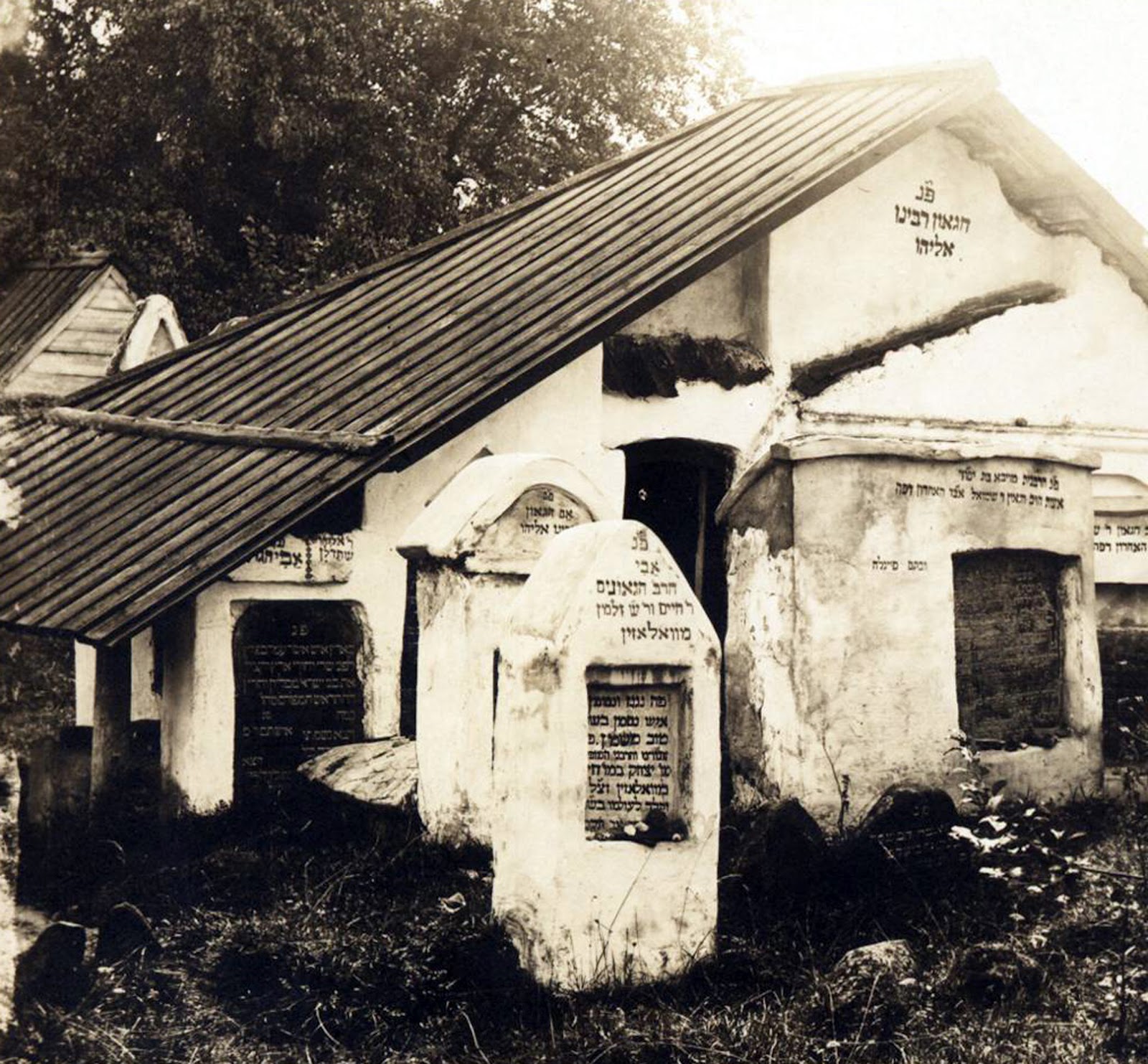
            This, then, is a complete list of all those who were buried in the original Ohel ha-Gra in the old Jewish cemetery. That Klausner has the order perfectly right can be seen from the following photograph.
            Notice the inscription פ”נ הגאון רבינו אליהו in the center of the photograph, near the roof-top of the Ohel. Turning to the extreme left of the Ohel, where the roof slopes down almost to the ground, one can see two grave markers above a single tombstone.
            When enlarged, the inscriptions above the tombstone clearly read (from left to right): פ”נ אבי הגר”א and   ר’ אליהו שתדלן, exactly in the order recorded by Klausner (see above, grave number 20).  When we compare Klausner’s list with the present occupants of the Ohel ha-Gra, it becomes clear that those who moved the Gra from the first to the third cemetery, moved the graves numbered 22-26, a total of six persons altogether, from the original Ohel ha-Gra. The seventh grave, unmarked, remains unidentified and could have come from any part of the old cemetery, and not necessarily from the Ohel ha-Gra.
            When we enter the Ohel ha-Gra today, we need to bear in mind that we are entering from the south and looking north. We see the mirror image of what Klausner depicted on his map. Thus the expected order today should be:
            The expected order solves all our problems. On the extreme right, Devorah and her son R. Zvi Hirsch are buried next to each other. In the center, R. Noah and his wife Minda are buried next to each other. And the Gra is second from the left. It is the actual order that creates our problem. Devorah and R. Zvi Hirsch are separated; neither is buried next to his or her spouse. The Gra is buried in between R. Noah Lipshutz and his wife Minda. אין זה אומר אלא דרשני.
            One more piece of evidence needs to be introduced before we attempt to solve the problem. Israel Cohen, British Zionist and world traveler, visited Vilna twice before World War II. Regarding the Shnipishok cemetery, he records the following: Most famous of all is the tomb of the Gaon Elijah, who lies in the company of a few other pietists on a spot covered by a modest mausoleum which is entered by an iron-barred door.
The tombstones, with long eulogistic epitaphs, are not enclosed within the mausoleum, but stand at the back of it, in close juxtaposition and closely protected by a thick growth of shrubs and bushes.
Israel Cohen, Vilna (Philadelphia, 1943), pp. 415-416. Cf. his Travels in Jewry (New York, 1953), pp. 149-150.
4. The Solution
            It seems obvious that those who moved the Gaon to the new Jewish cemetery made one slight adjustment relating to the ordering of the graves. They moved R. Zvi Hirsch from the extreme right to the extreme left. We will never know with certainty why they did so. What was gained, perhaps, is that now all the males were together on the left, and all the females were together on the right. By moving R. Zvi Hirsch to the extreme left, the Gra was now the third grave from the left. But the actual order today appears to have the Gra as the fourth grave from the left, and buried in between R. Noah and his wife Minda.
            We need to remember that in the old Jewish cemetery the tombstones were outside the Ohel ha-Gra, each tombstone opposite the remains of the person it described, with text of the tombstone facing in a northerly direction. Indeed, every tombstone in the old Jewish cemetery was placed opposite the remains of the person it described, with the text of the tombstone facing in a northerly direction.
            We also need to remember that the Gra and R. Noah shared one tombstone.5
            The Gra’s epitaph was on the right side of the tombstone; R. Noah’s epitaph was on the left side of the tombstone. This was in perfect order, since inside the Ohel, the Gra was to the left of R. Noah, and R. Noah was to the left of, and next to, his wife Minda. In the new Jewish cemetery, the six graves were laid out exactly as in the old cemetery, with the exception of R. Zvi Hirsch as indicated. But it was decided to place the original tombstones inside the Ohel, at the head of each of the graves. Instead of facing in a northerly direction, with texts that could be read only by standing outside the Ohel, the tombstones, now reversed, faced in a southerly direction, with texts that could be read only when standing inside the Ohel. Doubtless, this was done in order to protect the historic tombstones from exposure to the elements, from deterioration, and from vandalism. Also, the tombstones now immediately identified who was buried in each grave. Unfortunately, when the single tombstone shared by the Gra and R. Noah was reversed and set up inside the Ohel, it automatically (and wrongly) identified the third grave from the left as R. Noah, and the fourth grave from the left as the Gra, and caused a split between R. Noah and his wife. In fact, the Gra is the third grave from the left, and R. Noah is the fourth grave from the left – and R. Noah is properly buried next to his wife Minda. In other words, all Jews who visit the grave of the Gra today, pray, and leave qvitlach, at the wrong grave (i.e., at the grave of R. Noah Mindes Lipshutz).
            The above solution was based upon an examination of the literary evidence, and upon an examination of photographs preserved mostly in books. I call this עד אחד  (one witness), that is, the testimony of תורה שבכתב  (i.e., the literary evidence). But a matter established by only one witness is precarious at best.6 Intuitively I was persuaded by the one witness, but hesitated to put the solution in print until more evidence was forthcoming. Fortunately, a surprise second witness has come forward בבחינת תורה שבעל פה  (i.e., oral history). Rabbi Yitzhak Zilber (d. 2003) was a courageous Jew who lived most of his life under Soviet repression between the years 1917 and 1972, before ultimately settling  in Israel. He published a riveting autobiography in Russian in 2003. It has since been translated into Hebrew and English. In his autobiography, Zilber describes how in 1970, under Communist rule, he visited the Ohel ha-Gra in Vilna. The Jew who took him to the Ohel had participated in the transfer of the Gra from the first Jewish cemetery in Shnipishok to the third Jewish cemetery in Saltonishkiu. As they stood before the Gaon’s grave, the Jew turned to Zilber and said:7
            Remember the following forever: the Gaon’s tombstone is above the
           fourth grave from the left, but the Gaon’s body is in the third grave [from
           the left].
על פי שני עדים יקום דבר!  “A matter is established by the testimony of two witnesses.”
NOTES
1
  This essay should not be confused with an earlier essay of mine with a similar title, “Who is Buried in the Vilna Gaon’s Tomb? A Mysterious Tale with Seven Plots,” Jewish Action, Winter 1998, pp. 36-41. The primary focus of the earlier essay was on the identification of the six persons buried together with the Vilna Gaon in his mausoleum (the Ohel Ha-Gra). The primary focus of this essay is on the identification of the  grave of the Vilna Gaon himself. A version of this essay was read at a conference in honor of Professor Daniel Sperber, held at Bar-Ilan University on June 13, 2011. It is presented here in honor of the Vilna Gaon’s  215th yahrzeit on 19 Tishre, 5773.
2
  The claim that the Vilna Gaon was moved temporarily from the first to the second Jewish cemetery appears, among many other places,
in Y. Alfasi, ed., וילנא ירושלים דליטא חרבה (Tel-Aviv, 1993), p. 9; Y. Epstein, “,דער יידישער בית-עולם אין ווילנע”   ירושלים דליטא, October-November 1996, pp. 5-6; and N.N. Shneidman, Jerusalem of Lithuania (Oakville, Ontario, 1998), p. 161. An examination of eye-witness accounts of the reburial of the Gaon, and of much other evidence, yields the ineluctable conclusion that the Gaon was moved only once, directly from the first to the third Jewish cemetery.
3
  See the references cited in the Jewish Action essay (above, note 1).
4
  So reads the Hebrew sign above the entrance to the Ohel Ha-Gra. But the Ohel Ha-Gra was constructed over a three-year period between 1956 and 1958. I cannot say with certainty when the sign first went up, but logic dictates it did not go up before there was an Ohel. In all the early photographs of the Ohel I have seen, there was no sign at all. It surely wasn’t there during the period of Soviet domination of Lithuania, which means it first when up sometime after 1991. As such, it is hardly evidence for who is buried in the Ohel Ha-Gra. More importantly, one of the participants in the reinterment of the Vilna Gaon testified that he and his colleagues wanted to move the remains of Avraham ben Avraham, the Ger Zedek of Vilna, but could not locate his ashes in the old Jewish cemetery. See R.Yitzchak Zilber, To Remain a Jew (Jerusalem, 2010), pp. 389-390.
5
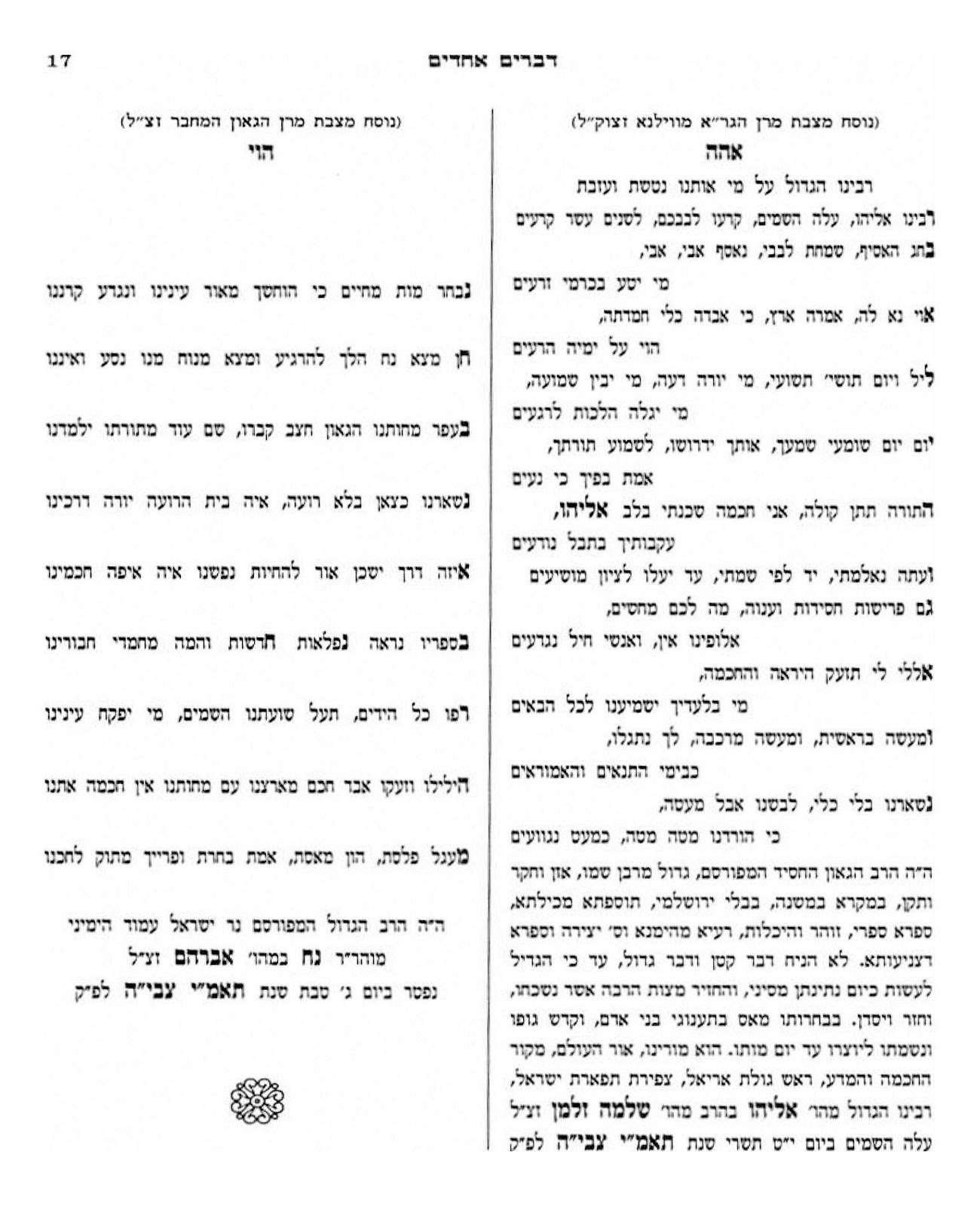
  For side by side transcriptions of the epitaphs on their tombstone, in clear Hebrew font, see R. Noah Mindes Lipshutz, פרפראות לחכמה (Brooklyn, 1995), p. 17.
6
  I was plagued by the remote possibility that the movers, precisely because the shared tombstone required the Gaon to be to the right of R. Noah, switched the remains of the Gaon and R. Noah, and deliberately buried the Gaon in between Minda and R. Noah. (I considered this a remote possibility, because it is highly unlikely that any rabbi would allow such tampering with who was buried to the immediate left and right of the Gaon. As is well known, R. Hayyim Zvi Shifrin [d. 1952] presided over the reinterment of the Gaon. See R. Yaakov Shifrin, קול יעקב [Jerusalem, 1981], pp. 26-30.) If so, all the tombstones are accurately positioned in the Ohel Ha-Gra, even today. Cf. my deliberations in American Jewish Monitor , October 24, 2003, p. 18.
7
  R. Yitzchak Zilber, op. cit. (above, note 4), p. 389.


On some new seforim, Copernicus, saying Ledovid , Moses Mendelssohn and other random comments


On some new seforim, Copernicus, saying Ledovid , Moses Mendelssohn and other random comments
By Eliezer Brodt

Here is a list of recent seforim and books I have seen around in the past few months. This is not an attempt to list everything or even close to it; rather it’s just a list of seforim and books on many random topics, which I have seen while shopping for seforim. I enumerated a few titles which I have a Table of Contents for. Please feel free to e-mail me for them.

1.   רשב”ץ על מסכת ברכות, אהבת שלום, עם הערות של ר’ דוד צבי הילמן

In this work they claim to have double checked the manuscript, thereby fixing some mistakes in the earlier edition of Rav Hilman. They included all of Rav Hillman’s notes

2.    חידושי הריטב”א, מהדורא בתרא, על מסכת קידושין מוסד רב קוק
3.   מנחת יהודה פירוש לתורה לר’ יהודה בן אלעזר מבעלי התוסופת, מכתב יד, על ספר בראשית, מוסד רב קוק, מהדיר: פר’ חזוניאל טויטו, מבוא של 176 עמ’ ורכ עמודים טקסט
4.     אבן עזרא, קהלת, מוסד רב קוק
5.    ספר המחלוקות, ספר הפשוטים, ר’ יהושע בועז [בעל ה’שליטי גיבורים’] ג’ חלקים, נדפס לראשונה מכתב יד על הספר ראה כאן
6.    אגרות ותשובות רבינו חיים בן עטר, בעל האור החיים הקדוש מכתב יד, כולל תפילה, ליקוטי
שמועות, תשובות ופסקים, מכתבים, קינות, הספדים, רעה עמודים.

This volume is nicely done, and it contains many new pieces never before printed. One thing that I found strange is when citing the sources for the various pieces, he did not bother to mention that some of them were already printed many years ago by Binyomin Klar in various journals. Later on they were collected in a volume called Rabbi Chaim Ibn Attar, printed by Mossad Rav Kook in 1951. Oddly enough they do quote some of the original places where Klar had printed the pieces first

7.    עטרת ראש לר’ לוי מקאנדי, על מסכת ברכות.
8.   יין ישן בקנקן חדש, על מסכת ברכות, מכון הדרת חן, תתקצב עמודים, אסופות חיבורים עתיקים מגדולי האחרונים שהיהו גנוזים מעיני הלומדים, בעריכה חדשה בתוספות מראה מקומות מפתחות ותולדות, [עשרים ספרים]. בין הספרים, ולא עוד אלא, בכור שור, גפן פוריה, ויאמר שמואל, לווית חן, מלך שלם, מירא דכיא, גנזי יוסף, למנצח דוד, זרע יעקב, ארץ החיים, איי הים, רוב דגן, מעיל שמואל, קהלת יעקב, צרור החיים, לשמוע בלימודים, ברכת דוד, מכתב לחזקיהו, ילקוט הגרשוני.
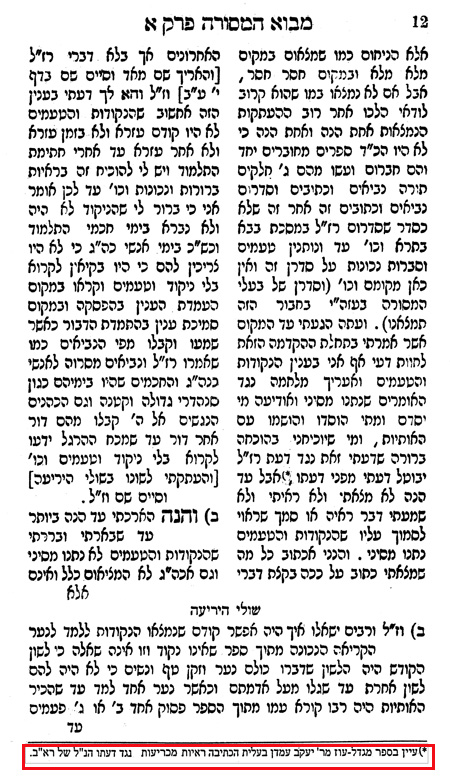
9.     מבוא המסורה, ר’ יוסף קלמן מקאסוויע, נדפס בווארשא תרמ”ט, 112 עמודים.

This work, first printed in 1862 and again in 1889 deals, with the subject of the Masorah by Rabbi Yosef Kalman. One of the points of interest to me about this work is that it received many different haskamot from gedolim of the time. This of interest because the first 15 pages of the work quotes many passages from R. Eliyahu Bachur’s classic work on the subject, including his controversial opinion about the post-Talmudic origin of the nekkudot. Now in the comments on the bottom of the page the author writes that this was already disproven (more on this shortly) but he had no problem to quote this controversial opinion in the main text of the work without arguing on it in the main body or censuring the Tishbi in any form. This is in sharp contrast to the work Nekudot Hakesef printed in 2001.

Now what is interesting is that the person who just printed this new work (someone from Bnei Brak) felt he had to add in one comment to this sefer, so right in the beginning of this long quote from R. Eliyahu Bachur he added in the following:

עיין בספר מגדל עוז מר’ יעקב עמדין בעלית הכתיבה ראיות מכריעות נגד דעת הנ”ל של רא”ב

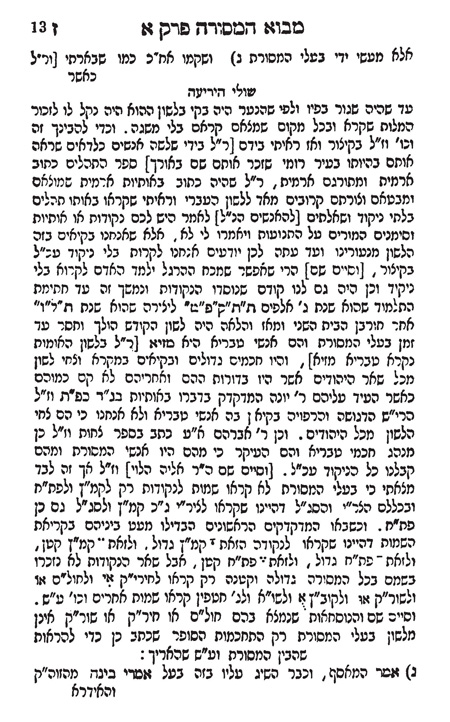
What’s interesting is that on the next page the original author of the sefer writes:

אמר המאסף וכבר השיג עליו בזה בעל אמרי בינה מהזוה”ק והאידרא שהנקודות היו קודם חתימת התלמוד ע”ש באורך הביאו הרמבמ”ן בהקדמתו על התורה ע”ש

I am positive that the recent printer of this sefer did not realize who this was. The original author of this sefer is quoting the Meor Einayim from Rabbi Azariah Min Hadomim who is quoted by Moses Mendelssohn in the introduction to his Chumash, where Mendelssohn quotes him in regard to the origin of the Nekudot. Possibly we can see from this another piece of evidence that it was not considered so bad to quote from Mendelssohn at that time, and especially how well known Mendelssohn’s introduction was. Apparently the printer did not realize the initials הרמבמ”ן refers to Mendelssohn. For a recent case of someone not realizing what these initials are see he work on the Koheles falsely attributed to the Malbim by Oz Vehadar [See Yeshurun 25 pp. 724-735, (PDF available upon request)]

One more addition to all this, in 1870 Rabbi Yosef Kalman put out another sefer on the subject called Shaar Hamesorah which received haskamot from Litvish Superstars of the time. In the introduction he returns to the subject of the origin of nekkudot and again he quotes the Meor Einayim of Rabbi Azariah, who is quoted by Moses Mendelssohn. However here he makes a strange mistake of thinking that the Rabbi Azariah quoted by Mendelssohn was the Rama Mepano!

Returning to the work Mevo Hamesorah, one last discussion of his worth nothing is about Ibn Ezra and his opinion of the origin of Nekudot (pp. 104-105).
[For more on the subject of Nekudot see Dan Rabinowitz’s excellent article available here; Jordan Penkower, The Dates of Composition of the Zohar and the book Bahir (Heb.) Cherub Press; Rabbi Dovid Rothestein work available here. See also my Likutei Eliezer, pp. 71-72]

10. יד יהודה, ר’ יהודה לנדא, תשובות פסקים וכתבים, מכתב יד, קלו עמודים
11. חמודי דניאל עם פ’ רחבת ידים
12.  חמודי דניאל על הלכות נדה, נדפס לראשונה מכתב יד בתוך ספר מעין בינה על מסכת נדה
13. קשר תורה, [לקשר סוף התורה לתחילתה] נדפס פעם ראשונה ווילנא תרסז, ר’ יצחק מו”צ בעיר ריטווא, 112 עמודים.
14. קול חיים, סדרי לימוד ותפילות להגיע האדם לגיל שבעים שנה ואילך, ר’ חיים פאלאג’י, מכון אהבת שלום
15. הקללה לברכה, הלכות איסור קללה, ר’ מרדכי גרוס, קמה עמודים
16.  מנהג אבותינו בידינו, ר’ גדלי’ אבעלראנדר, ביאורים ובירורים במנהגי ישראל מקורותיהם ושרשי טעמיהם, שבת, נישואין שונות, תסד עמודים, ניתן לקבל תוכן העניינים.

This volume is a collection of Rabbi Oberlander’s articles originally printed in the journals Or Yisroel and Heichel HaBesht as well as other places. These essays are very organized and well written on a wide range of interesting topics, all based on a nice collection of sources. I highly recommend this work. Of course one can always add to such collections of material here but לא המלאכה עליך לגמור .

17. אני לדודי, שיחות מוסר וחיזוק לחודש אלול וימים נוראים, ר’ שריה דבליצקי, קעג עמודים
18. ישא יוסף, אורח חיים חלק ב, ר’ יוסף אפרתי, רכו עמודים
19. הטבילה בהלכה ואגדה, ר’ משה סופר, תסד עמודים
20. ביד נביאך, בעניני הפטרות ונביאים, כולל אסופות תשובות ומאמרים בהלכה ואגדה, פרקי הלכה בעיני הפטרה וכתיבת נביאים, כולל כת”י של האדר”ת  על נביאים וכתובים בשם ‘נביאים טובים’, הלכות הפטרה להגר”ש דבליצקי, וס’ סימנים על עניני הפטרה  ונביאים, תרב עמודים
21. שעות שוות בהלכה, כולל מחקר וסקירה על תולדות הפחתות מדידית הזמן לאורך הדורות, ר’ יצחק זילבער, שצ עמודים
22. שמות בארץ, שמות אנשים, ממשנתו של מרן ר’ חיים קניבסקי, דיני וענייני שמות  אנשים ונשים ובשווי שמות בשידוכין, וקו’ שמות נשים, ר’ צבי יברוב, קלט עמודים
23.  ברכת הלבנה, הלכות ומנהגים, ר’ יוסף אדלר, קב עמודים
24.  בים דרך, מאמרי עולם חלק א, ר’ מיכל זילבר, שסז עמודים
25. גם אני אודך על ענייני ברכת כהנים, ר’ גמליאל רבינוביץ, תרלב עמודים
26. ספר פת שחרית כהלכה, ר’ יששכר דוב הופמן, צו עמודים

This is another work from the author of the now-famous recent work all about sneezing in Jewish law..

27. מאורות הגר”א, חלק ב, ר’ רובין, שפ עמודים
28. ר’ ראובן פרידמן, כי עת לחננה, הליה וישיבה בארץ ישראל, 490 עמודים, מוסד רב קוק
29. ר’ ישראל גארפינקל, כיצד מרקדין, בענין ריקודין של מצוה מצוה טאנץ, רמח עמודים
30. חזון עובדיה, שבת חלק ה, ר’ עובדיה יוסף הל’ צובע, קושר ומתיר, תופר צד ממחק כותב ומוחק, השמעת קול, בונה, אוהל, מתקן מנה, תד עמודים
31.הלכה ברורה חלק יג, ר’ דוד יוסף, סי’ רמב-רנב, תקלו +צ+נד עמודים
32. זהב לבושה, איסור פאה נכרית, הלכה הגות מחשבה, שכד עמודים
33. לוח ההלכות והמנהגים לשנת תשע”ג, 372 עמודים
34. קוטנרס האינטרנט בהלכה, קב עמודים
35. ישועות כהן, ר’ יהושע אדלר, ביאור סוגית קוי התאריך, צג עמודים
36. ספר תהלים עם פירוש מפורש, כולל ביאורים על תרגום כתובים ר’ לייביש דיייטש, תק”ח עמודים
37. שערי חג הסוכות, הלכות סוכה, ד’ מינים הו”ר שמיני עצרת ושמחת תורה, ר’ יהודה טשזנר, תקל עמודים
38. קובץ תשובות חלק ד, ממרן ר’ אלישיב זצוק”ל,  שכט עמודים, כולל מפתחות על לארבע כרכי קובץ תשובות, 73 עמודים
39. הערות במסכת ברכות, מר’ אלישיב זצוק”ל, תקמא עמודים
40.  כתבי הגרי”ש, בהלכה ואגדה, מכתבי יד של ר’ אלישיב זצוק”ל, ימים נוראים וסוכות, קס עמודים
41.  אשרי האיש, פסקי מרן הגרי”ש אלישיב זצוק”ל, יורה דעה, ב’ חלקים נלקט ע”י ר’ יחזקאל פיינהנדלר
42.  רישא דגולתא הספדים על ר’ אלישיב זצ”ל
43. שו”ת פוע”ה מניעת הריון, קובץ שאלות רבני פוע”ה ותשובות של פוסקים, 141 עמודים
44.  באמונה שלימה, ר’ יוסף בלאך, תרם עמודים

This work is written by Rabbi Yosef Bloch, who is a well-known Talmid Chacham from Monsey. In this volume Rabbi Bloch deals with many “hot” issues related to Emunah, bringing many interesting discussions to the table. Just to list a few side points of his: he brings that some say that the Chazon Ish’s work Emunah Ubitachon was never supposed to be printed (pp. 69-70) as the Chazon Ish never wanted it printed. He also deals with a piece that was censored from later versions of the Emunah Ubitachon (p. 39). He brings numerous sources against the Ralbag (pp. 140-141). He has a radical statement about what chazal mean when they say “there is wisdom by the Gentiles” (pp. 301-302):

דכל חכמת הגוים הוא בדברים גשמיים דוקא וכגון מכוניות סעלפאון כלי השחתה למלחמה וכדומה, שם ורק שם יש להם חכמה,… ברוחניות אין להם שום מגע והבנה כלל, ותיקון העולם הוא עצמו איבוד חכמיהם וזה כלל גדול בהבנת ענין חכמת האומות בברזל ובעצים ואבנים ובאלקטריק יודעים קצת, בצומחים יודעים פחות מזה בגופות בעלי חיים יודעים הרבה פחות מזה, בגוף האדם עוד הרבה פחות מזה, בחכמת התכונה השמיימית עוד הרבה פחות בנפשיות האדם
יודעים משהו ממשהו ממש , בחכמה עליונה אפס מוחלט לא כלום!

He has a radical explanation for the famous Gemarah about killing lice on Shabbas (pp. 305-307). Another very interesting discussion of his is about the sugyah of Elu Ve-elu Divrei Elokim Chayim (pp. 308-323).

A few years ago I wrote a few comments (here) about Rabbi Bloch’s work against Copernicus. I recently revisited the topic in the last issue in Hakirah. In this new volume Rabbi Bloch includes his anti-CopernicanEssay but with various updates. If one reads the essay carefully one can see many of these updates he is referring to points in my article. Hopefully in the future I will deal with all the issues he raises but for now I would just like to mention two points at one point he writes (p. 358):

ולא מצאתי אחד מגדולי ישראל מכל הדורות שיחזיקו אפילו במקצת דמקצת כדעת התוכנים ומה שהעידו בשם קדוש ה’ המהרי”ל דיסקין זצוק”ל דהיהו סבר ככה, שקר העידו בו דלא כך היה מעשה אלא שענה שלואל דאין הכרח נכד
התוכנים מלשון הברכה כמדומה ממה שנקראת ברכת החמה אבל מעולם לא יצא מפיו הקדוש דנקט איהו כהתוכנים.

I honestly have no idea what he is talking about but as I brought in my article (p.29) the source says as follows:

“וכן אמר לי ידידי הרב וכו’ ר’ אבנר נ”י בעל המחבר סי’ ציר נאמן, בתורת עדות ששמע מפי רבנו הקדוש רשכבה”ג מהרי”ל דיסקין זצוק”ל שהשיטה החדשה אינה מופרכת. ושאל לו מן הכתוב בקהלת א’ וזרח השמש ובא השמש וכו’ הולך על דרום כו’ וענה לו שהכתוב אמר לפי ראות עיני האדם”.

I also explained there (p. 31) why this sources is very reliable. But what bothered me even more was what he writes there on pg. 359.

 ומה שכמה מהמשגיחים וראשי הישיבות מהדור הקודם נ”ע כתבו דרך אגב בין הדברים בספריהם… כשיטת קופעריקוס, אין מזה שום הוכחה כלל לדעת התורה בענין הזה, דלא באו אותם הגאונים זללה”ה ליקח עמדה בהדיון הזה, דלא היתה זו הסוגיא שלהם ולא ידעו שיש בזה סתירה להשקפת התורה שלא ניסו בכגון אלו ולא עיינו בה, ונסתמכו דכיון דככה אומרים הכל מסתמא הוכיחו התוכנים דהאמת כן הוא, ולא ירדו לסוף דעתם של התוכנים לידע שכוונתם עקירת האמת ואין מדבריהם ז”ל הוכחה של כלום, וכאילו לא אמרו כלום בנידון הזה

Now besides for the haughtiness of this statement the only Rosh HaYeshiva I quoted in my article that wrote an essay very pro Copernicus was Rabbi Yonah Mertzbach someone who had a college degree in these areas so I am not really sure what he is talking about.

One last source related to this topic of Copernicus was brought to my attention in a collection of things by Rabbi Zerach Shapiro who was close with the Chazon Ish (part of this booklet was printed in Yeshurun volume 26) where he asked the Chazon Ish about Copernicus:

בענין מה מסתובב השמש או כדור הארץ, אמר שאין הכרעה בדברי חז”ל.

One last point in regard to Rabbi Bloch’s book is he prints an unprinted essay of his father’s, extremely anti Zionistic and the Mizrachi from 1943 (p. 115-116). I think the reason why he is printed this letter here, while it may otherwise seem out of place, is rather simple. In the same issue of the Hakirah where my essay about Copernicus appeared he saw another article froms Elazar Muskin, When Unity Reigned Yom ha’azmaut 1954 which deals with Rabbi Bloch positive attitude to Yom ha’azmaut.

קבצים
1  המעין גליון 203, ניתן לקבל תוכן העניינים
2. אור ישראל גליון סה, שפג עמודים, ניתן לקבל תוכן העניינים
3.  היכל הבעל שם טוב, גליון לד, קצב עמודים
4.  מוריה גליון שעג-שעד
5.  ארזים, גליון א, גנוזות וחידושי תורה, מכון שובי נפשי, תקפח עמודים [כולל רס עמודים של כת”י על ענינים שונים]
6.    קובץ בית אהרן וישראל גליון קסב, ניתן לקבל תוכן העניינים.
This issue includes another attack on Rabbi Dovid Kamentsky (PDF available upon request].

7.  עץ חיים גליון יח, ניתן לקבל תוכן העניינים
8.   ישורון חלק כז,  תתקמ”ב עמודים, ניתן לקבל תוכן העניינים

One piece worth mentioning in this issue is the complete manuscript of the Meishiv Nefesh printed for the first time, edited by Rabbi Yehudah Hershkowitz (59 pp).

מחקר ועניינים שונים
1.  גאון ההוראה אחרי 50 שנה:  היסטוריה, הגות, ריאליה; קובץ מחקרים בעקבות יום העיון במכללת אפרתה על הרב צבי פסח פראנק / עורך – ישראל רוזנסון, קע עמודים, מכללת אפרתה.
2.  המסע האחרון, מאתיים שנה למסעו בעל התניא בעיצומה של מלחמת נפוליאון תקע”ב-תשע”ב, [לאור מסמכים ותעודות, חדשים גם ישנים, וגם סיפורים ושמועות דרושים ומאמרים], יהושע מונדשיין, 378 עמודים.
3.  נתיבי מאיר, אסופות מאמרים, מאיר רפלד, 456 עמודים ]ניתן לקבל תוכן העניינים]

This is a beautiful collection of Dr. Rafeld’s articles on a very wide range of topics. Some of the articles relate to Rishonim on Chumash and many others relate to the world of minhag and Tefilah. There is also a nice collection of important articles related to the Maharshal and his generation (one of Rafeld’s specialties). All these articles show a great breadth and depth in each of their perspective subjects.
4.  הרב פנחס הירשפרונג, מעמק הבכא הנאצי, זכורנות של פליט, 215 עמודים
5.  ר’ יחזקאל סופר, במאי קמיפלגי, הפולמוס המשיחי בתנועת חב”ד, 408 עמודים
6.  הלבוש היהודי באירופה במהלך הדורות, הלכה, מנהגים, גזירות מאבקים, תקנות, מנחם מקובר, ניתן לקבל תוכן העניינים.
7. אביר הרועים, קורות העתים הנהגתו ומשנתו של ר’ עובדיה יוסף, משנת תרפ”א-תשי”א,יעקב ששון, 320 עמודים
8.  רבן של ישראל, מראות קודש ממרן פוסק הדור הגרי”ש אלישיב זצוק”ל, 219 עמודים
9.  יש”א שלום, הערכתו של הגרי”ש אלישיב זצ”ל כלפי מרן הראי”ה קוק זצ”ל, 58 עמודים
10.  הדף היומי, ר’ דוד מנדלבוים
11.  רועה ישראל, על ר’ ישראל יעקב פישר, חלק ב
12. יהדות התורה והמדינה, ר’ אוריאל צימר, בירור רעיוני קצר בשאלת היחס לציונות ולמידנה עם קצת פרקי היסטוריה מן העבר הקרוב, 47 עמודים,
13.  מפיהם אני חיים, ר’ משה קנר, מאמרים על תלמוד בבלי וירושלמי, רב האי גאון, רבינו גרשום, רש”י בעל התוספות, מהר”ם מרוטנבורג וגדולי ספרד, 375 עמודים.
14.   משונצינו ועד וילנא, תולדות הדפסת התלמוד, ר’ יעקב לופיר, 310 עמודים,

I hope to review this book at length here shortly.

15.   משה אידל, שלמויות בולעות קבלה ופרשנות, ידיעות ספרים, 695 עמודים
16.   רשימת הפירסומים, יוסף דן, תשי”ח-תשע”ב, 205 עמודים
17.   יעקב לאטס, פנקס קהילות רומא, שע”ה-תנ”ה, כולל מבוא והערות, מכון יצחק בן צבי, 409 עמודים
18.   משנת ארץ ישראל, שמואל, זאב, וחנה ספראי, מסכת פאה
19.    משנת ארץ ישראל, שמואל, זאב, וחנה ספראי, מסכת כלאים

After recently completing Seder Moed they are now almost finished with Seder Zerayim.

20.  צדיק יסוד עולם, השליחות הסודית והחוויה המיסטית של הרב קוק, סמדר שרלו, 444 עמודים, אונברסיטה בר אילן
21.  דעת גליון 73
22.  מקראות גדולות – `הכתר`-שמות א`-מהדורה מוקטנת
23.  משה פלאי, עטרה ליושנה, המאבק ליצירת יהדות ההשכלה, 501 עמודים, קיבוץ המאוחד
24.  ללמוד את שפת המולדת, מאמריו של י”ל גורדון בשנים 1881-1882, [מאמרי ביקרות על ספרים ועוד], מוסד ביאליק, ספריית דורות, 367 עמודים
25.  כִּתַאבּ אַלנֻּתַף: פירושו הדקדוקי של ר’ יהודה חיוג’ לספרי נביאים בעיבוד עלי בן סלימן מאת אהרן ממן ואפרים בן-פורת, אקדמיה ללשון העברית
26.   פרקי עיון בעברית החדשה ובעשייה בה מאת משה בר-אשר, אקדמיה ללשון העברית  
27.  מקורות ומסורות, סדר ניזקין, דוד הלבני, מגנס
28.  ההלכה: הקשרים רעיוניים ואידאולוגיים גלויים וסמויים, מגנס
29.  סידור תפילות בלאדינו, סלוניקי, המאה השש עשרה, מכון יצחק בן צבי
30.  רעואל וחבריו פרשנים יהודיים מביזנטיון מסביבות המאה העשירית לספירה, גרשון ברין, אוניברסיטת תל-אביב
31.    רבי חיים בן עטר ופירושו אור החיים על התורה, אלעזר טויטו, 291 עמודים, מכללת אורות ישראל
32.  מחשבת ישראל ואמונת ישראל, בעריכת דניאל לסקר, אוניברסיטת בן גוריון, 293 עמודים בעברית, 186 עמודים באנגליש, ניתן לקבל תוכן העניינים.

This volume has many interesting articles. Worth mentioning is Marc Shapiro’s Is there a Pesak for Jewish Thought and  David Shatz ‘s article Nothing but the truth? Modern Orthodoxy and the Polemical uses of History. In the first footnote Shatz mentions Marc Shapiro’s posts on the Seforim Blog. Much can be added to this essay but of note is footnote 28 where he writes:

To be clear, academics, I find, generally shun blogs that are aimed at a popular audience because the comments are often, if not generally, uninformed (and nasty). A few academics do read such blogs, but do not look at the comments. One result of academics largely staying out of blog discussions is that non-experts become viewed as experts. Even when academics join the discussion, the democratic atmosphere of the blog world allows non-experts to think of themselves as experts and therefore as equals of the academicians. Some laypersons, though, as I said earlier, are indeed experts in certain areas of history.

33. חקרי קבלה ותפילה, משה חלמיש, אוניברסיטת בן גוריון, 458 עמודים ניתן לקבל תוכן העניינים

This work is a collection of twenty five articles by Professor Hallamish about tefilah and kabbalah. Some of these articles appeared in print in various journals, festschrifts and memorial volumes, others are supposed to appear soon, and some were written specially for this volume. They all share the common denominator that they are based on research of an incredible amount of manuscripts and rare volumes. I have no idea how he had patience to open up that many books! Based on these discoveries Hallamish shows the influence of Kabbalah on tefilah. One can also find wealth of information on nussach of Tefilah in these volumes. There is a lot to comment on different points on this volume.

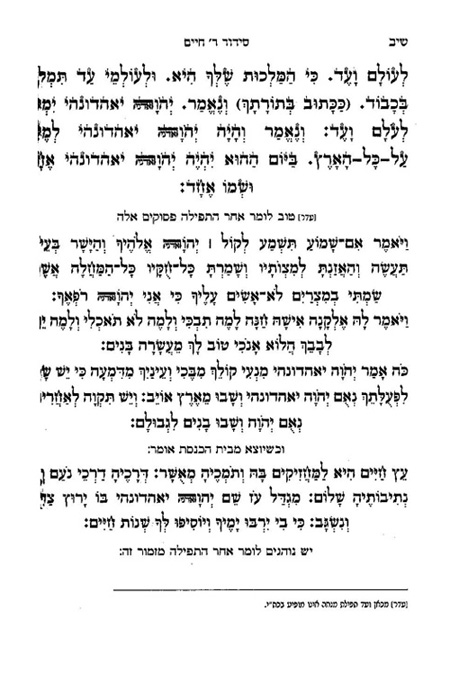
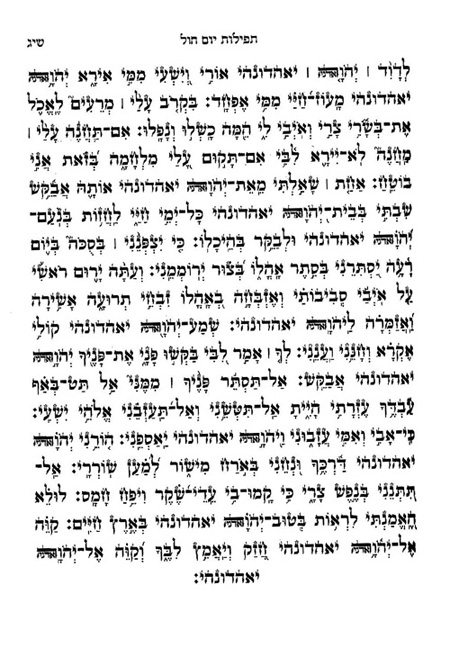
Just to make one small comment as it relates to Elul and a subject I have written about. In chapter thirteen he deals with sources for the custom of saying Ledovid in Elul. He brings early sources for saying it all year around. He quotes the Siddur Shaarei Rachamim which brings this custom to say Ledovid. Now the importance of this find is that this siddur is based on R.Chaim Hacohen who was a Talmid of Rabbi Chaim Vital. If this source is reliable then we have an earlier source for this custom. The first person (not noted by Hallamish) to point to this siddur for an early source for saying Ledovid in Elul was Rabbi Yakov Rokeach in his work Shaarei Tefilah, first printed in 1870. Now it’s well known that the editor of this siddur, Chaim Abadi, added in lots from the Chemdas Yamim and other sources so it’s not so simple if one can consider this siddur a reliable source. However, recently Rabbi Goldhaber checked up the many manuscripts of the actual siddur of R. Chaim Hacohen and found that the custom of saying Ledovid does not appear anywhere in it. Recently part of this siddur was printed by Mechon Zichron Aharon and the custom of Ledovid does appear inside this siddur. So based on this new printed siddur Hallamish has a very early source for saying Ledovid.

First of all what is clear is this is not a source to say Ledovid specifically during Elul but rather an early source to say Ledovid the whole year around. Earlier in this siddur where R. Chaim Hacohen has various chapters of Tehilim to be said on special days he does not include Ledovid to be said during Elul. However at the end of davening Ledovid appears in this new siddur. But more importantly one has to be careful to read the fine print on the page as above where it is printed to say Ledovid in small print the editor adds in that saying Ledovid here does not appear in the original manuscript! Now all this is rather strange; why did he bother adding this in? This is not the place for it as it should be earlier in the siddur with the other chapters said on special days. Even more interesting is that the editor of this siddur says that they decided that four of the manuscripts are authentic but all others have parts added in so they are not going to print all added in pieces  so the question is why did they choose to add in Ledovid
and add nothing else in this printed version.

A few months back I mentioned that the new work by David Assaf Hazitz Unifgah appeared in print. I noted that a complete bibliography of the sources that were used for writing this book was printed in the recent volume of Mechkarei Yerushalayim 23 (2011) pp. 407-481. This was not included in this new work. Recently this bibliography appeared on line here.

English 

1. The Tent of Avraham, Gleanings from the David Cardozo Academy, edited by Nathan Cardozo, Urim Press. 232 pp.
2. Inside Stam, A complete buyers Guide, Rabbi Reuvain Mendlowitz, Israel bookshop, 440 pp.
3.Edward Fram, A Window on Their World: The Court Diaries of Rabbi Hayyim Gundersheim Frankfurt am Main, 1773-1794, Wayne State Univ Press, 653 pps.


What’s Wrong With Wealth and Honor?

What’s Wrong With Wealth and Honor? 
by Eli Genauer
                                                                    
Below, we will present some timely notes regarding an English/Hebrew Machzor for Rosh Hashana which was printed in England in 1807.  We will touch upon a variety of issues, and thus first present general backgrounds regarding Hebrew printing in London, the prayer for the state, and Kol Nidrei.  
Hebrew Typography in London  
The earliest use of Hebrew typography in England is sometime in the middle to the late 1520s.  Of course, at that time, Jews were banned from England and the earliest works containing Hebrew type in England were produced for non-Jews.  
The prize of first was thought to go to Thomas Wakefield’s publication of his address regarding “Three Languages” – Hebrew, Arabic and Chaldean (Oratio de laudibus et utilitate trium linguarum [link]). The type, as you can see, was quite primitive.
This lecture was given in 1524, and as the book itself is undated, it was assumed that the lecture was published soon after it was given.  Thus, many dated it to 1524/25.  Wakefield, a noted Hebraist, actually spends the majority of the book discussing Hebrew and the other two languages get short shrift.[1]   
Recently, however, the dating of this work has been challenged and been shown to likely incorrect.  The author, in the self-described “Holmesian manner,”[2]   highlights the various persons Wakefield claims to have tutored in Hebrew and the honorifics used to describe those persons.[3] Based upon some of the descriptions, it seems likely that Wakefield’s work was not published prior to 1527 and most likely in 1528.   [4] This conclusion, coupled with the dating of another work by a different author, unseats Wakefield’s book claim to first.  Instead, Richard Pace’s Praefatio in Ecclesisten, printed in August 1527, is the most likely candidate for the first use of Hebrew typography in England.[5] Here is a sample:
It took nearly two hundred years after the appearance of Hebrew typography for the first Hebrew book published for a Jewish audience in England.  The controversy surrounding R. David Nieto’s remarks and their affinity or lack thereof to Spinoza would produce the first printed Jewish Hebrew book in England.  The first was a very small one, only a few pages, of a responsum written by R. Tzvi Ashkenzi, in R. Nieto’s defense, and published in 1705. It included both Spanish as well as Hebrew (available here).[6]   For more on R. Nieto and this controversy, see the Seforim Blog’s earlier post here
The Prayer for the Welfare of the State
The prayer for the welfare of the king or ruler is ancient.  Many point to the statements of Ezra as well as the passage in Avot as early sources for the prayer.  A variety of rationales are offered for this obligation.  For example, Rabbenu Yonah interprets the need for these prayers as indicative of a Universalist worldview, which requires all humans to display empathy for one another.  In order to effectuate that goal, Jews therefore pray for not only the Jewish leaders but also the secular one.  R. Azariah di Rossi, claims that the prayer carries a pacifist message as he emphasizes the lack of allegiance to a specific ruler or country and thereby transforms the prayer into one arguing for peace among all nations. 
The earliest extant prayers are from the Geniza, and can be dated to between 1127 and 1131.  The prayer is for the “Fatimid caliph al-Amir bi-ahkam Allah who ruled Egypt and its regions during the years 1101-1131.” See S.D. Goitein, “Prayers from the Geniza for Fatimid Caliphs, the Head of the Jerusalem Yeshiva, the Jewish Community and the Local Congregation,” in Sheldon R. Brunswick, ed., Studies in Judaica, Karaitica and Islamica: Presented to Leon Nemoy on His Eightieth Birthday (Ramat-Gan: Bar-Ilan University Press, 1982), 47-57.[7]   In this instance, the prayer includes not only a prayer for the secular ruler, but also a prayer for the local Rosh HaYeshiva.  Additionally, it blesses all of the Rosh HaYeshiva’s deceased predecessors, providing a nice genealogy. Goiten posits that these prayers may have been written in response to specific historical events and may not be indicative of the general practice in 12th century Egypt.  See id. at ___. 
The earliest sources, however, do not include the modern formulation of HaNoten Teshua.  Instead, early on there was a lack of conformity regarding this prayer.  Kol Bo records the custom but indicates that each community had its own practices.  But, none used the HaNoten Teshua formulation.  The first extant example of HaNoten Teshua is found in a Spanish manuscript dated between 1479-92.[8]   Ironically, this example was prepared for King Ferdiand V, who, in 1492, issued the expulsion order.  
It appears that with the expulsion and dispersion of the Spainish Jews, the HaNoten Teshua was disseminated throughout the Jewish world.  Indeed, the inclusion of this prayer in Yemenite rites, appears to undermine a major thesis of the noted Yemenite scholar, R. Yosef Kapach.  He asserts that the rite presents a pristine rite, unchanged over hundreds of years.  But, as the Yememite rite includes HaNoten Teshua, which is from the 15th century, indicates that the Yemenite rite is less pristine than Kapach would have it. [9]  
The prayer is also linked to the readmission of Jews into England.  Menasseh ben Israel in his plea  for readmission of the Jews to England (link) provides the full text – in English – of the HaNoten to demonstrate the Jews’ loyalty to their rulers.[10]
A English Hebrew Machzor Printed in London
The Jewish Encyclopedia notes “In 1794 David Levi published an English version of the services for New-Year, the Day of Atonement, and the feasts of Tabernacles and Pentecost, and thirteen years later gave a new version of the whole Mahzor. This second edition was “revised and corrected” by Isaac Levi, described as a “teacher of the Hebrew Language.”
The Machzor features a frontispiece with various engravings of the Jewish holidays. The engraving for Shavuos features Moshe Rabbeinu dressed in a manner probably unknown 3,000 years ago, and holding the Aseres HaDibros with the numerical sequence from left to right. Yom Kippur correctly shows two identically sized “Se’irim” as per our tradition.
If you look closely at the name of the engraver, you will see that it was done by an R. Gavey.
I tried to find out more about R. Gavey and finally came upon a website which dealt with his family. I sent an email to the address listed and waited and waited. Two years later, I received the following response from a fellow in Australia:

“Robert Gavey b.1775 London was my 4xGreat Grandfather. He is listed as an engraver. Both his father and grandfather were watch makers.  Robert Gavey’s daughter Harriot Angelina Gavey  married my 3x Great Grandfather whose son James Fletcher  emigrated to Australia 1852. The Fletchers were originally Huguenot silkweavers with the surname Fruchard and I believe the Gavey’s would have been Huguenots also.” 

It turns out that Robert Gavey’s Australian descendent had a copy of his certificate of indenture as an engraver to a goldsmith named William Norris. Robert was 15 years old at the time (1790) and his period of indenture lasted for seven years. He promised not get married during that time period or play cards or dice. He also was forbidden to frequent taverns or playhouses or engage in any act which would cause his master a loss of money. (Click to see a large, high-resolution image.)


The certificate of indenture was signed in May of 1790 which was noted as the thirtieth year of the reign of George III who is described as the king of Great Britain, France, and Ireland.
Speaking of George III, he received much better treatment in this Machzor than in our American Declaration of Independence. On our side of the pond, we know George III as a man who “ has plundered our seas, ravaged our Coasts, burnt our towns, and destroyed the lives of our people.” As part of the agreement by Cromwell to allow Jews back into England, the Jews promised to always pray for the welfare of the ruler. Accordingly, this Machzor blesses King George in this manner:

This is not the only edition that continued to praise the monarch.  Isaac Lesser, published the first complete machzor in the United States in 1837-38, for the Spanish and Portuguese rites with an English translation.  Lesser’s translation relies heavily upon that of David Levi’s translation.[11]   In an attempt to sell his machzor in both the United States as well in other English-speaking locals, he includes two version of the prayer, one asked that God “bless, preserve, guard, assist, exalt, and raise unto a high eminence, our lord the king.”  The other, replaced this phrase with the request that God “bless, preserve, guard, and assist the constituted officers of the government.”[12]  

The person who finally brought the prayer for the government more in keeping with American democratic values was Max Lilienthal (1814-1882).[13]   While some had been willing to change the prayer, they did so only in the vernacular but retained the Hebrew HaNoten Teshua.  Lilienthal, however, totally reworked the prayer, altering its tone and focus.  Lilienthal removes all mention of kings, focuses on the country more than its rulers, and seeks to bestow God’s blessing, not on the ruler but on all the inhabitants of the land.  This version was included in Henry Franks’s Teffilot Yisrael, a siddur containing the Orthodox liturgy. This siddur was first published in 1848, and reissued in more than 30 editions.  As Sarna notes, the acceptance of the prayer is somewhat ironic in that Lilienthal, later became part of the American Reform movement, was the author of a prayer that became the standard even in Orthodox siddurim.[14]  Id. at 436.

Aside from changing the text of the prayer to fit American sensibilities, how the prayer was recited was also changed.   Congregation Shearith Israel, in New York, after the revolutionary war, “ceased to rise for Hanoten Teshu’ah. According to an oral tradition preserved by H.P. Solomon, ‘the custom of sitting during this prayer was introduced to symbolize the American Revolution’s abolition of subservience.’”[15]

The United States was not the only country to undergo significant changes to its governmental structure.  France, in 1787, abolished (temporarily) the monarchy.   After which the prayer for the welfare of the government was radically changed.  Instead of praying for the benefit of kings and rulers, the French prayer focuses upon the Republic and its people.  All the biblical verses included bless the people and not the king.   [16] The prayer begins “Look down from your holy place on our land, the French Republic, and bless our nation, the French people, Amen.”

Other changes to the prayer, due to time and place, were common. For example, during the height of the Sabbati Zevi messianic frenzy, two versions of the prayer were produced, not asking to bless the secular ruler, but, instead, blessed Shabbati Zevi.

Today, the most significant change to this prayer has been the new prayer on behalf of the State of Israel.  The authorship of the prayer as well as its use is subject to controversy.[17]

In the most recent “Prayer For the State” news, French President François Hollande, specifically invoked this prayer when discussing French Jews’ relationship to the state.  He included in his remarks, translated in NYRB, commemorating the round-up of Jews at the Vélodrome d’Hiver: “Every Saturday morning, in every French synagogue, at the end of the service, the prayer of France’s Jews rings out, the prayer they utter for the homeland they love and want to serve. ‘May France live in happiness and prosperity. May unity and harmony make her strong and great. May she enjoy lasting peace and preserve her spirit of nobility among the nations.'” 

Kol Nidrei 
The Yom Kippur volume of this set contains a detailed “apology”for the Kol Nidre prayer. The Jews endeavored to incorporate themselves into general society and felt the need to emphasize that their word was binding on them. Kol Nidre was seen as indicating otherwise, so an explanation of the prayer was seen as necessary, both for Jew and Gentile. (See Y. Goldhaver, Minhagei Kehilot, Jerusalem: 2005, pp. 209-19 on the history of Kol Nidre and the controversy.) It concludes as follows.

Finally, I would like to focus on the special prayer said during the Yamim Noraim when the Torah is taken from the Aron Kodesh. It first appeared in the Siddur Shaarey Tzion of Rabbi Nathan Hanover and begins with the words “Ribbono Shel Olam”.

In it we ask Hashem to remember us for a long and good life, with everything that comes along with that. We include in our request that Hashem should provide us with “Lechem Le’echol, Beged Lil’Bosh, V’Osher V’Chavod”.  Let us see how David Levy translates these words.

As you can see, the request for “wealth and honor” is nowhere to be found in the English translation. I was curious about this and asked Dan Rabinowitz for his opinion. He offered that it is possible that this Machzor was printed at a time when the English community was quite interested in the Hebrew language. Non-Jewish scholars eagerly bought any books printed in Hebrew. As such, it could be that Levy decided to leave out the reference for our desire for wealth and honor because, well, maybe it was a bit too pushy on our part.

I hope all of you are blessed with a Shana Tova, even one that includes within it the promise of wealth and honor.

[1]  See Marvin J. Heller, The Sixteenth Century Hebrew Book, Brill, Leiden:2004, entry for Oratio and pp. 959-60 and the sources cited therein. But see Brad Sabin Hill, Incunabula, Hebraica & Judaica . . .” Ottawa:1981, #52 asserting that 1561 is the earliest introduction of Hebrew typography to England. It is unclear what the basis of that assertion is.

[2] Richard Rex, “Review: Robert Wakefield On Three Languages 1524,” The Journal of Ecclesiastical History 42:1 (Jan. 1991) 159.
[3] Richard Rex, “The Earliest Use of Hebrew in Books Printed in England: Dating Some Works of Richard Pace & Robert Wakefield,” Transactions of the Cambridge Bibliographical Society, Vol. 9, No. 5 (1990), 517-25.
[4] Id. at 517-18.
[5] Id. at
[6] See B. Roth, The Hebrew Printing Press in London, Kiryat Sefer 14 (1937), pp. 97-99.
[7] See also, Fenton,
[8] See Aaron Ahrend, “Prayers for the Welfare of the Monarchy and State,” in Aaron Ahrend, ed., Israel’s Independence Day: Research Studies (Ramat-Gan: Bar-Ilan University Press, 1998), 176-200 (Hebrew). This date is contrary to Schwartz who incorrectly posits that there is no evidence of HaNoten Teshua prior to the 16th century, and none in pre-expulsion Spain. See Barry Schwartz, “Hanoten Teshua: The Origin of the Traditional Jewish Prayer for the Government,” in HUCA, 57, (1986) 113-20. Sarna appears unaware of Ahrend’s article as he continues to assert that HaNoten Teshua was not composed prior to the 16th century. See Jonathan Sarna, “Jewish Prayers for the United States Government: A Study in the Liturgy of Politics and the Politics of Liturgy,” in Ruth Langer & Steven Fine, eds., Liturgy in the Life of the Synagogue: Studies in the History of Jewish Prayer (Winona Lake, Indiana: Eisenbrauns, 2005), 207 & n.9 (link).
[9] See Ahrend, “Prayers for the Welfare,” at 183.
[10] See Menasseh ben Israel, The Humble Address to his Highness the Lord Protector, 1655.
[11] Leeser was not the first American to utilize Levi’s translation. The first Hebrew prayer book published in the United States, The Form of Daily Prayers (Seder Tefilot), New York, 1826, also includes an English translation by Solomon Henry Jackson. Jackson, who emigrated to the United States from London, also relied heavily upon Levi’s translation. Jackson, in the introduction, indicates that HaNoten Teshua was adapted for U.S. audience, in fact, the Hebrew remained the same, only the “translation” was altered. See Sarna, Jewish Prayers, 213.

Additionally, some time in the 1820s, there was an attempt to reprint Levi’s machzor in the United States. A prospectus was issued, but Levi’s machzor was never reprinted in the United States. See Yosef Goldman, Hebrew Printing in America 1735-1926, Brooklyn, NY, 2006, no. 33.
The first appearance of HaNoten Teshua in the United States is found in the first prayer book published in the United States. Isaac Pinto’s holds that honor. In his English only edition whose first volume was published in 1761 with the second volume published in 1766, he includes HaNoten Teshu’ah.
[12] Jonathan Sarna, “Jewish Prayers for the United States Government,” at 215.

[13] See Jonathan Sarna, “A Forgotten 19th-Century Prayer for the United States Government ,” in Hesed ve-Emet, Studies in Honor of Ernest S. Frerichs, ed. Magness & Gitin, Atlanta, Georgia, 1998, 431-40.

[14] Today, however, the most widely used Orthodox siddur in the United States, Artscroll, does not include the prayer in any form in its standard editions. It is unclear why Artscroll omitted this very old prayer.

[15] Sarna, Jewish Prayers, at 210.

[16] Moshe Katon, “An Example of the Revolution in the Hebrew Songs of the French Jews,” Mahut 19 (1997) 37-44, esp. 37-8.

[17] See Aharon Arend, “The Prayer for the Welfare of the Monarchy and Country, in Arend ed., Pirkei Mehkar le-Yom ha-Atzmot, Ramat Gan: 1998, 192-200.


Introduction to The Song of Songs (An Excerpt) by Amos Hakham

Introduction to The Song of Songs (An Excerpt)
by Amos Hakham
Translated by David S. Zinberg

Amos Hakham passed away on August 2, 2012 at the age of 91.  The following is an unofficial translation of an excerpt from the Introduction to his commentary on the Song of Songs, published in 1973 by Mossad Harav Kook, in the Da’at Mikra series of Bible commentaries.  

The selection below is an outstanding example of Hakham’s distinct approach, in both his Introduction and commentary, characterized by uncompromising scholarship coupled with faithfulness to tradition.  Here and in his other writings, he displays a profound mastery of the Bible and the literature of the Sages, a keen eye for subtle literary and linguistic features of the text, a love of Jewish tradition, and a genuine religiosity that is never cloying.  His style is marked by a fluid, graceful clarity.  With courage and sensitivity, Hakham confronts one of the most challenging subjects in traditional biblical exegesis.   

Hakham’s presentation is transparent and honest rather than pedantic.  First, he cites a broad range of general approaches and specific theories, from both traditional and modern sources.  He then carefully and fairly evaluates each view, adds his own observations and, finally, offers a  conclusion.   

Biblical quotations are from the New JPS Version, except for translations inconsistent with Hakham’s understanding of the verse.  The translation of a passage from Maimonides’ Mishneh Torah is from I. Twersky, A Maimonides Reader (New York: Behrman House, 1972).  Where valuable, I have included Hakham’s original Hebrew in square brackets.  Hakham’s footnotes are not included in this translation.    

__________________________________________
The Content and Meaning of the Song of Songs in the Literal Sense
The Song of Songs, in the natural sense of Scripture [peshuto shel mikra], is about a man’s love for his beloved woman [ahavat ha-dod le-ra’eyato], and the woman’s love for him.
The question of continuity and division is critical for understanding the Song of Songs, and there are a variety of views on the subject.  Aggadists tended to interpret its verses independently, each conveying its own idea.  Opposing this method, Rashi wrote in his Introduction: “There are many aggadot on this book . . . but they are inconsistent with the syntax of Scripture and the sequence of the verses.  I have endeavored to follow the natural sense of the verses and to interpret them sequentially . . .”  Indeed, one who studies Rashi’s commentary on the Song of Songs will find that he attempts to interpret the entire book as a single, continuous poem.  For Rashi, the continuity of the Song of Songs lies mainly within its referent [nimshal], which is Israel’s history from its origin to the end of days.  R. Abraham ibn Ezra interpreted the Song of Songs in similar fashion, though Ibn Ezra also tried to find continuity within its literal sense.  In his commentary, the Song of Songs is a chronology of events taking place between two lovers.
A number of modern biblical scholars attempted to follow this approach to its logical conclusion; they maintained that the Song of Songs is a single, continuous poem written in the form of a dramatic dream vision.  But adherents of this view are forced to posit far-fetched interpretations and to take many verses out of context.  Other scholars held that the Song of Songs is an anthology of several poems (excerpts of poems, for the most part) — composed in various periods and provenances — which were compiled haphazardly at a later time.
The most plausible approach, I believe, is as follows:  The Song of Songs is not a continuous chronology of two lovers, and it is certainly not a drama.  But neither is it an anthology of poetic excerpts.  Rather, it is an anthology of complete poems written by a single author on a single subject, following a specific methodology and purpose.  The poems are sometimes brief and simple, sometimes lengthy and complex.  Nevertheless, for the most part they are self-contained units.  In the commentary, I have assigned a unique title to each poem and have also noted its division into sections or stanzas.  Often, the divisions are ambiguous; other commentators have split or combined the poems differently.  But these are merely details which do not undermine the central thesis that the Song of Songs is an anthology of complete poems.
As mentioned, the overall theme of the poems is the love between the dod and his ra’eyah.  However, there are several differing opinions regarding the circumstances in which the poems were composed.  Rashi (in the  Introduction to his commentary) says that the ra’eyah in the Song of Songs is a “widow of the living,” i.e., her husband has abandoned but has not divorced her, and she longs for him in her songs.  He consoles her, promising that he will yet return.  Ibn Ezra reads the Song of Songs as the story of a preadolescent girl, whose beloved is a shepherd, guarding a vineyard.  
Modern biblical scholars have suggested that the poems in this book do not describe events which took place between a particular pair of lovers but, instead, these songs were popular at wedding banquets.  As proof, some point to a statement of the Sages forbidding the use of lyrics from Song of Songs in drinking halls (Sanhedrin 101a; Tosefta Sanhedrin 12:5).  Because the Sages prohibited such a practice, their argument goes, this was in fact the original custom.  It was eventually forbidden, they say, due to deteriorating moral standards and out of fear that it might create an atmosphere of levity leading to the desecration of the sacred.  Among those who maintain that the Song of Songs comprises wedding songs, some suggest that the name “Solomon” — appearing seven times in the book — refers not to King Solomon, but to the groom, who is likened to a king.  In light-hearted humor, he is caricatured as “Solomon.”  Some have claimed that these songs were originally sung at festivals for Israelite girls, such as the dance festival at Shiloh recorded in Judges (21:21), and the festival mentioned at the end of Mishnah Ta’anit (4:8) as well as the Targum to Lamentations, on the phrase “her maidens are unhappy” (1:4).         
The most reasonable approach, I believe, is as follows: Although the Song of Songs does include dance songs (e.g., “Turn back, turn back, O maid of Shulem!” 7:1), one cannot claim that all the poems are dance songs.  It is likely that the poet borrowed phrases from dance songs and embedded them, as necessary, within his poems.  Likewise, some of the poems may have originally been wedding songs — at least one, ending in the words, “Eat, friends, drink deeply, beloved” (5:1), is an obvious example; it is a call to the diners at a wedding banquet to eat and drink — but one cannot generalize this to all the poems.  Most likely, the portraits of the lovers within the Song of Songs depict a variety of circumstances.  In some, the lovers may be formally unconnected; in others, they may be betrothed, at their wedding banquet, or already married.  Also, the notion that every “Solomon” is a metaphor for the groom seems far-fetched.  Sometimes, “Solomon” is simply King Solomon himself.  
The love portrayed in the Song of Songs is untainted and pure.  It is entirely within the bounds of that which is appropriate, permissible, and accepted.  No divine or human obstacle stands in the way of their love.  The ra’eyah brings her dod to her mother’s home; that is, everything is conducted according to custom and convention, and with the family’s approval.  The ra’eyah does have desperate moments.  But although she calls herself “lovesick” (2:5, 5:8), she is referring to an intense longing for her beloved rather than an emotional crisis.  At times, the ra’eyah refuses her dod, and the dod may elude her and disappear, but that does not mean that there was animus between them.  Instead, this dynamic should be understood as “a rejection with the left hand, and an embrace with the right.”  The ra’eyah is treated cruelly by her brothers, but they do not keep her away from her beloved.  They are intent only on increasing their possessions but, in  the end, they relinquish what is hers.
Whether the entire Song of Songs refers to a single pair of lovers, or describes multiple couples, is a significant question.  That is, can all that is said of the dod and the ra’eyah be conflated within the portrait of an individual man or woman?  There do not appear to be substantive contradictions between the different descriptions of the dod and ra’eyah; we may thus assume that the book intends to describe different circumstances or events in the lives of a pair of lovers who actually lived at some point in time.  
I do not mean to suggest that everything recounted in the Song of Songs should be taken as a narrative or that it only describes events that actually took place between two specific individuals.  The very nature of poetry is to portray circumstances more beautifully and more perfectly than they really are.  Here too, the primary goal of the Song of Songs is to present an ideal portrait of the innocent love between a dod and his ra’eyah.  But the descriptions are based on reality.  
The dod portrayed in the Song of Songs is a shepherd.  His sheep are never mentioned explicitly in the poems, but “shepherd” is used several times as his alternate name.  Although there appear to be instances where “shepherd” is used a metaphor for the dod, wandering the hills and tending his gardens like a grazing gazelle, he is initially depicted as a real shepherd, as implied by the verse, “Where do you pasture your sheep?  Where do you rest them at noon?” (1:7).  Possibly, because he would wander the countryside with his sheep, he mentions the names of several places scattered far and wide throughout the land.  It is also possible that because he was a shepherd, he compares his love’s beauty to flocks of goats and ewes.  But there is no hard evidence that compels us to interpret the text this way.  Nevertheless, we may infer from Scripture that he roamed the mountains (“leaping over mountains”; 2:8), which is consistent with shepherding.  The image of the dod is depicted with all the emotion and intensity of one who is “lovesick.”  Scripture suggests that he was tall (“preeminent among ten thousand,” “stately as the cedars”; 5:10,15), that his hair was “curled, and black as a raven” (5:11), his cheeks were ruddy and bearded (“his cheeks are like beds of spices”; 5:13), and he was a swift runner (2:9, 8:14).    
The ra’eyah is also tall, with an upright posture (“Your stately form is like the palm”; 7:8), her hair is black (“Your hair is like a flock of goats”; 4:1), and her complexion is dark as well (“because I am swarthy”; 1:6).  The white of her teeth, which “bear twins” (6:6), stands out against her dark face.  Her movement and her gait are full of grace (“How lovely are your feet in sandals, O daughter of nobles!”; 7:2).
She is called a “daughter of nobles,” and the poems imply that she was from a well-to-do family: She wears costly perfumes, and her brothers offer her a “silver battlement” (8:9).  They own vineyards, but she too has a vineyard of her own.  Her brothers direct her to tend the vineyards, and she also tends to sheep (perhaps at the advice of her dod, so that he might see her more easily: “Go follow the tracks of the sheep, and graze your kids by the tents of the shepherds”; 1:8).  The portrait in the Song of Songs suggests that her brothers treated her heavy handedly, forcing her to work in the vineyards.  She knew her dod previously and, unbeknownst to her brothers, fell in love with him; to them, she was still a child.  After much time elapsed, the brothers were finally inspired to provide for their sister’s upcoming marriage, only to discover that she had already found her intended.                                              
God is never mentioned in the Song of Songs.  This is likely one of the motivations for the Sages’ pronouncement that “every ‘Solomon’ in the Song of Songs is divine” (Shavu’ot 35b).  But the question remains why God is not mentioned explicitly.  Commentators and thinkers have said that the holiness of a text is not determined by tallying its divine names.  Just as there are texts whose sacredness is self-evident even without reference to God, so is the untainted and sacred love depicted in the Song of Songs.  Nevertheless, it seems that the poet deliberately excluded the explicit form of God’s name from the text.  Possibly, because the poems — in their literal sense — were originally meant to be recited as expressions of love between a groom and bride, it was feared that they might not always be recited in purity, and for this reason God’s name was omitted.  It is also possible the omission contains a moral statement, related to Rava’s comment (Mo’ed Katan 18b), that a lover may not solicit divine intervention in the hope of marrying his love.            
It is also worth noting that the dod and ra’eyah are nowhere mentioned by name.  They address each other not by proper name, but by pet name, like dodi, ra’eyati, and many others.  The ra’eyah’s friends are called “Daughters of Jerusalem,” and the dod’s friends are called “companions” [haverim], “friends” [re’im], and “beloved” [dodim].  This is a known biblical feature, in which male or female characters may remain anonymous for the duration of a lengthy and detailed narrative.    

The Song of Songs as a Parable of Divine Love
In the Midrash, the Sages offered many allegorical interpretations of the Song of Songs, taking its earthly love as a parable for the love between God and Israel.  This notion is based on prophecies in which God’s covenant with Israel is symbolized by the marriage covenant between a man and his beloved wife.  The great medieval Jewish exegetes interpreted the Song of Songs within this conceptual framework and objected strenuously to the idea that its meaning is limited to its literal, natural sense of the love between a man and woman.
It is well known that the term “parable” [mashal] in the Bible, as well as in Hebrew generally, has several different meanings.  Many types of parables are found in the Bible (and not all parables are explicitly termed “parables”).  The parable in the Song of Songs is apparently not the type in which the referent displaces the literal sense but, instead, adds a nobler and more sacred meaning to the natural meaning.  That is, although the natural, literal sense refers to the love between a flesh-and-blood dod and ra’eyah, by virtue of the fact that their love is wholesome, innocent, pure, and holy, it is worthy of serving as a representation and a model for a more exalted love.  Support for such an approach can be found in the statements of the Sages and Jewish scholars throughout history.  Indeed, while the Sages of the Midrash interpreted the Song of Songs’ love as that between Israel and God, they also interpreted it naturally, viewing the dod and the ra’eyah as two human beings.  For example, in R. Yohanan’s exegesis of the verse, “I have come to my garden, my own, my bride” (5:1; see the commentary, in the poem’s summary section) [In the summary of that poem, Hakham cites Vayikra Rabba (9:6): “The Torah teaches you proper etiquette: A groom may enter the bridal chamber only after receiving his bride’s consent. First, (the bride) says, ‘Let my beloved come to his garden and enjoy its luscious fruits’ (4:16); and only then (in the next verse, the groom responds), ‘I have come to my garden, my own, my bride’ -dsz].  This is linked to the idea, appearing frequently in the literature of the Sages, that all aspects of marital relations are rooted in holiness and allude to holy matters.  For this reason, the marriage blessings include the following: “The barren will surely rejoice when her children return to her joyfully.  Blessed are you, God, who brings joy to Zion with her children.”  From the formulation of this blessing, we may infer that the joy experienced by every bride and groom represents the joy associated with the redemption and the ingathering of the Diaspora.  There are many kabbalistic teachings which take aspects of marital relations as symbols of lofty matters.      
We should also draw attention to the mistaken notion that the Sages interpreted the Song of Songs allegorically because they considered its natural sense to be unworthy of the Holy Scriptures. It is not so.  Some of the greatest exegetes have noted that one must not even contemplate the idea that a prophetic text would employ something inherently offensive to suggest that which is holy and pure.  Rather, just as the referent is holy, so is the allegory.  The fact that the prophets compare the covenant between God and Israel to the marriage covenant suggests that the latter is sacred and noble.  The Sages have said, “If a married man and woman are worthy, God’s presence dwells with them” (Sotah 17a).
As noted, many exegetes interpreted the Song of Songs allegorically, viewing the ra’eyah as an emblem for Israel and the dod for God.  Thus, the love between the dod and the ra’eyah represents God’s love for his people and Israel’s love for God.  In the Midrash, the Sages followed this exegetical method.  Likewise, the Targum translated the Song of Songs allegorically and ignored its literal sense.  Many such midrashim are embedded in Jewish liturgical poetry [piyyutim].  On Passover, several communities once recited — some still do — piyyutim based entirely on the Song of Songs, from start to finish, on the subject of God’s love for his people and the promised redemption.  Many piyyutim for other occasions include phrases from the Song of Songs; such phrases were a quintessential part of the piyyut vocabulary and, subsequently, entered popular usage.  
The great medieval exegetes such as Rashi, Ibn Ezra, and others, were also of the view that the Song of Songs allegorizes God’s love for his people.  The difference between the approach of Rashi and Ibn Ezra and that of the Midrash is as follows:  The Midrash generally ignores the allegory entirely and exclusively addresses the referent.  The exegetes, on the other hand, also address the literal sense of the allegory.  Furthermore, they attempt to connect adjoining verses and to find context and continuity within the Song of Songs as a whole.  In their view, the Song of Songs includes hints regarding all of Jewish history, from its origins until the end of days.  The hints are not of a general nature; they refer to specific future events.  Thus, for example, Rashi interprets the verse, “Before I knew it, my desire set me mid the chariots of Ammi-nadib” (6:12) as an allusion to the civil war between the Hasmonean brothers John Hycranus and Aristobulus, which led to Israel’s subjugation by Rome.  They saw the Song of Songs as a prophetic or visionary work.  But there are those who do not accept — within the natural sense of the book — interpretations predicting future events.  However, this objection does not undermine the view which sees the love in the Song of Songs as emblematic of God’s love for his people.  
All the midrashim and the exegesis cited above view the ra’eyah as a “collective personification,” representing Israel as a whole.  However, some exegetes emphasize that God’s love applies to each Jew individually and they thus identify the ra’eyah with the devout soul, serving God out of love and longing for Him.  The Bible does contain expressions supporting the notion that the devout’s yearnings for God are represented by human love, e.g.: “We long for the name by which you are called” (Is. 26:8); “My soul thirsts for you, my body yearns for you” (Ps. 63:2); “My soul is attached to you” (Ps. 63:9).  See also Hagigah 15b where the verse “Draw me, let us run after you” (Song 1:4) is said to refer to R. Akiva, who “entered the orchard” of divine wisdom in peace, and left in peace.  Maimonides writes in the Laws Concerning Repentance (10:3):
What is the love of God that is befitting?  It is to love the Eternal with a great and exceeding love, so strong that one’s soul shall be knit up with the love of God, and one should be continually enraptured by it, like a lovesick individual, whose mind is at no time free from his passion for a particular woman, the thought of her filling his heart at all times, even when sitting down or rising up, when he is eating or drinking.  Even more intense should be the love of God in the hearts of those who love Him.  And this love should continually possess them, even as He commanded us in the phrase, “with all your heart and with all your soul” (Deut. 6:5).  This, Solomon expressed allegorically in the sentence, “for I am sick with love” (Song 2:5).  The entire Song of Songs is indeed an allegory descriptive of this love.
See also what Maimonides states in Guide of the Perplexed, Section III, at the end of chapter 51.
Many exegetes followed this approach by interpreting the details of the Song of Songs as allusions to the inner spiritual life of devout lovers of God; their feelings, longings, uncertainties, doubts, failures, and triumphs in attaining their goal, to gaze upon the beauty of the Lord.  A number of them saw allusions to scientific and philosophical subjects — as they understood them — within the detailed descriptions of the book.  Among the adherents of this approach are R. Samuel ben Judah ibn Tibbon (translator of the Guide of the Perplexed), R. Joseph ibn Aknin (a disciple of Maimonides), R. Joseph ibn Kaspi (a commentator on the Bible and on the Guide), and R. Meir Malbim.  R. Abraham ibn Ezra and R. Isaac Arama (author of the Akedat Yitzhak) rejected this type of exegesis.  In their respective Introductions to the Song of Songs, they underscored the obligation to remain completely faithful to the Sages, and they rejected the conception of the Song of Songs as an allegory of anything other than the love between God and his people. Yet it appears that their statements were not directed at Maimonides.  His words stand firm, and we may take the yearnings of love in the Song of Songs as faithful expressions of the worshiper’s yearnings for God.  However, in Maimonides’ view, the allegory applies to the general theme of the book, but we should not attempt to draw  parallels between details of the allegory and details of the referent.       
We must also mention the kabbalistic approach to the Song of Songs.  Generally, “we are not to delve into hidden things”; as R. Isaac Arama writes in the Introduction to his commentary on the Song of Songs, he does not wish to address kabbalistic interpretations.  Still, it was the kabbalists who, in recent times, popularized its study — or, at least, its recitation — among the Jewish populace.  Based on their commentaries, the custom of reciting the Song of Songs before the Service for Welcoming the Sabbath has become widespread.    
In simple terms, the kabbalistic view is essentially this: The love in the Song of Songs represents the longing of creation for its Creator, the longing of worlds detached and distant from their origin to return and reunite with their Maker.  However, for our purposes we must emphasize that for kabbalists, that which takes place in the supernal realms is reflected in (or, casts a shadow upon) the events of our world.  The reflection is revealed in multiple stages and by various means.  Thus, we may conclude, a variety of hermeneutics of the Song of Songs are possible: The literal interpretation, describing the love between a man and woman; the midrashic, referring to God’s love for his people; the hermeneutic which speaks of the devout’s love for God; the mystical interpretation, which is about the love that permeates all of creation.  For kabbalists, each hermeneutic points to the same essential idea, even if revealed in a variety of ways and in different stages.